Hindu man murdered by brothers for refusing to go to Church and convert to Christianity
 Banswara, Rajasthan, India
  26 October, 2025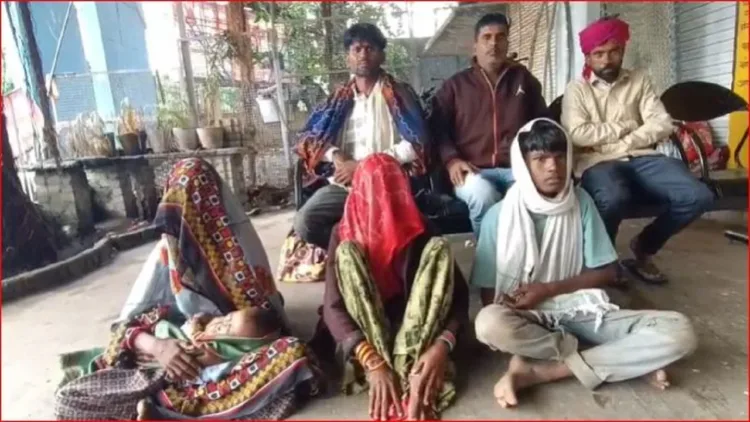
Case Summary
A 35-year-old man named Kalu Solanki Bhil was murdered by his four younger brothers for not converting to Christianity on the night of October 27, 2025, in Shambhoopura village under the Kalinjara police station limits in Banswara district, Rajasthan. The brutal assault, carried out using sticks and an axe, followed a heated argument that turned violent. According to police, Kalu was found severely injured when officers reached the scene and was rushed to the hospital, where he died during treatment. The family comprises six brothers — Kalu, Kamlesh, Vinod, Rakesh, Ravindra, and Ditesh. Kalu and Kamlesh were on one side of a long-standing family dispute, while the four younger brothers formed the opposing side. Investigations revealed that the tension began during Diwali celebrations and escalated in the following days. On the night of October 27, 2025, the altercation intensified, leading to Kalu’s death. Kalu’s brother Kamlesh later filed a complaint accusing the four younger brothers of committing the murder. However, a new angle emerged when Kalu’s wives, Jeevi and Mangli, stated that the killing was linked to religious coercion. They stated that the accused brothers had been forcing Kalu to visit a church and meet a pastor, threatening to kill him if he refused. According to them, the brothers came armed on that night, insisting that he must accompany them to church. The police dismissed this version, stating that no church exists in the area and attributing the incident to a domestic feud. Officers said all aspects are being investigated, but initial findings point to a family conflict rather than a case of religious pressure. Kalu Solanki was survived by his two wives and four children — three with his first wife Jeevi and one with his second wife Mangli. Police registered a murder case, questioned the accused family members, and deployed forces in the area as a precaution.
Why it is Hate Crime ?
The primary category in this case is: Predatory Proselytisation. The subcategory under this is: Murdered for refusing to convert. When there is pressure, threat or coercion employed upon the Hindu victim to convert to a different religion, in several cases, the victim refuses to succumb to the pressure/threats. Once the victim refuses, the perpetrator proceeds to murder the victim owing to his/her refusal to convert. In such cases, the pressure/threat/intimidation/coercion/violence itself is driven by animosity towards the victim’s Hindu faith. The murder then is another hate crime driven by the victim’s refusal to abandon his professed faith, Hinduism, and convert to the religion of the non-Hindu perpetrator. Since the victim’s faith is at the heart of the pressure to convert and the ensuing murder of the victim, such cases are considered religiously motivated hate crimes. Another primary category in this case is: Attack resulting in death. The subcategory under this is: Attacked for opposing radicals or trying to save victim. In several cases, Hindus are attacked for opposing religiously motivated crimes being committed against a fellow Hindu or simply for voicing an opinion opposing radical elements, who either have in the past or continue to persecute Hindus. In such cases, the initial attack against the victim, against which the Hindu was trying to defend the victim, would also need to be classified as a religiously motivated hate crime. Since the initial crime itself was religiously motivated and the subsequent crime of attempting to save the victim or speaking against the radical elements ends up inviting a violent attack, it would also be classified as a religiously motivated hate crime. Under this category, cases where the attack led to the death of the Hindu victim/s would be documented. The other subcategory selected is- Attack for refusal to convert. When pressure, threats, or coercion are employed upon a Hindu victim to convert to another religion, in several cases the victim refuses to succumb. Once the victim resists, the perpetrator proceeds to attack the victim due to this refusal to convert. In such instances, the pressure, intimidation, and violence are clearly driven by hostility toward the victim’s Hindu faith. The attack then becomes an expression of that same hate, motivated by the victim’s refusal to abandon Hinduism and embrace the religion of the non-Hindu perpetrator. Since the victim’s faith is central to both the coercion and the subsequent attack, such cases are categorised as religiously motivated hate crimes. The murder of Kalu Solanki Bhil in Banswara district represents a significant case for documentation within the Hinduphobia tracker due to its manifestation of two distinct but interrelated patterns of religion-based violence. The testimony provided by the victim's widows establishes the crucial religious dimension that elevates this case beyond a commonplace familial dispute into the realm of religious hate crime. According to the sworn statements of Jeevi and Mangli, the four younger brothers had engaged in systematic religious coercion against Kalu Solanki prior to the lethal assault. Their account describes repeated pressure to visit a church and meet with a pastor, accompanied by explicit death threats for non-compliance. The fatal confrontation itself reportedly originated from the perpetrators' demand that Kalu accompany them to religious services, culminating in physical violence when he maintained his refusal. This narrative aligns precisely with the established pattern of murder following refusal to convert, where the victim's adherence to the Hindu faith directly precipitates the fatal attack. The police dismissal of the religious angle, based on the absence of a church in the immediate vicinity, overlooks the fundamental nature of religious coercion networks. The existence of pastoral figures and conversion activities frequently operates through informal channels rather than established institutions, particularly in rural regions. The widows' specific reference to church attendance and pastoral meetings indicates their awareness of organised conversion efforts in their locality, regardless of whether these activities occurred within a recognised ecclesiastical building. Furthermore, this case potentially embodies the secondary categorisation of attack resulting from opposition to religious radicals. If the initial dispute during Diwali celebrations involved Kalu's resistance to his brothers' religious activities or affiliations, his murder would constitute retaliation for opposing proselytisation efforts within his own family. This dimension illustrates how religious extremism fragments Hindu families from within, creating violent divisions along religious lines. The historical context of the Banswara district, with its significant tribal Hindu population, adds considerable weight to the religious persecution aspect. Tribal communities frequently face targeted conversion efforts that exploit economic vulnerabilities and intra-familial tensions. The brothers' attempt to enforce religious compliance through violence reflects a documented strategy of religious expansion through coercion rather than consent. This case exemplifies how religious hatred operates within intimate social units, using family structures as conduits for conversion pressure and punishing resistance with extreme violence. The Hinduphobia tracker, therefore, documents this incident as evidence of how religious persecution permeates domestic spheres, demonstrating that murder for refusing conversion represents the ultimate manifestation of anti-Hindu animus.
Victim Details
Total Victim
1
Deceased
1
Gender
- Male 1
- Female 0
- Third Gender 0
- Unknown 0
Caste
- SC/ST 1
- OBC 0
- General 0
- Unknown 0
Age Group
- Minor 0
- Adult 1
- Senior Citizen 0
- Unknown 0


Case Status
Complaint filed


Perpetrators Details
Perpetrators
Christian Extremists
Perpetrators Range
From 2 To 5
Perpetrators Gender
male
 Sources




