Blatant Hinduphobia in academia: Leftist researcher at government-funded university publishes 'research paper' maligning Hindu goddesses and saints
 Kanpur, Uttar Pradesh, India
  10 October, 2018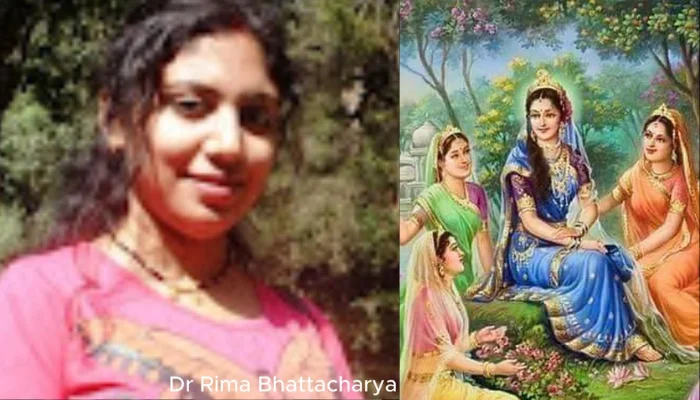
Case Summary
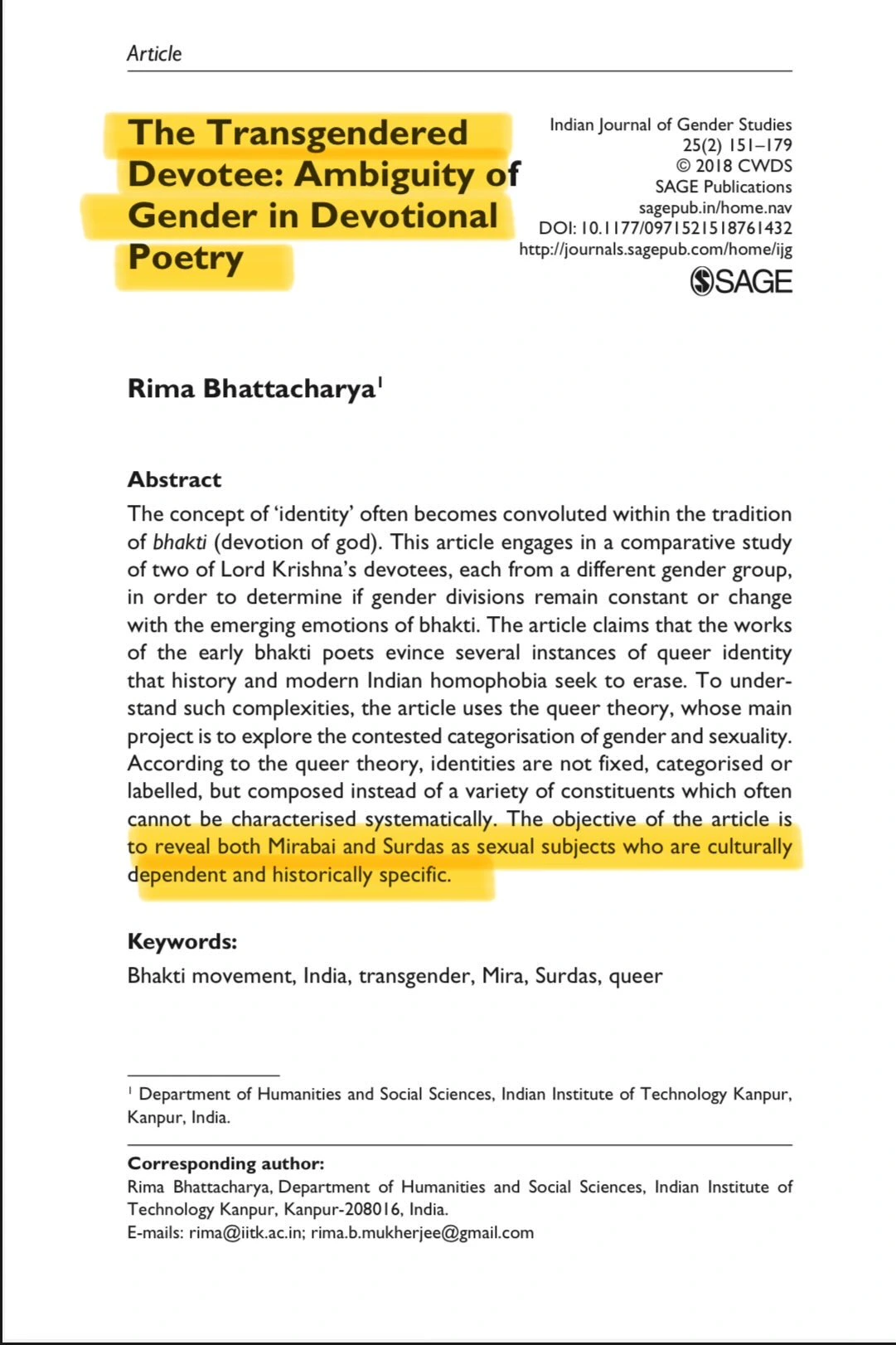
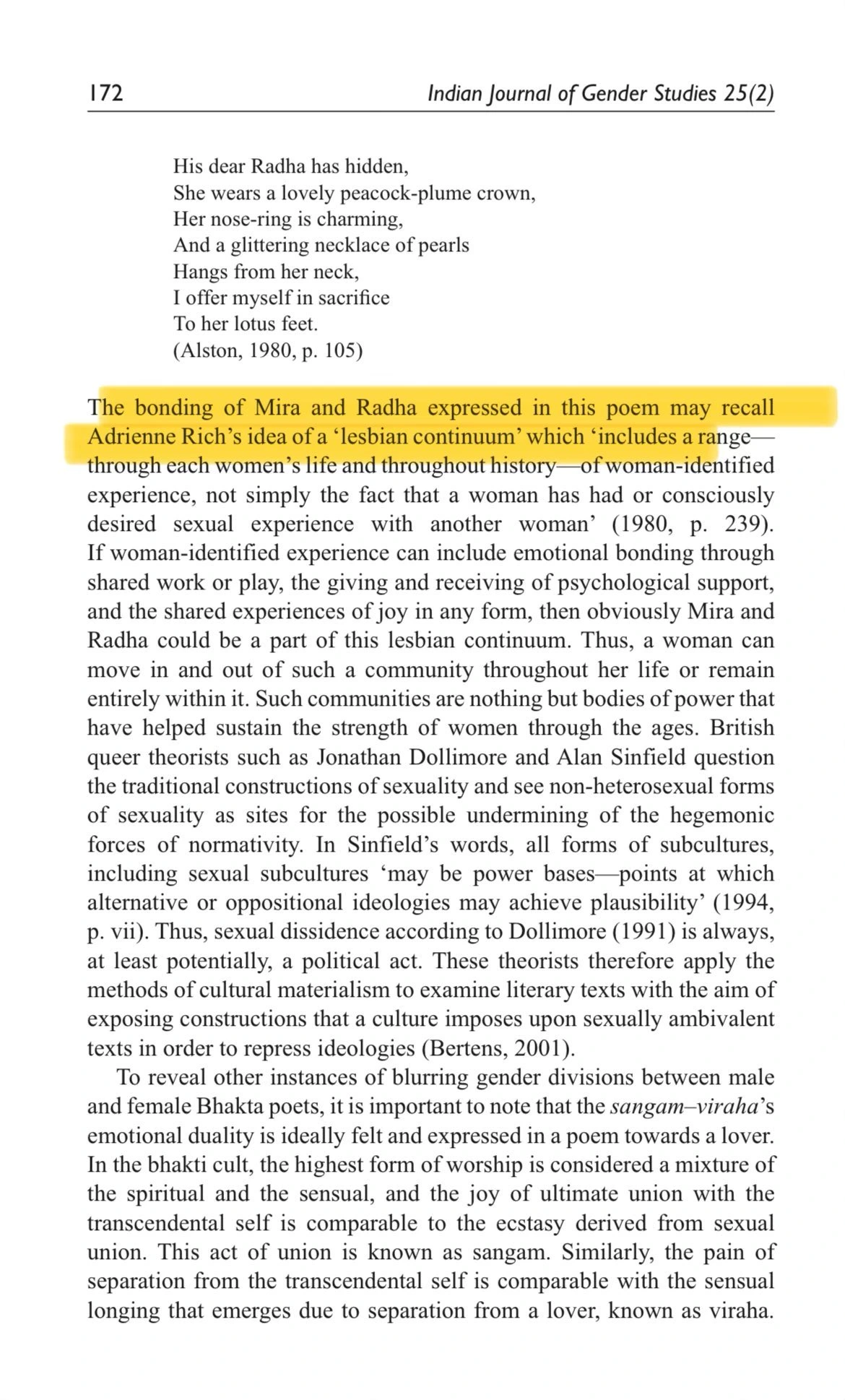
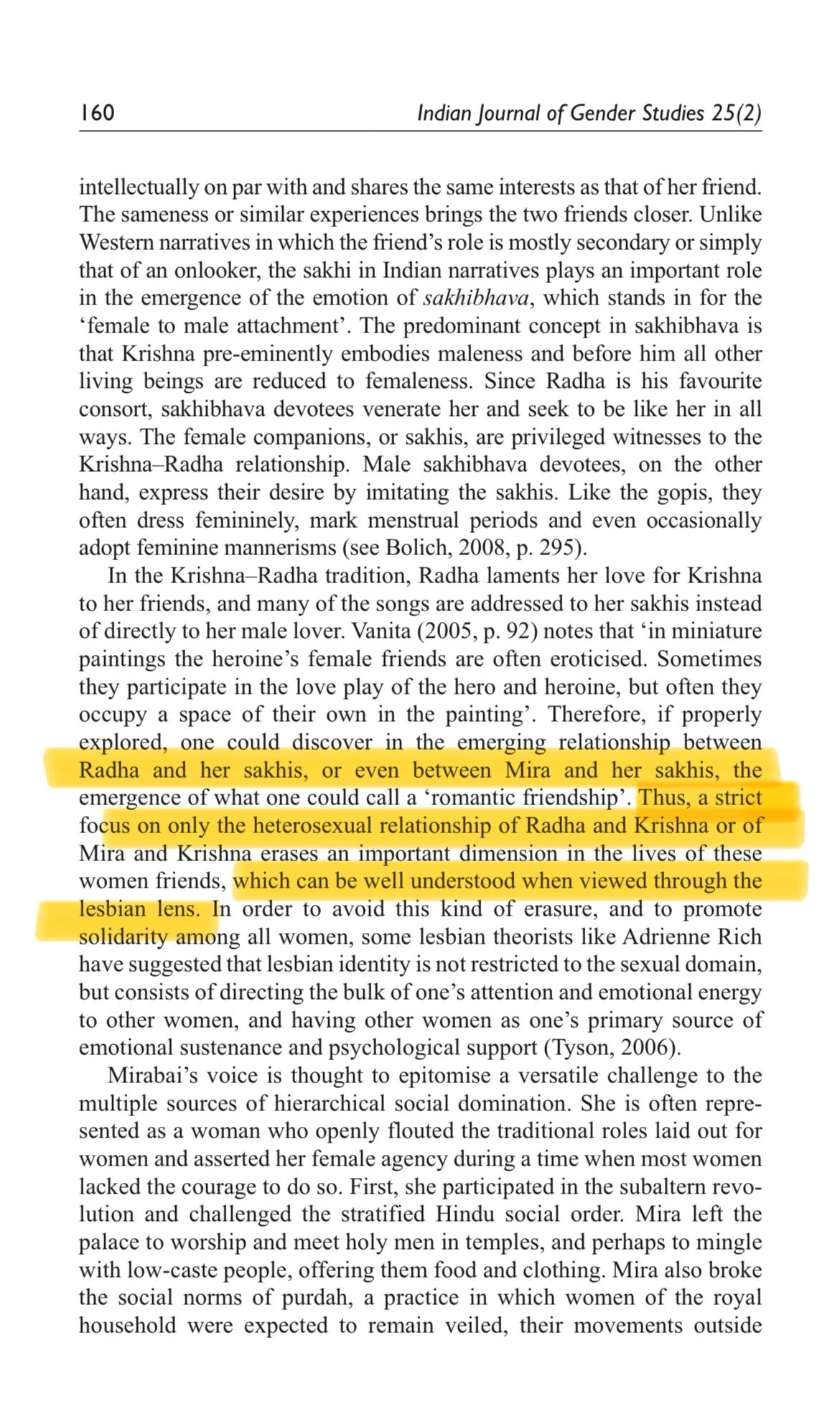
At the Indian Institute of Technology (IIT) Kanpur, a derogatory research paper containing obscene assertions about revered Hindu figures such as Goddess Radha, her companions (sakhis), saint Mirabai, and saint Surdas was authored by a leftist researcher named Dr Rima Bhattacharya. According to media reports, the accused faced widespread criticism on social media after excerpts from her research paper circulated online. The paper, titled “The Transgendered Devotee: Ambiguity of Gender in Devotional Poetry,” was published in 2018 in the Indian Journal of Gender Studies (SAGE Publications). It discussed themes of gender and sexuality within Bhakti literature and interpreted the emotional relationship between Goddess Radha and saint Mirabai through a concept described as a “lesbian continuum.” This research was conducted when Dr Bhattacharya was affiliated with IIT Kanpur, as mentioned in the paper. Online critics stated that she later taught at IIT Kharagpur and subsequently moved to Christ University, although this information remains uncertain. The accused's article examined two prominent devotees of Lord Krishna—Mirabai and Surdas—and stated that early Bhakti poetry contained “instances of queer identity” that had been erased or ignored in later interpretations. The author applied queer theory to analyse gender fluidity and non-heteronormative expressions within Bhakti traditions, suggesting that devotional emotions often transcended fixed gender categories. According to the paper, both Mirabai and Surdas could be understood as “sexual subjects who are culturally dependent and historically specific.” The author wrote that the study employed queer theory “to explore the contested categorisation of gender and sexuality,” asserting that identities were not fixed but composed of varied constituents. A section of the paper that provoked widespread outrage cited literary interpretations of devotional poetry and stated, “The bonding of Mira and Radha expressed in this poem may recall Adrienne Rich’s idea of a ‘lesbian continuum’, which includes a range of woman-identified experiences… not simply the fact that a woman has had or consciously desired sexual experience with another woman.” The paper further remarked that “Mira and Radha could be a part of this lesbian continuum,” portraying their emotional and spiritual connection as an instance of woman-identified power and solidarity. It also referenced queer theorists such as Jonathan Dollimore and Alan Sinfield, describing non-heterosexual subcultures as “points at which alternative or oppositional ideologies may achieve plausibility.” The article also claimed that “sexual dissidence” could operate as a political act capable of challenging prevailing cultural norms. In its analysis of emotional dualities like sangam (union) and viraha (separation) within Bhakti poetry, the paper asserted that these states were “ideally felt and expressed in a poem towards a lover.” It equated the ecstasy of spiritual union with the joy of sexual union, suggesting that “the highest form of worship in the Bhakti cult is considered a mixture of the spiritual and the sensual.” The research paper provoked strong condemnation from Hindu readers and social media users, who questioned the appropriateness of such material being produced under publicly funded institutions. Critics described the paper as “academic perversion” and stated that it reflected the imposition of a Western interpretative framework upon sacred Hindu figures. At the time of writing this report, neither IIT Kharagpur nor Dr Bhattacharya had issued any public statement on the matter. The Ministry of Education had also remained silent regarding this incident.
Case Images
Why it is Hate Crime ?
This case has been added to the tracker under the primary category- Hate Speech against Hindus. The subcategory selected is- Anti-Hindu slurs, mocking faith. Anti-Hindu slurs and the deliberate mocking of the Hindu faith owing to religious animosity involve the usage of derogatory terms, stereotypes, or offensive references to religious practices, symbols, or figures. One of the common anti-Hindu slurs used against Hindus is “cow-worshipper” and “cow piss drinker”. The intention of using this term is to demean and mock Hindus as a group and their religious beliefs since Hindus consider the cow holy. Additionally, some symbols and the slurs attached to them have a historical context that exacerbates the insult, hate, stereotyping, dehumanisation and oppression against Hindus. Cow worship has been used for centuries to denigrate Hindus, insult their faith and oppress Hindus specifically as a religious group. There has been overwhelming documentation about how cow slaughter has been used to persecute Hindus with cow meat being thrown in temples and places of worship. There has also been overwhelming documentation where cow meat (beef) has been force-fed to Hindus to either forcefully convert them to Islam or denigrate their faith. Apart from cow worship, the Swastika – which holds deep religious significance for the Hindus – has also been misinterpreted and distorted to use as a slur against Hindus. Similarly, the worship of the Shivling has been used by supremacist ideologies and religions to denigrate Hindus owing to religious animosity. Such slurs and denigration stem out of inherent animosity and hate towards Hindus and their faith, therefore, it is categorised as hate speech targeted at Hindus specifically owing to their religious identity. In this case, it is important to note that all the divine figures mentioned by the accused and presented in a derogatory manner hold deep reverence in the Hindu community and faith. In Hinduism, Goddess Radha is regarded as the eternal consort of Lord Krishna and the divine embodiment of unconditional love, devotion, and spiritual bliss. Her companions, known as sakhis, are viewed as embodiments of pure devotion who assist in the divine union of Radha and Krishna. Saint Mirabai is remembered as one of the most venerated women saints of the Bhakti movement, whose poetry and songs expressed her unwavering devotion to Lord Krishna. Saint Surdas, a blind poet-saint, is revered for his profound devotional compositions that glorify Krishna’s divine play and teach humility, surrender, and spiritual love. The accused’s act of making obscene assertions about these divine figures caused deep hurt to Hindu sentiments because saints and goddesses like Radha, her sakhis, Mirabai, and Surdas are worshipped as sacred and divine within Hinduism. They are not merely literary or historical personalities but revered spiritual icons who shaped India’s devotional and moral landscape. The accused’s deliberate attempt to portray them in an abusive and sexualised manner demonstrated deep-seated religious animosity towards Hinduism. In her paper, she wrote that “Mirabai and Surdas are sexual subjects who are culturally dependent and historically specific” and that her study aimed to explore “the contested categorisation of gender and sexuality.” Using such language for revered saints and placing them within a sexual framework constitutes an act of intellectual perversion under the guise of scholarship. This not only distorts the spiritual essence of Bhakti (Devotion) but also inflicts grave emotional and religious hurt upon the Hindu community. The Bhakti tradition represents the spiritual heart of Hindu civilisation, built upon devotion, divine love, and surrender to God. To denigrate such saints by sexualising them is a direct assault on the sanctity of this sacred movement and its spiritual values. Furthermore, the author’s description of the emotional bond between Goddess Radha and Saint Mirabai as part of a “lesbian continuum” reflects an intentional act of mockery and desecration of Hindu beliefs. It reduces divine love and spiritual longing to a carnal framework that neither tradition nor context supports. This portrayal distorts the devotional bond between a goddess and her devotee into something sexual, thereby violating the deepest beliefs of millions of Hindus. The use of terms such as “sexual dissidence” and the reworking of Bhakti through a Marxist or queer theoretical lens demonstrates deep-rooted hostility towards Hinduism itself. It is important to note that Hinduism, unlike many Abrahamic faiths, has never viewed homosexuality or gender diversity as sinful or punishable by death. Yet the accused’s appropriation of Western academic frameworks, particularly neo-Marxist frameworks, to sexualise Hindu deities and saints represents not an effort at inclusion or analysis but a deliberate attempt to demean and dismantle sacred Hindu symbols under the pretext of “queer theory.” In another section, the accused asserted that the emotional dualities of Bhakti poetry—sangam (union) and viraha (separation)—should be viewed not merely as spiritual states but as expressions of sexual union. This misrepresentation of one of the most significant spiritual concepts in Hindu Bhakti tradition is profoundly offensive. The Bhakti tradition treats sangam and viraha as metaphors for the soul’s relationship with the Divine—its longing, union, and separation from God. By twisting these sacred ideas into depictions of physical or sexual passion, the accused mocked the very foundation of Hindu spirituality. Her portrayal of Bhakti as a “cult of sensuality” exposed the malicious and prejudiced intent embedded in such interpretations. Taken together, this body of work constituted not academic research but religiously motivated hate speech targeting Hindu traditions and deities. It weaponised scholarship to ridicule sacred figures and undermine Hindu faith under a pseudo-intellectual framework. By sexualising divine relationships and portraying revered saints as “sexual subjects,” the accused exhibited a clear pattern of contempt for Hindu beliefs. Such actions go beyond academic discussion—they reveal an ideological hostility that seeks to desacralise, deconstruct, and demean one of the world’s most ancient and tolerant faiths, Hinduism. Therefore, this case is being added to the hate crime database of the Hinduphobia Tracker. Disclaimer: The Hinduphobia Tracker records the date of an incident based on when the act occurred rather than when it is reported by the media. In this case, media reports did not specify the exact date when the research paper was published, only noting that it appeared in 2018. However, the issue caused widespread outrage and discussion on social media when excerpts from the paper first surfaced on Twitter on 11th October 2025. Based on both these pieces of information, for the purpose of documentation, 11th October 2018 has been used as an indicative date of the incident.


Case Status
Unknown


Perpetrators Details
Perpetrators
Others
Perpetrators Range
One Person
Perpetrators Gender
female
 Sources




