Hindu temple selectively targeted and vandalised, temple idols desecrated by state authorities under guise of 'development'
 Bhopal, Madhya Pradesh, India
  19 October, 2025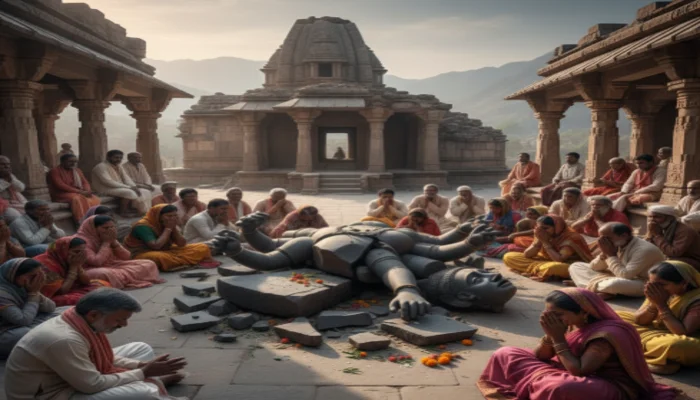
Case Summary
In Bhopal, Madhya Pradesh, a 120-year-old Hindu temple was vandalised, and the idols of Lord Shiva and Goddess Parvati were desecrated by railway authorities during the construction of a laundry facility awarded to the Samdariya Group, a contractor firm. According to reports, the Shiva temple was demolished by railway officials and the contractor company without any written order, creating a tense atmosphere in the area. The railway had granted the contract for constructing the laundry facility to the Samdariya Group. On 20th October 2025, officials from the railway, Government Railway Police (GRP), the local police, and the contractor company arrived at the temple site and demolished the temple structure. The idols of Lord Shiva and Goddess Parvati were desecrated, and sacred trees such as the peepal were uprooted. When local residents protested, they were informed that the demolition was being carried out under orders from railway authorities. However, the company’s site manager later admitted that there was no written directive for the demolition, and the work had been undertaken purely on verbal instructions. The temple’s head priest, Rambhushan Das, stated that nearby Mazhaars (Islamic shrines) were left untouched by the authorities. He explained that the temple had valid land records and old maps proving its legitimacy, yet the railway acted arbitrarily. He said, “This temple was about a hundred years old and held deep religious significance for the local people. The administration demolished the temple while leaving the Mazhaars intact; this is blatant religious discrimination.” Upon learning of the incident, more than a dozen members of Hindu organisations arrived at the site and jointly demanded that reconstruction of the temple begin immediately. They emphasised that the rebuilding must proceed without delay. Meanwhile, the contractor company and railway officials issued an apology, admitting their mistake. However, Hindu organisations remained firm on their demand to register a First Information Report (FIR) against both the railway department and the contractor company. Subsequently, the Vishva Hindu Parishad lodged a formal complaint at the Government Railway Police station.
Why it is Hate Crime ?
This case has been added to the tracker under the primary category- Attack on Hindu religious representations. Within this, the subcategory selected is- Attack on Temples. In Hinduism, a temple is the abode of the Deity. The Deity in the Temple is consecrated, thereby, making it a real, breathing entity. Hindus believe that not just the Deity but the temple premises itself are sacred to Hindus since Hindus hold the faith that the entire Temple space is an amalgamation of the divine energy of the deity. Given the central significance of Temples in Hindu Dharma, any attack against a Hindu Temple or its peripheral premises is an attack on the faith itself and is born out of animosity towards the faith, of which, the Temple is a central tenet. Any manner of attack against a Temple and/or its premises would therefore be considered a religiously motivated hate crime. The other subcategory selected in this case is- Desecration of Hindu religious symbol. Icons and symbols or a religious representation of a spiritual ideal are widely revered in Hinduism. Iconography is of vital significance in the Hindu milieu. It helps connect people’s spiritual beliefs with the real world. Iconography within the Hindu faith takes several shapes and forms. Murtis are of most significance to Hindus, to which daily rituals, prayers and offerings are done. Besides the murtis, there are several other symbols which have deep significance in the Hindu faith – the Om and Swastika for example. Since these Hindu religious symbols hold paramount importance in Hinduism, any desecration of symbols, icons, murtis, religious representations and manifestations, is driven by animosity towards the faith itself which manifests itself through these murtis, icons and symbols. Therefore, any desecration of these Hindu religious symbols and representations is considered religiously motivated hate crimes under this category. In this case, the demolition of the century-old Hindu temple in Bhopal was an unmistakable instance of a religiously motivated hate crime against a Hindu place of worship. State authorities, including the railway officials and the contractor firm, the Samdariya Group, vandalised and desecrated the temple under the guise of development and supposed railway orders. In reality, there was no written directive authorising such an act. Under this false pretext, the entire temple complex was destroyed — sacred idols of Lord Shiva and the goddess were desecrated, and even the revered peepal tree, considered holy and worshipped by Hindus, was uprooted. The act was presented as a routine developmental measure, but its execution revealed a deliberate disregard for the sanctity of the temple and the sentiments of the Hindu devotees. At first glance, the act might appear as part of an administrative development drive, but a closer examination raises serious questions about intent. If this had truly been a lawful or planned exercise, why was there no prior communication or notice given to the temple authorities to relocate or safeguard the premises? Instead, the officials marched in without warning and desecrated the temple, shattering idols and sacred structures that embodied generations of faith. A Hindu temple is not just a structure of stone; it is the spiritual nucleus of the Hindu community — a sacred abode of divine presence. Destroying it in such a callous manner inflicted not only physical destruction but also a profound spiritual wound. The desecration of this temple thus stands as a clear, deliberate attack on Hindu faith and sentiment, qualifying it as a religiously motivated offence. The desecration of temple idols further deepened this assault. In Hinduism, idols are not mere artistic representations but are sacred embodiments of the divine — the living manifestation through which devotees connect with God. The act of demolishing or defiling these idols is regarded as a grave sacrilege, one that inflicts immeasurable emotional and spiritual pain upon the Hindu community. Along with the idols, the destruction of sacred elements such as the peepal tree, revered as a symbol of life and divinity, intensified the sense of religious violation. The uprooting of these symbols amounted not only to an attack on faith but to the destruction of Hindu heritage and identity. Some may argue that this was a state procedure unrelated to religious animosity. However, this argument collapses when viewed against the selective nature of the demolition. The nearby Mazhaars (Islamic shrines) were completely untouched. If the exercise was genuinely for development purposes, why was only a Hindu place of worship targeted and desecrated? This selective demolition exposes a glaring institutional bias and apathy towards Hindu religious sites. It demonstrates how Hindu faith symbols continue to face systematic disregard under administrative actions masked as 'development initiatives'. This was not an act of infrastructure expansion or neutral governance; it was an instance of institutional discrimination against a Hindu place of worship. The demolition of the Bhopal temple, its sacred idols, and its revered natural symbols constitutes both a physical and spiritual attack on the Hindu religion. Viewed in its entirety, the act stands as a religiously motivated hate crime — a direct affront to Hindu faith, identity, and cultural sanctity. Therefore, this case is being added to the hate crime database of the Hinduphobia Tracker.


Case Status
Complaint filed


Perpetrators Details
Perpetrators
State and Establishment
Perpetrators Range
Unknown
Perpetrators Gender
unknown
 Sources




