Hindu man and family brutally attacked by Muslim mob of 50 on Diwali night while lighting firecrackers outside home
 Haridwar, Uttarakhand, India
  19 October, 2025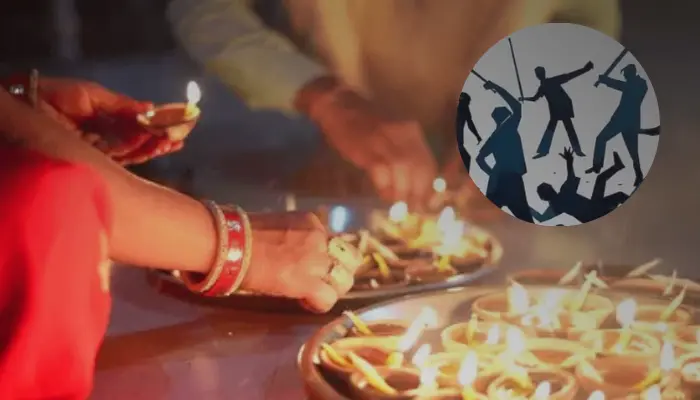
Case Summary
A Hindu man was brutally attacked in Ranipur, Haridwar, Uttarakhand, on the night of Diwali while lighting firecrackers outside his home. The victim, identified as Sagar, was celebrating with his family near their house in Bijulpur village when a violent mob of around 45 to 50 men armed with sticks, rods, and sharp weapons stormed the area and assaulted him. The attack, which occurred around 8 PM on 20 October 2025, left Sagar and his family members injured. According to the complaint filed by his brother, Rajan Kumar, the assailants began abusing Sagar for lighting fireworks and then launched a coordinated assault. When Sagar’s relatives rushed to his aid, they too were attacked. Rajan said his family pleaded for mercy, but the mob continued to beat them mercilessly in the darkness. Several members of the family sustained serious injuries before the attackers fled, threatening to kill them if they reported the incident. Some media reports claim that Sagar was attacked because of an old dispute. Police have registered a case and identified ten of the perpetrators, including Muneer, Salman, Faizan, Mujib, Nadeem, and Saheel, all residents of the same locality. Authorities launched a search operation to arrest the accused, while the injured victims were receiving medical treatment.
Why it is Hate Crime ?
The primary category in this case is: Attack not resulting in death. The subcategory under this is: Attacked for Hindu identity. In several cases, Hindus are attacked merely for their Hindu identity without any perceived provocation. A classic example of this category of religiously motivated hate crime is a murder in 2016. 7 ISIS terrorists were convicted for shooting a school principal in Kanpur because they got ‘triggered’ seeing the Kalava on his wrist and tilak that he had put. In this, the Hindu victim had offered no provocation except for his Hindu religious identity. The motivation for the murder was purely religious, driven by religious supremacy. Such cases where Hindus are targeted merely for their religious identity would be documented as a hate crime under this category. Another subcategory under this is: Communal clash/attack. Communal clash is a form of collective violence that involves clashes between groups belonging to different religious identities. For a communal clash between Hindus and non-Hindus to qualify as a religiously motivated hate crime, the trigger of the violence itself would have to be anti-Hindu in essence. For example, if there is a Hindu religious procession that comes under attack from a non-Hindu mob and after the initial attack, Hindus retaliate in self-defence, leading to a communal clash between the two religious communities. While at a later stage, both communities are involved in the clash/violence, the initial trigger of the violence was by the non-Hindu mob against the Hindus and therefore, it could safely be termed as an anti-Hindu violence. Further, the trigger would also have to be religiously motivated. In the cited example, the attack by the non-Hindu mob was against religious processions and therefore, can be concluded to be religiously motivated. In some cases, the trigger may be non-religious, however, it develops into religious violence against Hindus at a later stage. In such cases too, the foundational animosity towards Hindus becomes the motivating factor of the crime and therefore, it would be classified as a religiously motivated hate crime against Hindus under this category. Another primary category in this case is: Attack on Hindu religious representations. The subcategory under this is: Defiling religious customs. Sanatan Dharma is not a religion of one book, which is to say that while it has religious scriptures that form the central tenets of the faith, there are several traditions followed through thousands of years, mostly passed from generation to generation orally. There are several such customs and traditions that are followed by various Hindus and Hindu sects. Defiling of these traditions and customs is a breach of an individual or group’s religious practices. Such practices can range from dietary restrictions like not eating non-vegetarian food for a certain period of the year, not eating non-vegetarian food at all, not eating beef since the cow is considered holy in Hinduism, the sanctity of religious customs followed in the house (like many ISCKON devotees), etc. Any malicious action leading to the breach of such traditions or defilement of these traditions owing to animosity towards the faith or for the sake of activism stems not only from the lack of faith in the religion itself but also from disregard for the faith of the devotees who follow the customs/traditions and implicit bias against the faith, the tradition itself. Since these specific traditions are central to the faith of the devotees of that specific sect of Hindus, any non-compliance with these traditional rules would be considered a religiously motivated hate crime. This case has been included in the Hinduphobia Tracker because it reflects a pattern of targeted violence against Hindus that carries a distinctly communal undertone. Though local reports suggest that the attack on Sagar in Bijulpur village, Ranipur, stemmed from an existing enmity, the deliberate choice of timing and the nature of the assault make it impossible to dismiss the religious dimension. The mob of nearly fifty Muslim men attacked Sagar and his family on the night of Diwali, a sacred Hindu festival, precisely when they were lighting firecrackers outside their home. This act of aggression during a Hindu religious celebration signifies more than personal hostility; it demonstrates a conscious attempt to defile the sanctity of a festival central to Hindu identity and communal joy. The attackers’ hostility towards Sagar for performing a customary Hindu practice, lighting diyas and fireworks, reflects intolerance toward public expressions of Hindu faith. The brutality of the attack, the scale of mobilisation, and the targeting of an entire family during a religious occasion reveal a collective intent rooted in animosity against the Hindu identity itself. Even when personal disputes exist, the selection of a Hindu festival night for violent reprisal transforms the event into a communal assault, as it carries both symbolic and psychological weight within the Hindu community. Therefore, this incident falls under two intersecting hate-crime categories: attack not resulting in death, and attack on Hindu religious representations. Lighting diyas and bursting crackers form an essential part of Diwali rituals, symbolising the triumph of light over darkness and good over evil. To violently interrupt this act through mob aggression represents an affront to both the victim’s personhood and his religious identity. By recording this case in the tracker, it becomes part of a broader pattern where Hindus are attacked not merely for personal disputes but at moments and in contexts deeply connected to their faith. It reflects how religiously motivated violence can manifest under the guise of local rivalry, yet the choice of moment and method exposes the underlying communal bias. The assault on Sagar, therefore, is not an isolated instance of interpersonal conflict but a case of anti-Hindu violence executed under the cover of existing hostility, revealing a disturbing tendency of weaponising religious festivals to assert religious dominance and instil fear within Hindu communities. Disclaimer: The number of victims in this case has been recorded as one, representing Sagar, who was brutally attacked and sustained serious injuries. Although several of his family members were also assaulted, the primary victim in focus is Sagar. The number of perpetrators has been set to fifty, as reports and eyewitness statements indicate that around fifty men participated in the assault. While the police have so far named only ten individuals in the FIR, the broader figure of fifty has been adopted to reflect the full scale of the mob involved in the attack.
Victim Details
Total Victim
1
Deceased
0
Gender
- Male 1
- Female 0
- Third Gender 0
- Unknown 0
Caste
- SC/ST 0
- OBC 0
- General 0
- Unknown 1
Age Group
- Minor 0
- Adult 1
- Senior Citizen 0
- Unknown 0


Case Status
Complaint registered


Perpetrators Details
Perpetrators
Muslim Extremists
Perpetrators Range
From 10 to 100
Perpetrators Gender
male
 Sources




