Hindu family violently attacked for celebrating Diwali in UP's Kasganj, Muslim mob assaults, pelts stones and fire gunshots
 Kasganj, Uttar Pradesh, India
  20 October, 2025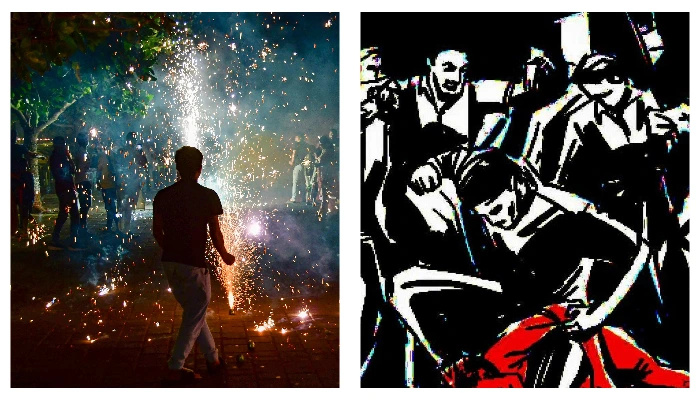
Case Summary
On the night of October 21, 2025, violence erupted in Bilram town, under Dholna police station limits in Kasganj district (Uttar Pradesh), after a Hindu family was attacked by a Muslim mob for bursting firecrackers during Diwali celebrations. The dispute escalated into stone pelting, vandalism, and physical assault, leaving six people injured, including two women. According to the complaint filed by Lalaram Verma, a Hindu resident of Mohalla Chaudhary in Bilram’s main market, his son Ayaan was bursting firecrackers outside their house around 9:15 PM when Ajmeri, a Muslim resident from the opposite Mohalla Peerzada, objected to the firecrackers being lit near his shop. An argument broke out, following which Ajmeri, along with his brother Shanu, Bablu, Aqeel, Nazim, and others, attacked Lalaram, his son Ayaan and wife Sheeba, injuring them and attempting to break open the gate of their house. As tensions rose, a large crowd gathered, and members of the Muslim community began pelting stones from rooftops, targeting the Hindu family and nearby houses. In the violence, Dr Lalaram, his wife Sheeba, and son Ayaan sustained injuries. Multiple videos of the incident went viral on social media, showing a mob attempting to break down the gate of a house using sticks, rods, and bricks, while women were seen pelting stones from rooftops. CCTV footage from the area, which also went viral, shows a shop beside which a person can be seen bursting firecrackers. Shortly after, a man wearing a red kurta approaches the shop, and an argument breaks out. As tensions rise, a crowd begins to gather, and some members of the group are seen assaulting the man in the red kurta and a woman who tries to intervene. Within moments, the altercation escalates into a full-scale attack, with individuals resorting to vandalism, stone pelting, and chaos near the house where the firecrackers were being burst. Men can be seen trying to break down the gate of the house. According to reports, gunfire was also heard during the incident. Upon receiving information about the clash, police from Bilram outpost and Dholna police station arrived and used mild force to disperse the crowd. All six injured individuals were sent for medical examination. Senior officers, including ASP Sushil Kumar and Sadar CO Aanchal Chauhan, reached the site with a heavy police force to assess the situation. Cross-FIRs were filed by both parties at the Dholna police station, and police deployment remains in place to maintain peace. In a counter-allegation, Nazim’s wife, Shabnam, claimed that when she objected to firecrackers being burst in front of her shop, Dr Lalaram, Ayaan, Saurabh, Gaurav, Chunnu, and others allegedly beat her, her husband, Nazim, and Shanu, and vandalised their shop and gate.
Why it is Hate Crime ?
This incident has been added to the tracker under the primary category- Attack not resulting in death. Within this, the first subcategory selected is- Attacked for Hindu identity. In several cases, Hindus are attacked merely for their Hindu identity without any perceived provocation. A classic example of this category of religiously motivated hate crime is a murder in 2016. 7 ISIS terrorists were convicted for shooting a school principal in Kanpur because they got ‘triggered’ seeing the Kalava on his wrist and tilak that he had put. In this, the Hindu victim had offered no provocation except for his Hindu religious identity. The motivation for the murder was purely religious, driven by religious supremacy. Such cases where Hindus are targeted merely for their religious identity would be documented as a hate crime under this category. The second subcategory selected is- Communal clash/attack. Communal clash is a form of collective violence that involves clashes between groups belonging to different religious identities. For a communal clash between Hindus and non-Hindus to qualify as a religiously motivated hate crime, the trigger of the violence itself would have to be anti-Hindu in essence. For example, if there is a Hindu religious procession that comes under attack from a non-Hindu mob and after the initial attack, Hindus retaliate in self-defence, leading to a communal clash between the two religious communities. While at a later stage, both communities are involved in the clash/violence, the initial trigger of the violence was by the non-Hindu mob against the Hindus and therefore, it could safely be termed as an anti-Hindu violence. Further, the trigger would also have to be religiously motivated. In the cited example, the attack by the non-Hindu mob was against religious processions and therefore, can be concluded to be religiously motivated. In some cases, the trigger may be non-religious, however, it develops into religious violence against Hindus at a later stage. In such cases too, the foundational animosity towards Hindus becomes the motivating factor of the crime and therefore, it would be classified as a religiously motivated hate crime against Hindus under this category. This incident has been added to the Hinduphobia Tracker as a clear example of targeted anti-Hindu aggression rooted in religious hostility and intolerance toward Hindu celebrations. The violence erupted when a Hindu family was attacked while performing a customary and deeply symbolic act of Diwali — bursting firecrackers outside their home. The act, which represents joy, devotion, and the triumph of light over darkness, became the trigger for a communal assault that left multiple Hindus injured. The Hindu family did not initiate the violence; they were merely observing a religious tradition in a public space. The escalation occurred only after members of the Muslim community objected to the celebration, using it as a pretext for confrontation. The disproportionate nature of the response, with a large mob armed with sticks, rods, and bricks, demonstrates that the attack was not spontaneous but deliberate and organised, aimed at asserting dominance and punishing the family for asserting their Hindu identity publicly. Video evidence of the incident reinforces this pattern. Footage shows members of the Muslim community attempting to break open the Hindu family’s gate, pelting stones from rooftops, and attacking anyone who tried to intervene. Such imagery mirrors a familiar pattern seen across several other states, where Hindu religious expressions, especially during festivals, are increasingly met with aggression and organised intimidation. The assault also reflects a form of radical assertion, where those opposing Hindu customs seek to impose their will through violence. In this case, the Hindu family’s act of celebrating Diwali, a festival central to their faith, was treated as an offence that needed to be suppressed through force. By attacking them and vandalising their property, the perpetrators effectively sought to dictate which religious expressions are “permissible,” undermining the freedom of Hindus to celebrate their festivals in peace. This pattern aligns with a wider ecosystem of intolerance, where Hindu festivities are policed and disrupted under the guise of objections to sound, smoke, or space, while the underlying motive remains communal hostility. The Bilram attack was not a simple neighbourhood dispute; it was an act of collective intimidation designed to silence Hindu visibility and reinforce the message that their faith can be practised only on terms dictated by others. While cross-FIRs were filed, the nature, timing, and scale of the attack, a Diwali-night assault by an organised mob targeting a Hindu household, leave little doubt that this was an unprovoked and disproportionate act of religious hostility. It illustrates how Hindus, even while peacefully observing their traditions, face violence and coercion in the face of rising radical assertiveness in mixed localities.
Victim Details
Total Victim
6
Deceased
0
Gender
- Male 4
- Female 2
- Third Gender 0
- Unknown 0
Caste
- SC/ST 0
- OBC 0
- General 0
- Unknown 6
Age Group
- Minor 0
- Adult 5
- Senior Citizen 0
- Unknown 1


Case Status
Case sub-judice


Perpetrators Details
Perpetrators
Muslim Extremists
Perpetrators Range
From 10 to 100
Perpetrators Gender
both
 Sources




