Hindus attacked while celebrating Diwali in Amroha, 10 Injured in twin village clashes over firecrackers
 Amroha, Uttar Pradesh, India
  19 October, 2025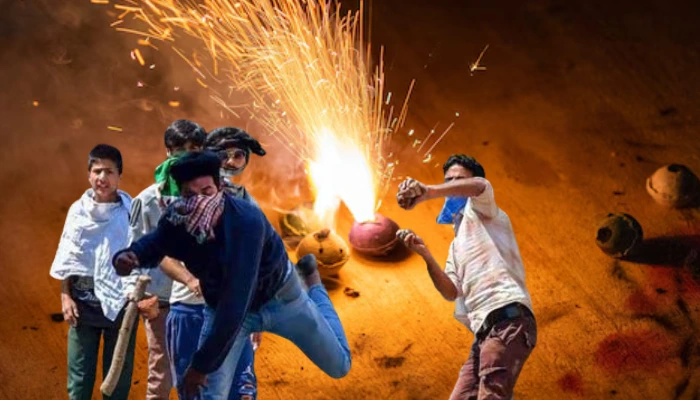
Case Summary
On Diwali night (October 20, Monday), violence broke out in two villages of the Hasanpur police station area, Amroha district, after Hindus were attacked during firecracker celebrations. Separate incidents of stone pelting and assault left at least 10 people injured, two of whom were later referred to a higher medical facility due to critical injuries. In the first incident, in Shyampuri village, Munnalal Vakil’s wife and daughter were lighting diyas at the village well to mark Diwali when a few local youths standing on the road set off firecrackers in their direction. The act led to an argument that quickly turned violent. Members of the other group began throwing stones and attacking, injuring four Hindus, including an uncle and his niece, who were later hospitalised. In a second incident, the same night in Shahpur Khurd village, another dispute over bursting firecrackers during Diwali escalated into a violent confrontation between two groups. Attackers used sticks, iron rods, and other weapons, injuring more than six Hindus celebrating the festival. Police from Hasanpur station, led by Inspector Prempal Singh, confirmed that two separate attacks occurred during Diwali celebrations. All the injured were admitted to the Community Health Centre (CHC), with two referred to a higher centre. At the time of documenting this incident, the Police said that complaints had been filed, and investigations were underway.
Why it is Hate Crime ?
The primary category selected in this case is- Attack not resulting in death. The subcategory selected is- Attacked for Hindu identity. In several cases, Hindus are attacked merely for their Hindu identity without any perceived provocation. A classic example of this category of religiously motivated hate crime is a murder in 2016. 7 ISIS terrorists were convicted for shooting a school principal in Kanpur because they got ‘triggered’ seeing the Kalava on his wrist and tilak that he had put. In this, the Hindu victim had offered no provocation except for his Hindu religious identity. The motivation for the murder was purely religious, driven by religious supremacy. Such cases where Hindus are targeted merely for their religious identity would be documented as a hate crime under this category. The other subcategory selected is- Communal Clash/Attack. Communal clash is a form of collective violence that involves clashes between groups belonging to different religious identities. For a communal clash between Hindus and non-Hindus to qualify as a religiously motivated hate crime, the trigger of the violence itself would have to be anti-Hindu in essence. For example, if there is a Hindu religious procession that comes under attack from a non-Hindu mob and after the initial attack, Hindus retaliate in self-defence, leading to a communal clash between the two religious communities. While at a later stage, both communities are involved in the clash/violence, the initial trigger of the violence was by the non-Hindu mob against the Hindus and therefore, it could safely be termed as an anti-Hindu violence. Further, the trigger would also have to be religiously motivated. In the cited example, the attack by the non-Hindu mob was against religious processions and therefore, can be concluded to be religiously motivated. In some cases, the trigger may be non-religious, however, it develops into religious violence against Hindus at a later stage. In such cases too, the foundational animosity towards Hindus becomes the motivating factor of the crime and therefore, it would be classified as a religiously motivated hate crime against Hindus under this category. This case has been added to the Hinduphobia Tracker as a clear instance of targeted aggression against Hindus for performing traditional Diwali rituals. The attacks, which occurred on Diwali night (October 20, 2025), expose the deepening intolerance toward open expressions of Hindu faith. In the first incident, Hindu women lighting diyas at a village well as part of the Diwali ritual were subjected to harassment when local youths allegedly set off firecrackers directly at them. What should have been a moment of devotion and festivity turned into violence after the act provoked an argument and led to stone pelting and physical assault, injuring four Hindus, including a woman and her niece. In a separate incident the same night, a similar dispute over bursting firecrackers during Diwali escalated into a violent assault involving sticks, rods, and iron bars, leaving six more Hindus injured. Across both attacks, those participating in or defending their religious celebration were targeted, revealing a pattern of resentment toward visible Hindu worship and festivity. The timing and nature of these assaults underscore that these were not random neighbourhood disputes but acts of hostility rooted in opposition to Hindu customs and public celebration. Lighting lamps and bursting firecrackers are not trivial pastimes, but acts of religious symbolism, representing the triumph of light over darkness and good over evil. By attacking Hindus engaged in these rituals, the perpetrators sought to disrupt and defile a sacred Hindu festival, turning an occasion of peace and unity into one of fear and violence. This pattern reflects a broader social hostility toward overt expressions of Hindu identity, where even harmless religious practices are met with aggression and scorn. For the victims, the attacks were both physical and psychological, sending a message that Hindu devotion, when expressed publicly, can invite violence. Such incidents expose the growing challenge Hindus face in freely practising their faith, especially during festivals that celebrate light, spirituality, and divine renewal. The Amroha Diwali attacks stand as a reminder that intolerance toward Hindu expression is not confined to rhetoric; it manifests in direct violence aimed at silencing and intimidating the community. Disclaimer: Since both attacks took place within the same jurisdiction, on the same night, and arose from similar disputes over Hindu Diwali celebrations, they have been documented together as part of a single communal episode. According to available reports, four Hindus were injured in Shyampuri and over six in Shahpur Khurd, bringing the combined victim count to 10 Hindus. One victim has been identified as a Hindu woman, while the genders of the remaining nine victims have not been specified in the reports. Therefore, the total count has been conservatively recorded as 10, with one female and nine of unspecified gender.
Victim Details
Total Victim
10
Deceased
0
Gender
- Male 0
- Female 2
- Third Gender 0
- Unknown 8
Caste
- SC/ST 0
- OBC 0
- General 0
- Unknown 10
Age Group
- Minor 0
- Adult 1
- Senior Citizen 0
- Unknown 9


Case Status
Complaint filed


Perpetrators Details
Perpetrators
Unknown
Perpetrators Range
Unknown
Perpetrators Gender
unknown
 Sources




