Hindu family brutally attacked by armed Muslim mob over bursting crackers during Diwali celebrations in Baghpat, Uttar Pradesh
 Baghpat, Uttar Pradesh, India
  21 October, 2025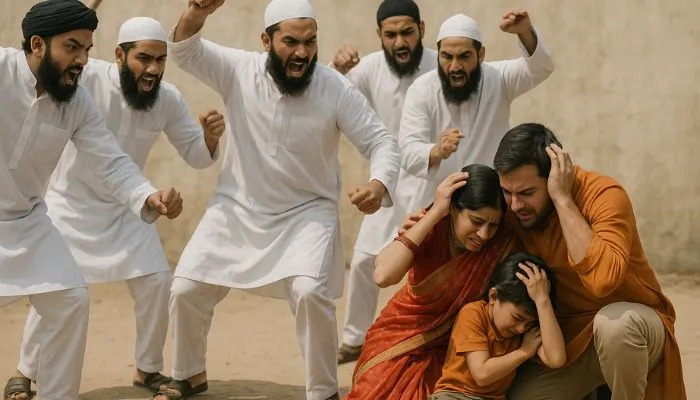
Case Summary
In Badarkha hamlet, located in the Baghpat district, Uttar Pradesh, a Hindu family was brutally attacked by an armed Muslim mob over the bursting of firecrackers during Diwali celebrations, a revered Hindu festival. According to media reports, the Hindu victim, Pravendra Singh, stated that the incident took place on the night of 22nd October 2025. His daughters, Bulbul and Ayushi, were setting off firecrackers outside their home when one firecracker accidentally landed in the house of their neighbour, Mehruddin, a Muslim man. This led to an argument and exchange of insults between the two families. Some elders and respected members of the village intervened and calmed the situation, but the dispute escalated later that night. At 10:30 pm, Mehruddin called his sons, Yameen and Shadin, who live in Baraut. Shortly afterwards, about two dozen people from Mehruddin’s family, armed with sticks, rods, and sharp weapons, arrived at Pravendra’s house and attacked. They assaulted the Hindu family with the intention of killing them. In this sudden attack, Pravendra alias Bhuttu, Karan Singh, Arvind, Ravita, Anita, and Jagwati were seriously injured. This led to a communal clash-like situation. Even some of the Muslim attackers got injured. Pravendra’s father, Karan Singh, suffered a broken bone in his right leg, while Pravendra broke his left arm. All the injured were receiving treatment at Astha Hospital in Baraut. The police arrived at the scene and attempted to manage the situation. Deputy Superintendent of Police Vijay Chaudhary and Additional Superintendent of Police Praveen Singh Chauhan visited the location, inspected the area, and gathered information from both sides. They instructed officers to maintain peace and order in the village. Inspector Shivdutt stated that, based on the complaint filed by the victim, Pravendra Kumar, the police had registered a case under serious sections against the Muslim accused, namely, Mehruddin, Saleem, Yameen, Wasim, Shadin, Islam, Sameer, Sam, Sada, Mohammad, Ash, Asif, Champy, Shabnam, Praveen, Shakeela, and other unknown individuals. At the time of writing this report, the accused Mehruddin, Yameen, Shamshad, Shabana and Shakila had been arrested and sent to jail by the police. Following this, the police began searching for the other absconding accused.
Why it is Hate Crime ?
The primary category selected in this case is- Attack not resulting in death. The subcategory selected is- Attacked for Hindu identity. In several cases, Hindus are attacked merely for their Hindu identity without any perceived provocation. A classic example of this category of religiously motivated hate crime is a murder in 2016. 7 ISIS terrorists were convicted for shooting a school principal in Kanpur because they got ‘triggered’ seeing the Kalava on his wrist and tilak that he had put. In this, the Hindu victim had offered no provocation except for his Hindu religious identity. The motivation for the murder was purely religious, driven by religious supremacy. Such cases where Hindus are targeted merely for their religious identity would be documented as a hate crime under this category. The other subcategory selected is- Communal Clash/Attack. Communal clash is a form of collective violence that involves clashes between groups belonging to different religious identities. For a communal clash between Hindus and non-Hindus to qualify as a religiously motivated hate crime, the trigger of the violence itself would have to be anti-Hindu in essence. For example, if there is a Hindu religious procession that comes under attack from a non-Hindu mob and after the initial attack, Hindus retaliate in self-defence, leading to a communal clash between the two religious communities. While at a later stage, both communities are involved in the clash/violence, the initial trigger of the violence was by the non-Hindu mob against the Hindus and therefore, it could safely be termed as an anti-Hindu violence. Further, the trigger would also have to be religiously motivated. In the cited example, the attack by the non-Hindu mob was against religious processions and therefore, can be concluded to be religiously motivated. In some cases, the trigger may be non-religious, however, it develops into religious violence against Hindus at a later stage. In such cases too, the foundational animosity towards Hindus becomes the motivating factor of the crime and therefore, it would be classified as a religiously motivated hate crime against Hindus under this category. This case is being added to the tracker as it represents a clear instance of targeted violence against the Hindu family due to their religious identity. The Hindu family was assaulted solely for observing a traditional Diwali custom of bursting crackers, an age-old practice symbolising joy and devotion. Some may attempt to argue that the attack was the result of a firecracker that accidentally landed in the house of the Muslim accused. However, if that had been the primary cause, the issue could have ended after the initial argument and dispute. Instead, the Muslim perpetrator chose to escalate the matter with a large Muslim group to attack the Hindu family, demonstrating deliberate religious intent. The violence stemmed from a benign and culturally rooted act—bursting crackers during Diwali—but this simple expression of faith and celebration provoked hostility. The attack, therefore, reflected religious profiling and direct targeting of a Hindu family for their faith and customs. Such assaults on Hindus based on their religious identity constitute clear instances of religiously motivated hate crimes. The assault was brutal and deliberate, showcasing a clear example of communal violence. When a Hindu family is attacked solely for their religious identity, it reveals an underlying hostility rooted in contempt for their faith, symbols of worship, and cultural practices such as Diwali and the custom of bursting firecrackers. The fact that the assault occurred during Diwali, one of the most sacred Hindu festivals, underscores that the intent was not only to inflict physical harm but also to provoke, humiliate, and terrorise Hindus during their sacred celebration. The timing of the attack, coinciding with an important religious festival, exposes a calculated effort to undermine and desecrate the spirit of Diwali. This was therefore not an isolated dispute but a targeted act of intimidation against Hindus, making it a clear and deliberate case of a religiously motivated hate crime. Moreover, the fact that the Muslim group, led by Mehruddin, returned with almost two dozen Muslim individuals armed with dangerous weapons, such as sharp weapons, sticks, and rods, confirms that this assault was neither impulsive nor a momentary outburst of anger. Their preparation with deadly weapons and their coordinated attack demonstrate premeditation and organised violence. The aggression was disproportionate and excessive, launched over a minor incident—an accidental firecracker landing in the accused’s home. It is evident that the real motive was religious hatred directed at the Hindu family for publicly expressing their faith and cultural traditions. The brutality of the attack displays deep-seated religious animosity and intolerance towards Hindus and their customs, turning what should have been a peaceful festival into a violent episode of hate and aggression, clearly constituting a religiously motivated crime. Given that this case meets all criteria of a religiously motivated crime—targeting Hindus for their faith, employing coordinated violence, and deliberately timing the attack to coincide with a religious festival such as Diwali—this incident has been added to the Hinduphobia Tracker’s hate crime database, reflecting its clear nature as a hate crime without any ambiguity. Disclaimer: Media reports in this case have stated that nearly two dozen Muslim youths attacked the Hindu family. However, the exact number of perpetrators has not been specified. Therefore, for the purpose of documentation and clarity, an indicative perpetrator count of 24 is being used. This number is an estimate for record-keeping purposes; the actual number may be higher or lower. This estimate is not definitive but intended solely to aid consistent documentation for this incident.
Victim Details
Total Victim
8
Deceased
0
Gender
- Male 3
- Female 5
- Third Gender 0
- Unknown 0
Caste
- SC/ST 0
- OBC 0
- General 0
- Unknown 8
Age Group
- Minor 2
- Adult 6
- Senior Citizen 0
- Unknown 0


Case Status
Case sub-judice


Perpetrators Details
Perpetrators
Muslim Extremists
Perpetrators Range
From 10 to 100
Perpetrators Gender
both
 Sources




