Hindu woman brutally assaulted by Muslim neighbours in Ratlam for lighting Diyas and bursting firecrackers on Diwali
 Ratlam, Madhya Pradesh, India
  20 October, 2025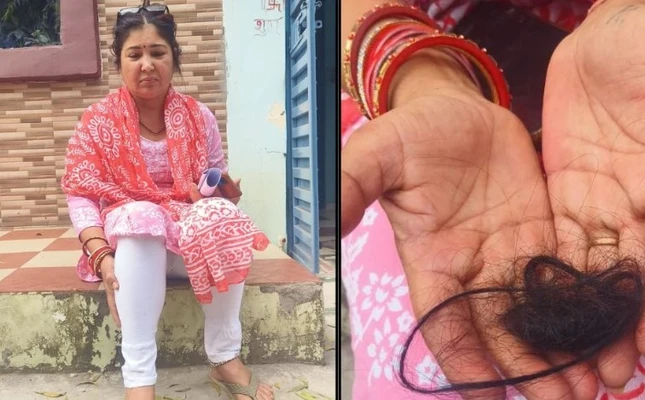
Case Summary
In Madhya Pradesh’s Ratlam, a Hindu woman was assaulted by Muslim women for lighting lamps and bursting firecrackers on Diwali. The victim, Rashmi Chauhan, was beaten, her hair pulled, and her leg fractured by four women, Rani, Najmeen, Sania, and Gudiya, who have all been named in an FIR. A video of the incident also surfaced. According to media reports, the incident took place near Ganesh Nagar, close to Mohan Nagar, in Ratlam. Rashmi, who works as a tailor, stated in her complaint that on the night of October 21, 2025, she was celebrating Diwali at home. After lighting diyas, she stepped outside to burst firecrackers in front of her house. At that moment, Rani, the wife of a local resident named Wasim, objected to her bursting firecrackers near their house. A heated argument followed, and Rani, along with Najmeen, Gudiya, and Sania, attacked Rashmi, pulling her hair and beating her severely. Rashmi further stated that the four women threatened to kill her if she dared to burst firecrackers again. Meanwhile, a woman from the accused side, Rizwana, has also filed a counter-complaint against Rashmi, alleging assault. The case drew attention from the Hindu Jagran Manch, which has protested the counter-case filed against the victim. The organisation stated that Rashmi was violently assaulted, her hair pulled, and that she sustained a fracture in her leg during the attack.
Why it is Hate Crime ?
The first category under which this incident has been placed is- Attack not resulting in death. Within this, the subcategory selected is- Attacked for Hindu identity. In several cases, Hindus are attacked merely for their Hindu identity without any perceived provocation. A classic example of this category of religiously motivated hate crime is a murder in 2016. 7 ISIS terrorists were convicted for shooting a school principal in Kanpur because they got ‘triggered’ seeing the Kalava on his wrist and tilak that he had put. In this, the Hindu victim had offered no provocation except for his Hindu religious identity. The motivation for the murder was purely religious, driven by religious supremacy. Such cases where Hindus are targeted merely for their religious identity would be documented as a hate crime under this category. The second is- Attacked for crossing 'Muslim area'. One of the reasons that Hindus get attacked unprovoked specifically by Islamists is for crossing ‘Muslim areas’. Essentially, Muslim mobs often attack Hindus crossing or present in certain areas which have a majority Muslim population. It has often been cited as one of the reasons to blame Hindus for attacks against themselves, signalling that Hindus displaying religious symbols, taking our religious processions or crossing any area which is dominated by Muslim residents is a provocation in and of itself. These areas are mostly ghettoized areas where mobs mobilize quickly to attack Hindus for a variety of reasons like playing music during a religious procession, crossing a mosque, wearing a tilak or any other religious symbol in a Muslim-dominated area, praying at a local temple in that area etc. There have been cases where the few local Hindus of that area have been attacked on their way to the Temple for prayers as well, simply because the area is considered a Muslim-dominated area. Several times, it is entirely possible that the immediate trigger for the violence against Hindus was non-religious in nature, however, the violence became religiously motivated in nature because the area was Muslim dominated and the residents on the whole harboured animosity towards Hindus, evidenced from the actions of the mob, the slogans, and the nature of the attack. Such crimes are motivated by the religious identity of the victims and are therefore classified as hate crimes under this category. The other category selected is- Attack on Hindu religious representations. Within this, the subcategory selected is- Defiling religious customs. Sanatan Dharma is not a religion of one book, which is to say that while it has religious scriptures that form the central tenets of the faith, there are several traditions followed through thousands of years, mostly passed from generation to generation orally. There are several such customs and traditions that are followed by various Hindus and Hindu sects. Defiling of these traditions and customs is a breach of an individual or group’s religious practices. Such practices can range from dietary restrictions like not eating non-vegetarian food for a certain period of the year, not eating non-vegetarian food at all, not eating beef since the cow is considered holy in Hinduism, the sanctity of religious customs followed in the house (like many ISCKON devotees), etc. Any malicious action leading to the breach of such traditions or defilement of these traditions owing to animosity towards the faith or for the sake of activism stems not only from the lack of faith in the religion itself but also from disregard for the faith of the devotees who follow the customs/traditions and implicit bias against the faith, the tradition itself. Since these specific traditions are central to the faith of the devotees of that specific sect of Hindus, any non-compliance with these traditional rules would be considered a religiously motivated hate crime. This case has been added to the Hinduphobia Tracker as a clear instance of a faith-based hate crime, where a Hindu woman was attacked and intimidated for observing a core Hindu festival ritual. The incident in Ratlam, Madhya Pradesh, represents a deliberate act of hostility toward Hindu identity and customs, specifically the celebration of Diwali — one of Hinduism’s most sacred and unifying traditions. The victim, Rashmi Chauhan, was lighting diyas and bursting firecrackers outside her home, a symbolic gesture marking the victory of light over darkness and good over evil. Her act of devotion was met with unprovoked and disproportionate violence by her Muslim neighbours, who objected to her celebrating the festival in front of their house. The physical cruelty, combined with their threat to “finish her” if she burst firecrackers again, shows the intent to intimidate and suppress Hindu religious expression. Such attacks are not isolated incidents, but part of a recurring pattern seen in Muslim-dominated or communally sensitive areas, where open Hindu celebration often provokes resentment among radicalised elements. The underlying cause lies in the assertion of religious dominance, the idea that Hindu rituals, symbols, and festivals should remain invisible or restricted within such spaces. This mindset treats Hindu visibility as provocation and Hindu assertion as defiance, resulting in frequent confrontations during festivals like Diwali, Holi, and Ram Navami. In these environments, even benign acts such as lighting diyas or bursting firecrackers are interpreted through a lens of religious competition rather than coexistence. The attack on Rashmi thus goes beyond a neighbourhood quarrel; it is a manifestation of entrenched hostility toward the public practice of the Hindu faith. The perpetrators sought to defile a sacred custom by turning a peaceful act of worship into an occasion of humiliation and fear. This not only desecrates a spiritual ritual but also enforces social intimidation, sending a message that Hindus in such areas must either suppress their traditions or face consequences. The disproportionate nature of the assault, the explicit threats, and the religious targeting collectively confirm this as a hate crime motivated by animosity toward Hindu identity and the desecration of its customs. Rashmi’s ordeal reflects a broader pattern of Hinduphobic aggression, where Hindus are attacked for celebrating their own festivals, revealing how deeply intolerance and religious supremacy continue to shape inter-community relations in certain regions.
Victim Details
Total Victim
1
Deceased
0
Gender
- Male 0
- Female 1
- Third Gender 0
- Unknown 0
Caste
- SC/ST 0
- OBC 0
- General 0
- Unknown 1
Age Group
- Minor 0
- Adult 1
- Senior Citizen 0
- Unknown 0


Case Status
Complaint registered


Perpetrators Details
Perpetrators
Muslim Extremists
Perpetrators Range
From 2 To 5
Perpetrators Gender
female
 Sources




