Diwali celebrations attacked, Hindu devotees subjected to brutal violence by Muslims in Pakistan
 Umerkot District, Sindh, Pakistan
  21 October, 2025
Case Summary
In the village of Jinathi Dhanai in Umerkot, Sindh, Pakistan, a Hindu religious event on the occasion of Diwali, a revered Hindu festival, was attacked by a Muslim group. Hindu devotees were subjected to brutal violence by the attackers. A video of this incident was shared on Instagram by a Hindu rights group named “Rescue Sindhi Hindus” and Hindu activist Nikhil Chandwani. Nikhil Chandwani, an author and Hindu activist, is known for rescuing more than 9,300 Hindu families from Pakistan who faced religious persecution in their home country. Even Pakistani Hindu activist Shiva Kachhi shared a tweet highlighting this incident on his official X (formerly Twitter) handle. As per the social media posts, the attack in Jinathi Dhanai village took place under the jurisdiction of Chhor Police Station. A Muslim mob led by men named Shoukat Junejo, Abu Bakar, Barkat, Khan Muhammad, Allahdad, and Obhayo Junejo violently attacked the local Hindu community’s Diwali celebration. Armed with axes and sticks, the Muslim group destroyed the stage setup and forced the event to stop midway. Hindu participants were also brutally assaulted by the Muslim perpetrators. Some of the victims were identified as Tirth Meghwar, Nirmal, Nihal, Jiram, Aatam, and Bhutto. The victims stated that despite repeated pleas, the local police refused to register a case or take any action against the attackers. This case is a stark reminder of the persistent persecution faced by Hindu minorities in Pakistan, marked by systemic discrimination, violence, and forced conversions. Hindus, particularly women and young girls, are often abducted, forcibly converted to Islam, and married off to Muslim men with little to no legal recourse. Temples are frequently vandalised or destroyed, and Hindu communities are subjected to social and economic marginalisation. Blasphemy laws are disproportionately used against Hindus, leading to false accusations and severe punishments. Many Hindu families are forced to flee their homes due to religious intolerance, living in constant fear of attack. This sustained persecution highlights the dire conditions for Hindus in Pakistan, where their religious identity makes them targets of oppression.
Case Images
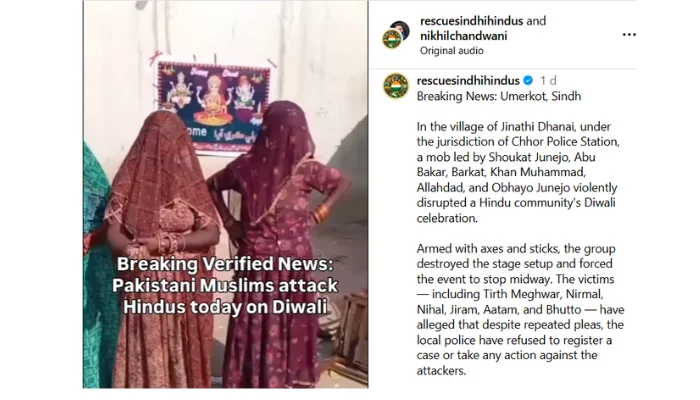
Why it is Hate Crime ?
This case has been added to the tracker under the primary category- Attack not resulting in death. Within this, the subcategory selected is- Communal Clash/ Attack. Communal clash is a form of collective violence that involves clashes between groups belonging to different religious identities. For a communal clash between Hindus and non-Hindus to qualify as a religiously motivated hate crime, the trigger of the violence itself would have to be anti-Hindu in essence. For example, if there is a Hindu religious procession that comes under attack from a non-Hindu mob and after the initial attack, Hindus retaliate in self-defence, leading to a communal clash between the two religious communities. While at a later stage, both communities are involved in the clash/violence, the initial trigger of the violence was by the non-Hindu mob against the Hindus and therefore, it could safely be termed as an anti-Hindu violence. Further, the trigger would also have to be religiously motivated. In the cited example, the attack by the non-Hindu mob was against religious processions and therefore, can be concluded to be religiously motivated. In some cases, the trigger may be non-religious, however, it develops into religious violence against Hindus at a later stage. In such cases too, the foundational animosity towards Hindus becomes the motivating factor of the crime and therefore, it would be classified as a religiously motivated hate crime against Hindus under this category. The other subcategory selected is- Attack against Hindu devotees. Hindu devotees are a few of the easiest targets of religiously motivated hate crimes because during the festival/procession/puja etc, for non-Hindus it is easy to profile their victims on the basis of religion. Hindu devotees come under attack on several occasions by individual non-Hindus or mobs of non-Hindus owing to their animosity against Hinduism, its symbols and tradition/practices. There are several instances of Hindu devotees being attacked while they worship in temples or temporary religious structures, during religious processions, doing bhajan/kirtan/puja in their own homes, in the residential society etc. These attacks are perpetrated by non-Hindus primarily because of their animosity towards Hindus and their faith. In some cases, the trigger for the violence may be non-religious, however, there are two elements that make these hate crimes. First, the Hindus who come under attack are attacked violently while indulging in religious activity. Whether they are in a place of worship or not is immaterial to the crime. When individuals are attacked while indulging in religious practices, the attack in itself is a hindrance to their freedom to practice religion and therefore constitutes a hate crime. Secondly, religious supremacist doctrines and ideologies deem religious practices of Hindus to be offensive ab initio since they are considered “sinful” by these ideologies, worthy to be annihilated by force or coercion. Driven by these religious supremacist ideologies and doctrines, the attacks against Hindu devotees stem from intrinsic animosity towards Hinduism. In some cases, the trigger for the violence may be non-religious, however, it develops into a religiously motivated crime during the course of the violence. Since these attacks stem from animosity towards Hindus and Hinduism, they are considered religiously motivated hate crimes under this category. The other subcategory selected is- Attacked for Hindu identity. In several cases, Hindus are attacked merely for their Hindu identity without any perceived provocation. A classic example of this category of religiously motivated hate crime is a murder in 2016. 7 ISIS terrorists were convicted for shooting a school principal in Kanpur because they got ‘triggered’ seeing the Kalava on his wrist and tilak that he had put. In this, the Hindu victim had offered no provocation except for his Hindu religious identity. The motivation for the murder was purely religious, driven by religious supremacy. Such cases where Hindus are targeted merely for their religious identity would be documented as a hate crime under this category. This incident is a clear example of an anti-Hindu hate crime as the Muslim perpetrators attacked Hindus in Pakistan while they were celebrating Diwali, a revered Hindu religious festival of light that symbolises the triumph of good over evil. The attack took place during one of the most sacred and joyous religious events for Hindus, which made the assault especially painful and symbolic. By assaulting Hindus during a moment of religious devotion and community celebration, the attackers showcased deep-seated religious animosity towards the Hindu community and their faith. Diwali holds immense religious and emotional significance for Hindus, and the fact that the Muslim perpetrators chose that sacred occasion to launch the attack revealed deliberate intent and a pattern of hatred rooted in religious intolerance. It clearly reflected an ingrained bias against Hindu culture, traditions, and the right of the community to practise their faith peacefully. The desecration of a Hindu religious event, the Diwali celebration, in such a manner by the accused demonstrated the depth of hostility they harboured towards Hindus. This was not merely an act of disruption or provocation; rather, it was a calculated and purposeful attempt to humiliate the Hindu community and desecrate a sacred event that represented their religious and cultural identity. The act struck at the heart of Hindu spiritual expression and was meant to instil fear and insecurity among Hindus. The attackers’ goal was to display Islamic dominance and contempt for the minority Hindu community through the public degradation of its most cherished rituals and symbols, further reflecting extreme intolerance towards Hindus. The fact that the perpetrators were armed with weapons and launched a violent assault on Hindu devotees who were present at the Diwali celebration exposed the violent and premeditated nature of the crime. Their preparation with axes, sticks, and other weapons made it apparent that this was not spontaneous aggression but a deliberate and organised act targeting people for their religious identity. The attack was directed solely against Hindus because of their faith in Hinduism. It was, therefore, a religiously motivated hate crime that aimed to terrorise a vulnerable community during their time of worship and celebration. Henceforth, this incident is a clear and undeniable instance of a hate crime. The assault also reflected the broader pattern of violence and persecution faced by Hindus in Pakistan at the hands of Muslim extremists. Over the years, Hindus in Pakistan have been subjected to continuous attacks on their temples, forced conversions of women and minors, mob violence, and social intimidation that denied them equal rights and religious freedom. The repeated targeting of Hindu festivals and religious symbols illustrated a larger systemic problem rooted in religious intolerance. It revealed how the Hindu community in Pakistan continued to live under constant fear of aggression, with little protection from state authorities and repeated failures of the justice system. This recurring pattern of hostility underscored the deteriorating condition of minorities in Pakistan, particularly Hindus, who had long faced violence and discrimination due to their religious identity. Given that this case met the defined parameters of a hate crime, and considering the existing background of violence targeting Hindus in Pakistan because of their faith, this incident is being added to the hate crime database of the Hinduphobia Tracker. Disclaimer: The Hinduphobia Tracker generally records the date of an incident based on when the crime took place, rather than when it is reported by mainstream media or social media. However, since in this case the exact date of the crime was not specified, the date of the post—22nd October 2025 is being used as the indicative date of the incident. This is done solely for documentation purposes and to record an estimated timeline of the event.
Victim Details
Total Victim
6
Deceased
0
Gender
- Male 6
- Female 0
- Third Gender 0
- Unknown 0
Caste
- SC/ST 0
- OBC 0
- General 0
- Unknown 6
Age Group
- Minor 0
- Adult 0
- Senior Citizen 0
- Unknown 6


Case Status
Complaint not filed


Perpetrators Details
Perpetrators
Muslim Extremists
Perpetrators Range
From 5 to 10
Perpetrators Gender
male
 Sources




