Two Hindu brothers brutally attacked with swords and sharp weapons by Muslims for bursting firecrackers on Diwali in Gujarat
 Bhavnagar, Gujarat, India
  20 October, 2025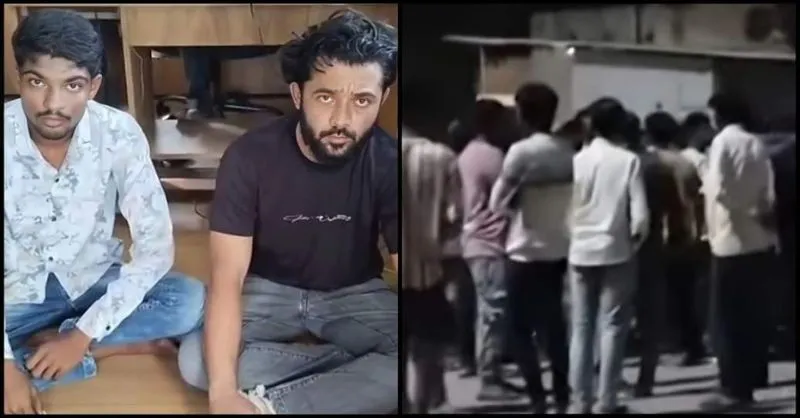
Case Summary
Two Hindu brothers, Ravi Bharatbhai Parmar (20, a labourer) and his elder brother Akash Parmar, endured a life-threatening assault by a group of Muslim men stemming from a dispute over bursting firecrackers during Diwali. The attack took place in the Kumbharwada–Madhiya Road area near Mahamadi Mosque, Bajrangnagar locality of Bhavnagar city. The incident occurred around 11:15 PM on October 19, 2025, when Ravi’s younger brother Vipul was bursting firecrackers near their house to celebrate Diwali. A local Muslim man named Samir objected to the firecrackers and engaged in a heated argument with Vipul. Later, Ravi received a distressing call from his friend Paresh, who informed him that two or three Muslim individuals were verbally abusing Vipul at the street corner. Concerned for his brother’s safety, Ravi rushed to the spot. Upon reaching the location near Mahamadi Mosque, Ravi encountered Riyaz Pathan, armed with a sharp weapon (dhariyu), Samir Husenbhai Saiyad, holding a pipe, and Aslam Pathan, also wielding a pipe. The trio immediately turned their aggression toward Ravi, hurling abuses at him. When Ravi objected to the verbal assault, Riyaz Pathan struck him on the head with the sharp weapon, causing a deep wound. Samir and Aslam then joined in, attacking Ravi repeatedly with pipes. Hearing Ravi’s cries of pain, his elder brother Akash Parmar rushed to the spot to rescue him. However, the assailants turned on Akash as well, with Samir and Aslam beating him mercilessly with pipes. The violence intensified when another man named Samir, wielding a sword, joined the attackers and struck Akash on the head, causing a severe injury. The ordeal ended only when friends Paresh Makwana, Hitin Bavaliya, and Karan Chudasama arrived at the scene after hearing the commotion. Their intervention forced the attackers to flee. Both Ravi and Akash, bleeding profusely, were rushed to Sir T Hospital, where Ravi received stitches for a deep head injury and treatment for a fractured left hand, while Akash was treated for a sword-inflicted head wound. Following treatment, Ravi filed a formal complaint at Bor Talav Police Station against Riyaz Pathan, Aslam Pathan, Samir Husenbhai Saiyad, and another individual named Samir. A copy of the FIR, accessed by OpIndia, confirms that the assault occurred over an objection to bursting firecrackers on the Hindu festival of Diwali. The complainant also alleged that initially 10–15 Muslim men gathered near the mosque, but the number later swelled to 40–45 individuals, many of whom were armed with weapons. He further accused the police of bias and negligence, claiming that despite providing the names of the main attackers, the police failed to take action against them. He also alleged that a woman named Khadija Khatoon, a local Congress leader, was present among the attackers and that her political influence shielded the culprits from immediate action. However, PI Dabhi of Bor Talav Police Station denied these allegations in a statement to OpIndia, clarifying that the complainant’s signature was taken at the time of FIR registration and that the names he later mentioned were not included initially. The police stated that if the complainant submits additional names, they will not hesitate to act. In total, two FIRs were registered in the case. The first, filed by the Hindu victims, accused Muslim men of attacking them for bursting firecrackers during Diwali. The second, filed by the Muslim men, alleged that the Hindu youths abused them while bursting firecrackers, leading to the altercation. Police have registered a case against Riyaz Pathan, Aslam Pathan, Samir Husenbhai Saiyad, and the second Samir under Sections 117(2), 118(1), 115(2), 352, and 54 of the Bharatiya Nyaya Sanhita (BNS) and Section 135 of the Gujarat Police Act. The police confirmed that two of the accused, Aslam Pathan and Samir Saiyed, have been arrested, and that further investigation is underway.
Why it is Hate Crime ?
The case has been added to the tracker under the first primary category: Attack not resulting in death. The first subcategory selected is: Attacked for Hindu identity. In several cases, Hindus are attacked merely for their Hindu identity without any perceived provocation. A classic example of this category of religiously motivated hate crime is a murder in 2016. 7 ISIS terrorists were convicted for shooting a school principal in Kanpur because they got ‘triggered’ seeing the Kalava on his wrist and tilak that he had put. In this, the Hindu victim had offered no provocation except for his Hindu religious identity. The motivation for the murder was purely religious, driven by religious supremacy. Such cases where Hindus are targeted merely for their religious identity would be documented as a hate crime under this category. The second subcategory selected is: Attacked for crossing 'Muslim area'. One of the reasons that Hindus get attacked unprovoked specifically by Islamists is for crossing ‘Muslim areas’. Essentially, Muslim mobs often attack Hindus crossing or present in certain areas which have a majority Muslim population. It has often been cited as one of the reasons to blame Hindus for attacks against themselves, signalling that Hindus displaying religious symbols, taking our religious processions or crossing any area which is dominated by Muslim residents is a provocation in and of itself. These areas are mostly ghettoized areas where mobs mobilize quickly to attack Hindus for a variety of reasons like playing music during a religious procession, crossing a mosque, wearing a tilak or any other religious symbol in a Muslim-dominated area, praying at a local temple in that area etc. There have been cases where the few local Hindus of that area have been attacked on their way to the Temple for prayers as well, simply because the area is considered a Muslim-dominated area. Several times, it is entirely possible that the immediate trigger for the violence against Hindus was non-religious in nature, however, the violence became religiously motivated in nature because the area was Muslim dominated and the residents on the whole harboured animosity towards Hindus, evidenced from the actions of the mob, the slogans, and the nature of the attack. Such crimes are motivated by the religious identity of the victims and are therefore classified as hate crimes under this category. The other subcategory relevant here is- Communal clash/attack. Communal clash is a form of collective violence that involves clashes between groups belonging to different religious identities. For a communal clash between Hindus and non-Hindus to qualify as a religiously motivated hate crime, the trigger of the violence itself would have to be anti-Hindu in essence. For example, if there is a Hindu religious procession that comes under attack from a non-Hindu mob and after the initial attack, Hindus retaliate in self-defence, leading to a communal clash between the two religious communities. While at a later stage, both communities are involved in the clash/violence, the initial trigger of the violence was by the non-Hindu mob against the Hindus, and therefore, it could safely be termed as an anti-Hindu violence. Further, the trigger would also have to be religiously motivated. In the cited example, the attack by the non-Hindu mob was against religious processions and therefore can be concluded to be religiously motivated. In some cases, the trigger may be non-religious; however, it develops into religious violence against Hindus at a later stage. In such cases, too, the foundational animosity towards Hindus becomes the motivating factor of the crime, and therefore, it would be classified as a religiously motivated hate crime against Hindus under this category. The second primary category selected here is- Attack on Hindu religious represenataions, and within this, the subcategory selected is- Defiling religious customs. Sanatan Dharma is not a religion of one book, which is to say that while it has religious scriptures that form the central tenets of the faith, there are several traditions followed through thousands of years, mostly passed from generation to generation orally. There are several such customs and traditions that are followed by various Hindus and Hindu sects. Defiling of these traditions and customs is a breach of an individual or group’s religious practices. Such practices can range from dietary restrictions like not eating non-vegetarian food for a certain period of the year, not eating non-vegetarian food at all, not eating beef since the cow is considered holy in Hinduism, the sanctity of religious customs followed in the house (like many ISCKON devotees), etc. Any malicious action leading to the breach of such traditions or defilement of these traditions owing to animosity towards the faith or for the sake of activism stems not only from the lack of faith in the religion itself but also from disregard for the faith of the devotees who follow the customs/traditions and implicit bias against the faith, the tradition itself. Since these specific traditions are central to the faith of the devotees of that specific sect of Hindus, any non-compliance with these traditional rules would be considered a religiously motivated hate crime. In this case, the act of stopping a Hindu from bursting firecrackers while celebrating Diwali was a direct attempt to suppress Hindu religious expression and identity. This was not an isolated incident but part of a growing pattern where Hindus are harassed or attacked for celebrating their festivals, particularly in Muslim-dominated localities. The attack took place near the Mahamadi Mosque, a predominantly Muslim area where Hindus often face informal restrictions on public expression of their faith. The opposition to Diwali celebrations here was thus not about noise or nuisance but an assertion of religious dominance within a ghettoised Muslim pocket. Diwali marks the return of Bhagwan Ram (the 7th avatar of Vishnu) to Ayodhya and symbolises the victory of dharma over adharma. Over centuries, bursting firecrackers has become a joyful and devotional form of celebration, deeply tied to Hindu religious identity. Hence, any attempt to obstruct or punish Hindus for celebrating Diwali is an act of cultural erasure, intended to signal that Hindu joy, faith, and symbols are unwelcome in certain spaces. Such actions reinforce an environment of religious intimidation, where local Muslims assert supremacy by dictating what Hindus can or cannot do, even during their holiest festivals. The Bhavnagar assault reflects this mindset clearly. The violence began when a Hindu boy was innocently bursting firecrackers outside his home. Within minutes, Muslim men from the surrounding locality, many emerging from near the mosque, gathered in large numbers with swords, sharp weapons, and iron pipes. This was not a dispute over firecrackers; it was a premeditated show of dominance, designed to terrorise Hindus for expressing their faith publicly. The attackers’ choice of lethal weapons and the scale of the assault reveal deep-seated animosity and the belief that Hindu assertion in a Muslim-majority area must be violently suppressed. This case meets all key indicators of a religiously motivated hate crime. It targeted Hindus for practising their faith during a sacred festival, took place in a setting marked by demographic dominance, was driven by religious hostility, and mirrors a recurring pattern of such anti-Hindu incidents across India. It is therefore entered into the Hinduphobia Tracker as a verified case of hate violence rooted in religious supremacy and the suppression of Hindu identity.
Victim Details
Total Victim
2
Deceased
0
Gender
- Male 2
- Female 0
- Third Gender 0
- Unknown 0
Caste
- SC/ST 0
- OBC 0
- General 0
- Unknown 2
Age Group
- Minor 0
- Adult 2
- Senior Citizen 0
- Unknown 0


Case Status
Case sub-judice


Perpetrators Details
Perpetrators
Muslim Extremists
Perpetrators Range
From 2 To 5
Perpetrators Gender
male
 Sources




