Celebration of Hindu festival Diwali cancelled by authorities in Leicester, United Kingdom
 Leicestershire, United Kingdom
  2 September, 2025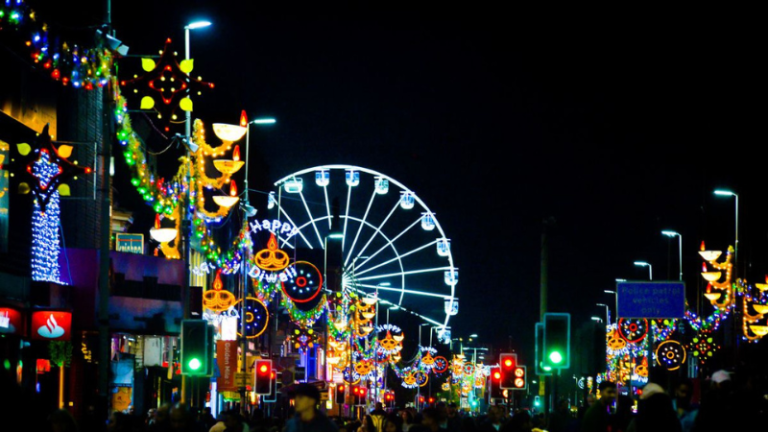
Case Summary
Celebration of Hindus’ revered festival Diwali was cancelled in Leicester, United Kingdom, marking the first time the city’s famous event did not take place. Leicester City Council prohibited fireworks, stage performances, and cultural programmes for Diwali 2025, citing public safety concerns. The Hindu community strongly criticised the decision, calling it discriminatory and unjust, especially since Leicester had hosted the largest Diwali celebration outside India. Every year, thousands gathered on Belgrave Road’s ‘Golden Mile’ for fireworks, traditional shows, and festivities. This year, although the street was decorated with lights and traffic was closed, the main events were cancelled. The move followed recommendations from the city’s Safety Advisory Group, which included the council, police, and emergency services. On 3rd September 2025, Leicester’s Safety Advisory Group rejected all proposals for extra Diwali activities on Belgrave Road, leaving this year’s 20th October celebrations limited to lights. The group claimed that the large turnout of about 50,000 people in 2024 had raised safety concerns. Indian-origin MP Shivani Raja condemned the decision, stating that the festival was under threat and expressing concern over the growing disregard for Hindu traditions. She wrote on X, “Our Diwali celebrations are still in danger; a cloud of uncertainty hangs over them.” The controversy followed a series of incidents in the United Kingdom that had disrespected Hindu sentiments. In 2024, during Prime Minister Keir Starmer’s administration, meat and alcohol were served at the official Diwali reception at 10 Downing Street, sparking outrage among Hindu, Sikh, and Jain communities. MP Shivani Raja had written to the Prime Minister, calling the act disrespectful to religious beliefs and offering to provide cultural guidance for future events. Leicester, where nearly 18 per cent of the population is of Hindu origin, has long been a centre of vibrant Hindu festivities. However, attempts to create an anti-Hindu atmosphere had become increasingly common. A previous dispute erupted during a Ganesh Chaturthi procession when saffron flags were displayed, which the Muslim Council of Britain described as “Hindu extremism.” Tensions had continued since the 2022 violence that followed an India-Pakistan cricket match, when false social media propaganda against Hindus led to attacks on Hindu homes and temples, desecration of saffron flags, and stabbings in public.
Why it is Hate Crime ?
The primary category in this case is: Restriction/ban on Hindu practices. The subcategory under this is: Administration restricting religious practice. In several cases, it is seen that the administration/state disallows a religious practice owing to prejudicial orders and concerns, targeted specifically against the Hindu community. Such restriction/prohibition would be considered documented as a hate crime because the orders are often a result of pressure by groups that harbour animosity towards Hinduism and Hindus. Often, the restriction by the authorities is driven by bias, hostility, or prejudice against the specific community being stopped from holding a religious practice, by pressure groups that harbour animosity towards Hindus, intrinsic to their faith. Since practices are intrinsic to the faith of the Hindus, such prejudicial restriction is considered a curtailing of the fundamental rights of the Hindu community. In several cases, for example, the authorities ban a Hindu religious practice due to pressure from groups opposed to the religion. In other instances the prohibition is selectively enforced against one religious group (Hindus) while others are allowed to proceed. There are still other cases where the authorities preemptively restrict a religious practice by Hindus because those who hold animosity towards Hindus may get “provoked” leading to them being violent, thereby assuaging the sentiments of those who hold animosity towards Hindus by curtailing the religious rights of Hindus. Such acts and orders are prejudiced, indicating discriminatory motives owing to the capitulation to groups that harbour animosity towards Hindus and therefore, would be categorized as a religiously motivated hate crime since the original pressure leading to the order itself is a result of hatred/bias/prejudice/religious hate against Hindus. This case has been added to the Hinduphobia Tracker because it represents an institutional restriction imposed on the public celebration of a central Hindu festival, Diwali, by the Leicester City Council in the United Kingdom. The cancellation of fireworks, stage performances, and cultural programmes under the pretext of “public safety” reflects a pattern of administrative discrimination against the Hindu community in a city where Diwali celebrations have historically symbolised multicultural harmony and Hindu cultural visibility. For millions of Hindus worldwide, Diwali is not merely a festival but a sacred expression of faith, symbolising the triumph of light over darkness and dharma over adharma. Restricting its celebration, therefore, is not a routine policy act but a direct affront to the religious sentiments and dignity of Hindus. The decision is not an isolated administrative act but part of a sustained pattern of hostility towards Hindu expression in Leicester. Over the past few years, Hindu festivals, religious processions, and symbols have been repeatedly targeted under politically convenient or selectively enforced pretexts. This includes the controversy over saffron flags during a Ganesh Chaturthi procession, the vilification of Hindus by groups such as the Muslim Council of Britain, and the continued legacy of misinformation-driven attacks following the 2022 Leicester riots, where Hindus were falsely accused of extremism and subsequently subjected to violence. The Leicester City Council’s ban effectively marginalised an entire community’s ability to practise its faith publicly, while similar events by other groups have not faced comparable restrictions. Such selective enforcement reflects an implicit bias and capitulation to pressure from groups that harbour animosity towards Hindus. The official justification of “safety” echoes a long-standing pattern where Hindu practices are curtailed preemptively, allegedly to prevent potential unrest from those opposed to them—thereby punishing the victims of prejudice instead of addressing its perpetrators. The cancellation must also be viewed within a broader trend across Western democracies, where Hindu religious expressions are increasingly portrayed as “provocative” or “problematic,” while similar practices of other communities are encouraged in the name of diversity. This unequal treatment underscores a systemic prejudice embedded within public institutions, which normalises the silencing of Hindu cultural identity under bureaucratic pretexts. The history of Leicester itself underscores this entrenched pattern. Since the 2022 communal unrest, Hindus in the city have repeatedly faced intimidation, vandalism of temples, and harassment for displaying Hindu symbols or participating in processions. Hindu-owned shops were attacked, saffron flags torn down, and community members were falsely portrayed as aggressors in media narratives. Despite evidence showing that the violence was organised by Islamist groups, official and institutional responses have consistently downplayed anti-Hindu motives. This persistent climate of hostility has made Leicester one of the most visible examples of systemic Hinduphobia in the Western world, where Hindus continue to face collective suspicion, selective restrictions, and cultural erasure under the guise of “public order.” Therefore, this case qualifies as a hate crime under “Restriction/Ban on Hindu Practices,” specifically “Administration restricting religious practice.” The suppression of Diwali celebrations through discriminatory governance reflects entrenched institutional Hinduphobia and a deliberate effort to curtail Hindu religious and cultural visibility in the public sphere.


Case Status
Unknown


Perpetrators Details
Perpetrators
State and Establishment
Perpetrators Range
Unknown
Perpetrators Gender
unknown
 Sources




