Hindu community vilified online after Ranchi restaurant owner murdered over a dispute
 Ranchi, Jharkhand, India
  17 October, 2025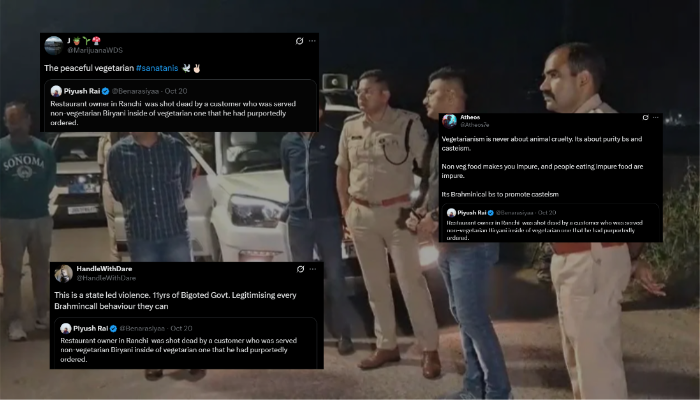
Case Summary
Hindus were vilified and targeted on social media following the murder of a restaurant owner named Vijay Nag in Ranchi, Jharkhand. The 47-year-old victim, who ran the Chowpatty restaurant on Kanke Road, was shot dead on the night of 18 October 2025 after a dispute with a customer over food. According to police, the customer, identified as Abhishek Singh, became angry after finding a bone in a vegetarian meal. During a heated argument, he pulled out a gun and shot Nag in the chest before fleeing. Soon after the incident was reported, several social media users, including members of the Congress party and the left-leaning ecosystem, began targeting the Hindu community as a whole. They portrayed the crime as a “Brahminical” act carried out by “vegetarian supremacists,” linking it to Hindu beliefs and organisations such as the Bharatiya Janata Party and the Rashtriya Swayam Sangh, even though Jharkhand is governed by an opposition coalition. Police later clarified that the case involved local criminals and that the accused had a history of land-grabbing and other offences. However, this information was largely ignored online, where several users continued to blame the Hindu community collectively. Some called the act “Hindu terror,” while others attributed it to a so-called “Brahminical mindset.” This wave of online commentary led to widespread stereotyping and vilification of Hindus, despite no evidence linking the murder to religion. The focus of many posts shifted away from the actual crime and the victim’s family, instead turning into a campaign that targeted Hindus and associated cultural practices, portraying them as intolerant or violent.
Why it is Hate Crime ?
The primary category in this case is: Hate speech against Hindus. The subcategory under this is: Anti-Hindu subversion and prejudice. The tertiary category under this is: Anti-Hindu Fake News or Downplaying. Hate speech is defined as any speech, gesture, conduct, writing, or display that is prejudicial against a specific individual and/or group of people, which is leading to or may lead to violence, prejudicial action or hate against that individual and/or group. Media plays a specific and overarching reach in perpetuating prejudicial attitudes towards a community owing to unfair, untrue coverage and/or misrepresentation/misinterpretation, selective coverage and/or omission of facts of/pertaining to issues affecting a specific religious group. This type of bias can dehumanise the victim group, making it easier for others to justify harmful actions against them, which aligns with the objectives of hate speech laws aimed at preventing such harm. It is often observed that the media takes a prejudicial stand against the Hindu community driven by their need to shield the aggressor community which happens to be a numeric minority, however, is the one perpetrating violence against Hindus. For example, the media is often quick to contextualise religiously motivated crimes against Hindus, omit or misrepresent facts that point towards religiously motivated hate crimes, justify and/or downplay religiously motivated hate crimes or simply present fake news to stereotype Hindus. Such media bias leads to the denial of persecution and is often used to dehumanise Hindus, leading to justification for violence against them. For example, the media covered several fake allegations of Hindus targeting Muslims and forcing them to chant Jai Shree Ram. Most of these cases were proved false and fabricated after police investigation. These fake news reports were subsequently never retracted or clarified. Such fake news led to the justification of violence and dehumanisation of Hindus based on the argument that since Hindus targeted Muslims and forced them to chant Jai Shree Ram, the dehumanisation of Hindus and violence against them was par for the course and merely a retaliation. Such media bias leads to prejudicial portrayal of Hindus and offers a justification for violence against them and therefore, is considered hate speech under this category. The other subcategory selected here is- Anti-Hindu slurs, mocking faith. Anti-Hindu slurs and the deliberate mocking of the Hindu faith owing to religious animosity involve the usage of derogatory terms, stereotypes, or offensive references to religious practices, symbols, or figures. One of the common anti-Hindu slurs used against Hindus is “cow-worshipper” and “cow piss drinker”. The intention of using this term is to demean and mock Hindus as a group and their religious beliefs since Hindus consider the cow holy. Additionally, some symbols and the slurs attached to them have a historical context that exacerbates the insult, hate, stereotyping, dehumanisation and oppression against Hindus. Cow worship has been used for centuries to denigrate Hindus, insult their faith and oppress Hindus specifically as a religious group. There has been overwhelming documentation about how cow slaughter has been used to persecute Hindus with cow meat being thrown in temples and places of worship. There has also been overwhelming documentation where cow meat (beef) has been force-fed to Hindus to either forcefully convert them to Islam or denigrate their faith. Apart from cow worship, the Swastika – which holds deep religious significance for the Hindus – has also been misinterpreted and distorted to use as a slur against Hindus. Similarly, the worship of the Shivling has been used by supremacist ideologies and religions to denigrate Hindus owing to religious animosity. Such slurs and denigration stem out of inherent animosity and hate towards Hindus and their faith, therefore, it is categorised as hate speech targeted at Hindus specifically owing to their religious identity. This case qualifies as a hate crime because it represents a deliberate and coordinated attempt to vilify Hindus collectively through online propaganda following a non-religious incident. The murder of restaurant owner Vijay Nag in Ranchi had no communal dimension — it arose from a personal dispute between two individuals. However, several social media users, including political figures and left-leaning commentators, deliberately communalised the case by branding it as an act of “Hindu terror” and attributing it to “Brahminical supremacy.” By invoking terms such as “Brahminical mindset” and “vegetarian supremacists,” these users falsely linked a crime to Hindu identity and practices, portraying Hindus as violent, intolerant, and oppressive. This framing was not accidental but ideological — a continuation of the pattern in which any incident involving a Hindu, irrespective of context, is weaponised to malign the entire community. The objective was not to seek justice for the victim but to stigmatise Hindu society as inherently extremist, using his death as a pretext for political and cultural vilification. In their attempt to politicise the incident, many left-leaning handles and Congress supporters also dragged the Bharatiya Janata Party (BJP) and the Rashtriya Swayamsevak Sangh (RSS) into the narrative, despite neither organisation having any connection to the case. They did so because both groups are seen as defenders of Hindu causes and symbols of Hindu civilisational pride. The hostility directed toward them is, therefore, not purely political but stems from a deeper animosity toward Hinduism itself. Since the RSS and BJP are regarded as “Hindutva outfits,” attacking them becomes a socially acceptable way of expressing contempt for Hindu faith, identity, and resurgence. The left-liberal ecosystem uses this tactic to vilify Hindu organisations under the guise of opposing “extremism,” when in reality, it is opposition to Hindu self-assertion and cultural revival. The use of “Brahminical supremacy” rhetoric is a key component of this narrative strategy. The left-liberal ecosystem routinely deploys this trope to pit Hindus against each other, portraying Brahmins as oppressors and non-Brahmins as their victims, thereby fracturing Hindu unity along caste lines. This divisive narrative erases the shared spiritual, cultural, and civilisational identity of Hindus and replaces it with a false binary of “upper-caste aggressors” versus “lower-caste victims.” By weaponising caste discourse in this manner, these groups transform internal social hierarchies into instruments of civilisational delegitimisation, making Hinduism itself appear inherently unjust and violent. This narrative manipulation constitutes hate speech because it dehumanises Hindus and frames their religious and cultural beliefs as sources of violence. By portraying vegetarianism, a deeply rooted Hindu practice, as a marker of “supremacy,” these commentators sought to criminalise Hindu ways of life and present them as socially dangerous. Such rhetoric fosters suspicion, ridicule, and hostility toward Hindus both online and offline, legitimising prejudice under the guise of social critique. Furthermore, the persistence of these false claims even after police clarification shows the intent to sustain the anti-Hindu narrative rather than correct misinformation. The online campaign transformed an individual crime into a communal indictment of an entire faith, establishing clear evidence of animus and ideological bias. Therefore, this case has been included in the Hinduphobia Tracker as an instance of hate propaganda and stereotyping directed at Hindus. It exemplifies how sections of the political and media ecosystem exploit neutral events to reinforce anti-Hindu tropes, deepen caste-based fissures, and normalise the collective vilification of the Hindu community under the guise of progressive discourse. Disclaimer: The hate speech and vilification of Hindus began on social media following the murder of Vijay Nag on 18 October 2025. Therefore, for documentation purposes, the date of the incident has been recorded as 18 October 2025.


Case Status
Unknown


Perpetrators Details
Perpetrators
Others
Perpetrators Range
N/A
Perpetrators Gender
unknown
 Sources




