Khalistanis attack Hindus in Canada's Surrey, call Hindus 'terrorists'
 Surrey, British Columbia, Canada
  2 November, 2024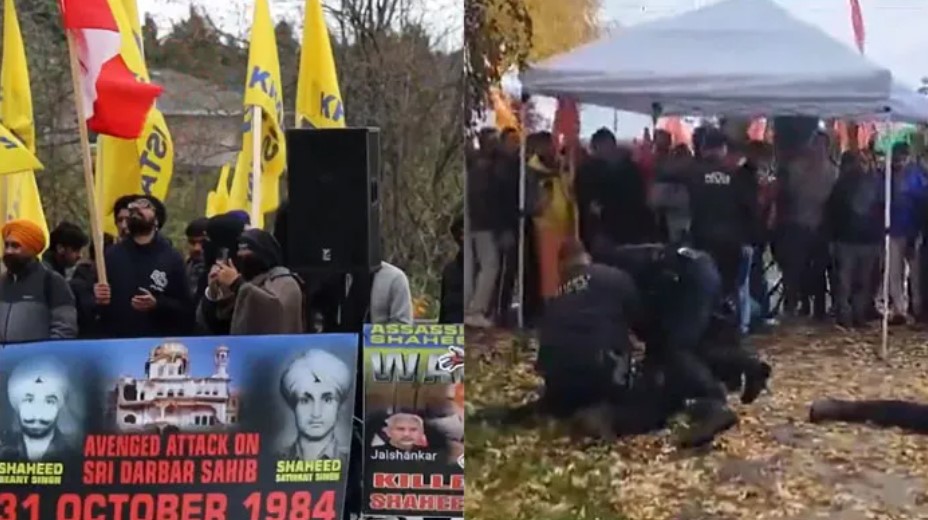
Case Summary
On November 3, following the attack on the Hindu Sabha Temple in Brampton, Canada, Khalistani elements escalated tensions by attacking Hindus in Surrey, British Columbia. These Khalistanis, reportedly affiliated with the same gurdwara where Hardeep Singh Nijjar, a slain Khalistani terrorist, served as chief, gathered at a Hindu temple to protest, chanting slogans in Nijjar’s memory and urging Hindus to “return to their country.” A video shared by investigative journalist Mocha Bezirgan captured these protesters making inflammatory statements, describing India as “a land of gangs” and accusing Hindu Canadians of “treason” for showing support toward India. They argued that Hindu Canadians lack true allegiance to Canada and used events like the 1984 anti-Sikh riots to cast themselves as victims of historical injustice, labelling Hindus as “terrorists.” Journalist Sameer Kaushal shared videos of Surrey Police restraining Hindus instead of arresting Khalistanis.
Why it is Hate Crime ?
This case has been added to the tracker as a religiously motivated hate crime under two prime categories. The first is- Attack not resulting in death. Under this, the sub-category chosen is- Attacked for Hindu identity. In several cases, Hindus are attacked merely for their Hindu identity without any perceived provocation. A classic example of this category of religiously motivated hate crime is a murder in 2016. 7 ISIS terrorists were convicted for shooting a school principal in Kanpur because they got ‘triggered’ seeing the Kalava on his wrist and tilak that he had put. In this, the Hindu victim had offered no provocation except for his Hindu religious identity. The motivation for the murder was purely religious, driven by religious supremacy. Such cases where Hindus are targeted merely for their religious identity would be documented as a hate crime under this category. The second prime category under which this case has been placed is- Hate speech against Hindus and within this, the sub-category selected is- Anti-Hindu slurs, mocking faith. Anti-Hindu slurs and the deliberate mocking of the Hindu faith owing to religious animosity involve the usage of derogatory terms, stereotypes, or offensive references to religious practices, symbols, or figures. One of the common anti-Hindu slurs used against Hindus is “cow-worshipper” and “cow piss drinker”. The intention of using this term is to demean and mock Hindus as a group and their religious beliefs since Hindus consider the cow holy. Additionally, some symbols and the slurs attached to them have a historical context that exacerbates the insult, hate, stereotyping, dehumanisation and oppression against Hindus. Cow worship has been used for centuries to denigrate Hindus, insult their faith and oppress Hindus specifically as a religious group. There has been overwhelming documentation about how cow slaughter has been used to persecute Hindus with cow meat being thrown in temples and places of worship. There has also been overwhelming documentation where cow meat (beef) has been force-fed to Hindus to either forcefully convert them to Islam or denigrate their faith. Apart from cow worship, the Swastika – which holds deep religious significance for the Hindus – has also been misinterpreted and distorted to use as a slur against Hindus. Similarly, the worship of the Shivling has been used by supremacist ideologies and religions to denigrate Hindus owing to religious animosity. Such slurs and denigration stem out of inherent animosity and hate towards Hindus and their faith, therefore, it is categorised as hate speech targeted at Hindus specifically owing to their religious identity. The Khalistani protesters targeted Hindu Canadians, attacking them not just on a personal level, but primarily because of their Hindu identity. The protesters raised slogans that explicitly denigrated India, a country that is predominantly Hindu. Here, it is important to note that although the slogans raised by the Khalistani supporters were anti-India in nature, denigrating India and its leaders, such rhetoric effectively humiliates the Hindu community, given India's majority Hindu population. Targeting India through these slogans becomes a way to indirectly express disdain for Hinduism and Hindu identity, as India represents the largest centre of Hindu culture, beliefs, and practices globally. Thus, anti-India sentiments expressed in this context reflect underlying animosity toward the Hindu faith itself, aligning with the motivations of a religiously motivated hate crime. Further, the Khalistani protesters went on to call Hindus "terrorists" and accused them of "treason." This reflects a deep-seated animosity towards Hindus, invoking historical grievances such as the 1984 anti-Sikh riots to further marginalize and vilify the Hindu community. Such rhetoric is not only an attack on the individuals present at the scene but is a broader assault on the Hindu identity itself, aimed at dehumanizing and ostracizing them in a foreign land. The use of slurs and hateful language, combined with physical aggression, underscores the religiously motivated nature of this attack, marking it as an attempt to intimidate and isolate Hindus based on their faith.


Case Status
Unknown


Perpetrators Details
Perpetrators
Sikh Extremists
Perpetrators Range
Unknown
Perpetrators Gender
unknown
 Sources




