10 Muslim youth arrested for defrauding people, Dainik Bhaskar misrepresent perpetrators as Hindus
 Ludhiana, Punjab, India
  11 October, 2024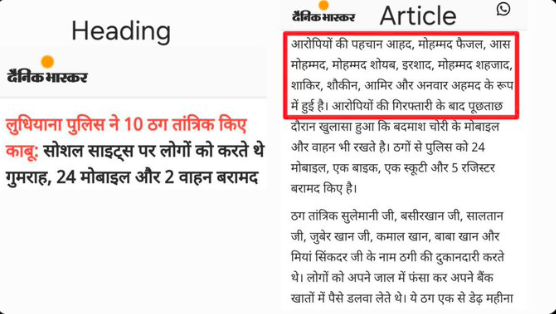
Case Summary
In October 2024, Dainik Bhaskar and The Tribune published reports with the headline "10 tantrik fraudsters held for duping people of lakhs of rupees in Ludhiana, Punjab." However, the suspects who were arrested were Muslim youths. Identified as Ahad, Mohammad Faizal, Aas Mohammad, Mohammad Shoyab, Irshad, Mohammad Shahzad, Shakir, Shaukeen, Aamir, and Anwar Ahmed, the accused operated under aliases such as Tantrik Suleimani and Baba Khan. They lured victims through deceptive social media ads, later extorting money from them. Under the leadership of Sub-Inspector Hamraj Singh Cheema from Dugri Police Station, authorities recovered 24 mobile phones, two stolen vehicles, and five registers linked to the fraudulent operations. They regularly changed locations to evade detection after collecting money. Netizens on Twitter called out Dainik Bhaskar, stating that the headline was misleading and insinuated that the perpetrators were Hindu "tantriks." Following this, Bhaskar edited their report and removed the word "tantrik."
Why it is Hate Crime ?
This case is being added to the primary category 'hate speech'. The secondary category is 'subversion and anti-Hindu prejudice' with the tertiary category being misrepresenting the perpetrator's religion as Hindu. Hate speech is defined as any speech, gesture, conduct, writing, or display that is prejudicial against a specific individual and/or group of people, which is leading to or may lead to violence, prejudicial action or hate against that individual and/or group. Media plays a specific and overarching reach in perpetuating prejudicial attitudes towards a community owing to unfair, untrue coverage and/or misrepresentation/misinterpretation, selective coverage and/or omission of facts of/pertaining to issues affecting a specific religious group. This type of bias can dehumanise the victim group, making it easier for others to justify harmful actions against them, which aligns with the objectives of hate speech laws aimed at preventing such harm. It is often observed that the media takes a prejudicial stand against the Hindu community driven by their need to shield the aggressor community which happens to be a numeric minority, however, is the one perpetrating violence against Hindus. For example, the media is often quick to contextualise religiously motivated crimes against Hindus, omit or misrepresent facts that point towards religiously motivated hate crimes, justify and/or downplay religiously motivated hate crimes or simply present fake news to stereotype Hindus. Such media bias leads to the denial of persecution and is often used to dehumanise Hindus, leading to justification for violence against them. For example, the media covered several fake allegations of Hindus targeting Muslims and forcing them to chant Jai Shree Ram. Most of these cases were proved false and fabricated after police investigation. These fake news reports were subsequently never retracted or clarified. Such fake news led to the justification of violence and dehumanisation of Hindus based on the argument that since Hindus targeted Muslims and forced them to chant Jai Shree Ram, the dehumanisation of Hindus and violence against them was par for the course and merely a retaliation. Such media bias leads to prejudicial portrayal of Hindus and offers a justification for violence against them and therefore, is considered hate speech under this category. In this case, the media labelled the perpetrators as 'tantriks'. Tantriks are specifically Hindu saints who practice "Tantra". However, the perpetrators were Muslims and had nothing to do with Tantra Vidya or Hinduism as a hole. This misrepresentation by the media is considered hate speech since it demonises and dehumanises Hindus, blaming them for crimes they did not commit.


Case Status
Unknown


Perpetrators Details
Perpetrators
Others
Perpetrators Range
N/A
Perpetrators Gender
unknown
 Sources




