Hindu family attacked; Muslim mob enters their house, spits on Govardhan Puja
 Muzaffarnagar, Uttar Pradesh, India
  2 November, 2024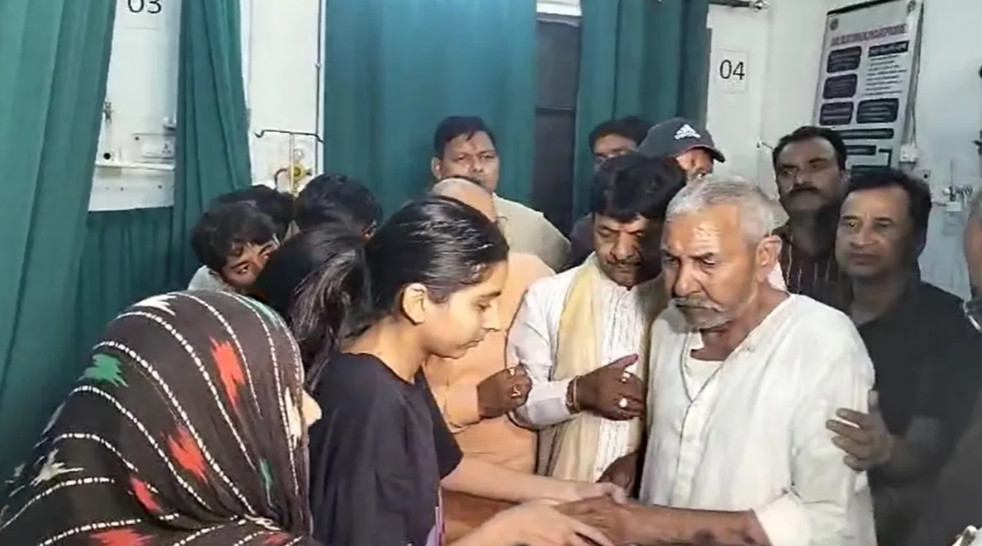
Case Summary
In Muzaffarnagar, Uttar Pradesh, a Hindu family was attacked by members of the Muslim community during Govardhan Puja, leading to serious clashes and incident of molestation and assault. People from the Muslim community forcibly entered the family's home, disrupted the puja, assaulted family members, and spat on their religious ceremony. The victims included young girls, with one family member describing how a boy spat on his sister and attacked him when he intervened. The family also stated that they faced ongoing harassment and were being pressured to sell their home. Upon hearing of the incident, BJP MLA and state minister Kapildev Agarwal arrived at the scene, urging the police to take swift action. Senior district officials also responded with a heavy police presence, taking one person into custody and ensuring the injured family members received medical care. CO City Vyom Bindal confirmed the incident, stating that the police had detained suspects and filed a complaint under relevant sections.
Why it is Hate Crime ?
Owing to the various indicators of a religiously motivated hate crime, this case is being added to three sub-categories under the primary category 'attack not resulting in death'. The first sub-category is 'attacked for Hindu identity'. In several cases, Hindus are attacked merely for their Hindu identity without any perceived provocation. A classic example of this category of religiously motivated hate crime is a murder in 2016. 7 ISIS terrorists were convicted for shooting a school principal in Kanpur because they got ‘triggered’ seeing the Kalava on his wrist and tilak that he had put. In this, the Hindu victim had offered no provocation except for his Hindu religious identity. The motivation for the murder was purely religious, driven by religious supremacy. Such cases where Hindus are targeted merely for their religious identity would be documented as a hate crime under this category. In this case, there was no provocation from the Hindus. They were peacefully conducting their rituals and celebrating their festival in the confines of their home. The Muslim mob entered their house forcefully, spat on the puja and attacked the Hindus. It is therefore, safe to conclude that the Muslim perpetrators held religious animosity towards Hindus and their rituals and attacked the family for their Hindu religious identity. The second sub-category is 'attack on Hindu devotees'. Hindu devotees are a few of the easiest targets of religiously motivated hate crimes because during the festival/procession/puja etc, for non-Hindus it is easy to profile their victims on the basis of religion. Hindu devotees come under attack on several occasions by individual non-Hindus or mobs of non-Hindus owing to their animosity against Hinduism, its symbols and tradition/practices. There are several instances of Hindu devotees being attacked while they worship in temples or temporary religious structures, during religious processions, doing bhajan/kirtan/puja in their own homes, in the residential society etc. These attacks are perpetrated by non-Hindus primarily because of their animosity towards Hindus and their faith. In some cases, the trigger for the violence may be non-religious, however, there are two elements that make these hate crimes. First, the Hindus who come under attack are attacked violently while indulging in religious activity. Whether they are in a place of worship or not is immaterial to the crime. When individuals are attacked while indulging in religious practices, the attack in itself is a hindrance to their freedom to practice religion and therefore constitutes a hate crime. Secondly, religious supremacist doctrines and ideologies deem religious practices of Hindus to be offensive ab initio since they are considered “sinful” by these ideologies, worthy to be annihilated by force or coercion. Driven by these religious supremacist ideologies and doctrines, the attacks against Hindu devotees stem from intrinsic animosity towards Hinduism. In some cases, the trigger for the violence may be non-religious, however, it develops into a religiously motivated crime during the course of the violence. Since these attacks stem from animosity towards Hindus and Hinduism, they are considered religiously motivated hate crimes under this category. The third category is 'attacked to induce migration from non-Hindu dominated area'. There have been cases where the Hindus living in an area, often with a majority dwelling belonging to non-Hindus or those harbouring animosity towards the Hindu faith, the Hindu residents experience threats and violence. The violence is employed with the aim of making the Hindus leave the area and relocate, so the area could be turned into an exclusive ghetto for adherents of the non-Hindu faith or those who harbor animosity towards the Hindu faith. In several cases, the aim of exodus is explicit. However, in several cases, the demand for exodus of Hindu residents is not explicit, however, violence by non-Hindu residents leaves the Hindu residents no option but to leave the area, thereby, turning the area into an exclusive ghetto of non-Hindu residents. In such cases, there are instances violence against the Hindu residents explicitly. For example, in the Hauz Qazi case of 2019, the Muslim residents claimed that mob violence against the Hindu residents had been triggered by a parking dispute. However, the violence did turn religious with a temple being desecrated and was directed specifically against the Hindu residents. The Hindu residents of the area were clear that the violence was religiously motivated and one of the motives was to affect an exodus of the Hindu residents. In such cases, even though the perpetrators have not explicitly expressed the aim of affecting exodus, the given circumstances and violence and precedent point to the intention of exodus and therefore would be categorized under this sub-category. Such crimes are religiously motivated and therefore are hate crimes. The second primary category this case is being added to is 'attack on Hindu religious representations' under the sub-category 'desecration of Hindu religious symbols'. Icons and symbols or a religious representation of a spiritual ideal are widely revered in Hinduism. Iconography is of vital significance in the Hindu milieu. It helps connect people’s spiritual beliefs with the real world. Iconography within the Hindu faith takes several shapes and forms. Murtis are of most significance to Hindus, to which daily rituals, prayers and offerings are done. Besides the murtis, there are several other symbols which have deep significance in the Hindu faith – the Om and Swastika for example. Since these Hindu religious symbols hold paramount importance in Hinduism, any desecration of symbols, icons, murtis, religious representations and manifestations, is driven by animosity towards the faith itself which manifests itself through these murtis, icons and symbols. Therefore, any desecration of these Hindu religious symbols and representations is considered religiously motivated hate crimes under this category. In this case, the family testified that they were repeatedly harassed, threatened and attacked because the Muslims of the area wanted them to sell their home and leave the area. This is a classic tactic to induce migration so the area can be turned into a purely Muslim population area. It further lends credence to the fact that this family was attacked purely on the basis of their religious identity. Disclaimer: In this case, it is mentioned that members of 1 family was attacked. However, the exact number of individuals attacked is not specified. Due to this lack of clarity, we have relied on the most recent Indian census data, which indicates that the average family size in India is approximately 4.8 members per household. To ensure a standardized estimation, we have opted to consider an average of 5 members per family.
Victim Details
Total Victim
5
Deceased
0
Gender
- Male 2
- Female 2
- Third Gender 0
- Unknown 1
Caste
- SC/ST 0
- OBC 0
- General 0
- Unknown 5
Age Group
- Minor 2
- Adult 0
- Senior Citizen 0
- Unknown 3


Case Status
Arrested


Perpetrators Details
Perpetrators
Muslim Extremists
Perpetrators Range
Unknown
Perpetrators Gender
male
 Sources




