Muslim mob brutally assaults Bageshwar Baba Dhirendra Shastri's devotees
 Kosi Zone, Nepal
  3 April, 2024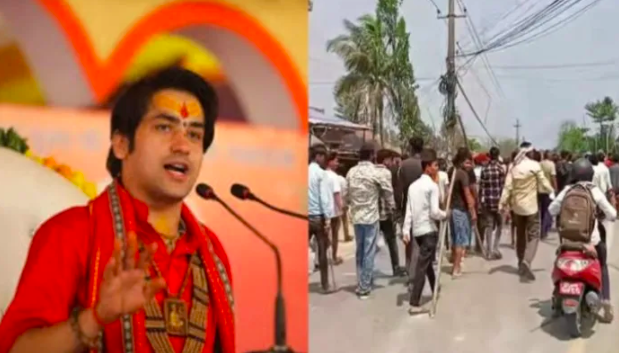
Case Summary
A curfew was imposed in Sunsari's Ramnagar Bhutaha area after members of a Hindu organisation promoting a religious programme by Bageshwar Dham Peethadhishwar Dhirendra Shastri were attacked, resulting in severe injuries to a Hindu youth named Jivan Mehta. Two Muslims have been arrested in connection with the attack. The situation worsened on April 4, 2024, when a mob of approximately 150-200 Muslims brutally assaulted Jivan Mehta, prompting him to seek refuge in a nearby school. The attackers, including individuals of all ages, pursued him into the school premises. Despite police presence, the mob attempted to abduct Mehta and hinder his medical treatment. The violent mob was allegedly led by Fayyaz Ansari, whose father is the president of the Harinagar local municipality, a Muslim-majority area near India. The following day, Hindu protests against the attack were met with further violence from a Muslim mob of around 500 people, resulting in injuries to dozens. Hindu leaders accused local Muslim journalists of spreading propaganda to portray their community as victims, despite Hindus being the targets of the violence. The dispute reportedly began during the consecration of the Ram Mandir in Ayodhya, with tensions escalating after members of the Muslim community tore down a saffron flag hoisted by Hindu youths in Gautampur, Harinagar. Jivan Mehta, in a video protesting the incident, criticised Muslims for disrespecting the saffron flag, leading to him being targeted by the Muslim community.
Why it is Hate Crime ?
This case has been added to the tracker under two prime categories. The first is- Attack not resulting in death, under which, the sub-category chosen is- Attack against Hindu devotees. Hindu devotees are a few of the easiest targets of religiously motivated hate crimes because during the festival/procession/puja etc, for non-Hindus it is easy to profile their victims on the basis of religion. Hindu devotees come under attack on several occasions by individual non-Hindus or mobs of non-Hindus owing to their animosity against Hinduism, its symbols and tradition/practices. There are several instances of Hindu devotees being attacked while they worship in temples or temporary religious structures, during religious processions, doing bhajan/kirtan/puja in their own homes, in the residential society etc. These attacks are perpetrated by non-Hindus primarily because of their animosity towards Hindus and their faith. In some cases, the trigger for the violence may be non-religious, however, there are two elements that make these hate crimes. First, the Hindus who come under attack are attacked violently while indulging in religious activity. Whether they are in a place of worship or not is immaterial to the crime. When individuals are attacked while indulging in religious practices, the attack in itself is a hindrance to their freedom to practice religion and therefore constitutes a hate crime. Secondly, religious supremacist doctrines and ideologies deem religious practices of Hindus to be offensive ab initio since they are considered “sinful” by these ideologies, worthy to be annihilated by force or coercion. Driven by these religious supremacist ideologies and doctrines, the attacks against Hindu devotees stem from intrinsic animosity towards Hinduism. In some cases, the trigger for the violence may be non-religious, however, it develops into a religiously motivated crime during the course of the violence. Since these attacks stem from animosity towards Hindus and Hinduism, they are considered religiously motivated hate crimes under this category. The second category and sub-category under which this case has been placed is- Hate speech against Hindus and Anti Hindu subversion and prejudice respectively. Further, the tertiary category chosen under this category is- anti-Hindu fake news, downplaying. Hate speech is defined as any speech, gesture, conduct, writing, or display that is prejudicial against a specific individual and/or group of people, which is leading to or may lead to violence, prejudicial action or hate against that individual and/or group. Media plays a specific and overarching reach in perpetuating prejudicial attitudes towards a community owing to unfair, untrue coverage and/or misrepresentation/misinterpretation, selective coverage and/or omission of facts of/pertaining to issues affecting a specific religious group. This type of bias can dehumanise the victim group, making it easier for others to justify harmful actions against them, which aligns with the objectives of hate speech laws aimed at preventing such harm. It is often observed that the media takes a prejudicial stand against the Hindu community driven by their need to shield the aggressor community which happens to be a numeric minority, however, is the one perpetrating violence against Hindus. For example, the media is often quick to contextualise religiously motivated crimes against Hindus, omit or misrepresent facts that point towards religiously motivated hate crimes, justify and/or downplay religiously motivated hate crimes or simply present fake news to stereotype Hindus. Such media bias leads to the denial of persecution and is often used to dehumanise Hindus, leading to justification for violence against them. For example, the media covered several fake allegations of Hindus targeting Muslims and forcing them to chant Jai Shree Ram. Most of these cases were proved false and fabricated after police investigation. These fake news reports were subsequently never retracted or clarified. Such fake news led to the justification of violence and dehumanisation of Hindus based on the argument that since Hindus targeted Muslims and forced them to chant Jai Shree Ram, the dehumanisation of Hindus and violence against them was par for the course and merely a retaliation. Such media bias leads to prejudicial portrayal of Hindus and offers a justification for violence against them and therefore, is considered hate speech under this category. Bageshwar Baba Dhirendra Shastri is a Hindu spiritual leader with a significant following. An attack on his devotee can be perceived as a larger attack on the entire Hindu community, as the purpose is clearly to send a broader message of hostility towards the community. It is a tactic to intimidate the community; instil fear and disrupt the cohesion and morale of the community. Such attacks are a form of symbolic aggression against the Hindu community that stems from an innate hatred for Hinduism. Further, this case has also been classified as hate speech because Hindu leaders accused local Muslim journalists of deliberately framing the Hindu community as aggressors while portraying the Muslim community as victims, despite evidence indicating that Hindus were the primary targets of the violence. By disseminating misleading information, these journalists fueled animosity against Hindus. Given that the fundamental motivation behind these actions is contempt for Hindus and their religion, this instance has been added to the tracker under the following category.


Case Status
Case sub-judice


Perpetrators Details
Perpetrators
Muslim Extremists
Perpetrators Range
Unknown
Perpetrators Gender
male
 Sources




