Hindu religious procession passing through Muslim-dominated area attacked, deity's idol desecrated by Muslim children
 Vidisha, Madhya Pradesh, India
  21 September, 2025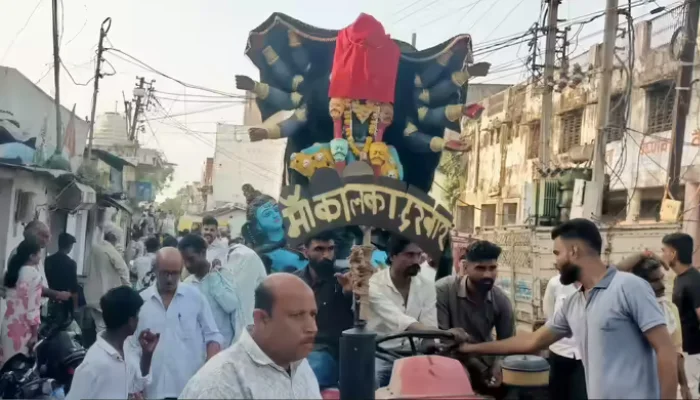
Case Summary
In Vidisha, Madhya Pradesh, a Hindu religious procession of Goddess Kali passing through a Muslim-dominated area was attacked by Muslim children. Stones were hurled at the Hindu devotees, resulting in injuries. Even the idol of Goddess Kali was desecrated in the course of the violence. According to media reports, the incident took place on the evening of 22nd September 2025 at Jayastambh Chowk in the Bajaria area, creating a tense situation. The Nandwana Samiti, a Hindu committee, was carrying the idol of Goddess Kali in the procession when the violence occurred. Two people sustained injuries. Eyewitnesses stated that the stones were thrown from nearby Muslim houses. Following the incident, a crowd gathered at the spot, and angered devotees began raising slogans. On receiving the information, Kotwali police station in-charge Anand Raj immediately reached the scene with a police force, and administrative officials appealed to the people to maintain peace. Police officers then visited the house from where the stones had been thrown. The police investigation said that the Muslim children had been playing on the roof, where construction materials were lying. A relative of the children, Shafin Pathan, claimed that construction work had recently been carried out at their house and some gravel was left on the roof. He claimed that the children had been playing and had inadvertently thrown the stones. He conveyed his apology to the procession committee and assured them that greater care would be taken in the future. On seeing the children, the anger of the Hindu committee members who were carrying out the procession subsided, and they requested that no police action be taken. CSP (Chief Superintendent of Police) Atul Singh described the matter as a dispute between children and confirmed that it had been resolved through discussions. The injured Hindu youths went to the police station and filed a report. The police began investigating the matter and stated that further action would be taken once the facts were established.
Why it is Hate Crime ?
This case has been added to the tracker under the primary category- Attack not resulting in death. Within this, the subcategory selected is- Attack on religious procession. The outward celebration and display of religious symbols in an intrinsic part of Hinduism. Religious processions on various festivals are age-old traditions and a way to manifest faith and form a part of the religious practices of Hindus. On several occasions, such religious processions come under attack by non-Hindu mobs, in a manifestation of their animosity towards Hinduism and their practices. The reasons cited for such violent attacks are many and range from crossing a non-Hindu resident-dominated area to playing loud music, crossing from an area where there is a religious structure of another faith etc. The violent attacks are triggered by the outward display of religiosity by Hindus. The attacks are mainly a manifestation of religious supremacist doctrine which believes that idolatry, essentially the Hindu faith, is one that deserves to be annihilated since the very tenets of Hinduism, its practices and traditions are considered a sin in those doctrines. Since these attacks emanate from intrinsic and doctrinal animosity towards Hindus and Hinduism, it is considered a religiously motivated hate crime under this category. The other subcategory selected is- Attack against Hindu devotees. Hindu devotees are a few of the easiest targets of religiously motivated hate crimes because during the festival/procession/puja etc, for non-Hindus it is easy to profile their victims on the basis of religion. Hindu devotees come under attack on several occasions by individual non-Hindus or mobs of non-Hindus owing to their animosity against Hinduism, its symbols and tradition/practices. There are several instances of Hindu devotees being attacked while they worship in temples or temporary religious structures, during religious processions, doing bhajan/kirtan/puja in their own homes, in the residential society etc. These attacks are perpetrated by non-Hindus primarily because of their animosity towards Hindus and their faith. In some cases, the trigger for the violence may be non-religious, however, there are two elements that make these hate crimes. First, the Hindus who come under attack are attacked violently while indulging in religious activity. Whether they are in a place of worship or not is immaterial to the crime. When individuals are attacked while indulging in religious practices, the attack in itself is a hindrance to their freedom to practice religion and therefore constitutes a hate crime. Secondly, religious supremacist doctrines and ideologies deem religious practices of Hindus to be offensive ab initio since they are considered “sinful” by these ideologies, worthy to be annihilated by force or coercion. Driven by these religious supremacist ideologies and doctrines, the attacks against Hindu devotees stem from intrinsic animosity towards Hinduism. In some cases, the trigger for the violence may be non-religious, however, it develops into a religiously motivated crime during the course of the violence. Since these attacks stem from animosity towards Hindus and Hinduism, they are considered religiously motivated hate crimes under this category. The other subcategory selected is- Attacked for crossing 'Muslim Area'. One of the reasons that Hindus get attacked unprovoked specifically by Islamists is for crossing ‘Muslim areas’. Essentially, Muslim mobs often attack Hindus crossing or present in certain areas which have a majority Muslim population. It has often been cited as one of the reasons to blame Hindus for attacks against themselves, signalling that Hindus displaying religious symbols, taking our religious processions or crossing any area which is dominated by Muslim residents is a provocation in and of itself. These areas are mostly ghettoized areas where mobs mobilize quickly to attack Hindus for a variety of reasons like playing music during a religious procession, crossing a mosque, wearing a tilak or any other religious symbol in a Muslim-dominated area, praying at a local temple in that area etc. There have been cases where the few local Hindus of that area have been attacked on their way to the Temple for prayers as well, simply because the area is considered a Muslim-dominated area. Several times, it is entirely possible that the immediate trigger for the violence against Hindus was non-religious in nature, however, the violence became religiously motivated in nature because the area was Muslim dominated and the residents on the whole harboured animosity towards Hindus, evidenced from the actions of the mob, the slogans, and the nature of the attack. Such crimes are motivated by the religious identity of the victims and are therefore classified as hate crimes under this category. The other subcategory selected is- Communal Clash/Attack. Communal clash is a form of collective violence that involves clashes between groups belonging to different religious identities. For a communal clash between Hindus and non-Hindus to qualify as a religiously motivated hate crime, the trigger of the violence itself would have to be anti-Hindu in essence. For example, if there is a Hindu religious procession that comes under attack from a non-Hindu mob and after the initial attack, Hindus retaliate in self-defence, leading to a communal clash between the two religious communities. While at a later stage, both communities are involved in the clash/violence, the initial trigger of the violence was by the non-Hindu mob against the Hindus and therefore, it could safely be termed as an anti-Hindu violence. Further, the trigger would also have to be religiously motivated. In the cited example, the attack by the non-Hindu mob was against religious processions and therefore, can be concluded to be religiously motivated. In some cases, the trigger may be non-religious, however, it develops into religious violence against Hindus at a later stage. In such cases too, the foundational animosity towards Hindus becomes the motivating factor of the crime and therefore, it would be classified as a religiously motivated hate crime against Hindus under this category. Another primary category selected is- Attack on Hindu religious representations. Within this, the subcategory selected is- Desecration of Hindu religious symbol. Icons and symbols or a religious representation of a spiritual ideal are widely revered in Hinduism. Iconography is of vital significance in the Hindu milieu. It helps connect people’s spiritual beliefs with the real world. Iconography within the Hindu faith takes several shapes and forms. Murtis are of most significance to Hindus, to which daily rituals, prayers and offerings are done. Besides the murtis, there are several other symbols which have deep significance in the Hindu faith – the Om and Swastika for example. Since these Hindu religious symbols hold paramount importance in Hinduism, any desecration of symbols, icons, murtis, religious representations and manifestations, is driven by animosity towards the faith itself which manifests itself through these murtis, icons and symbols. Therefore, any desecration of these Hindu religious symbols and representations is considered religiously motivated hate crimes under this category. The attack on the Hindu religious procession of Goddess Kali in Vidisha was a clear instance of a religiously motivated crime. Hindu religious processions hold immense religious, spiritual and cultural importance, as they are expressions of devotion and form an inseparable part of the Hindu identity. The fact that Muslim children deliberately targeted such a procession signified more than mere mischief – it highlighted deep-seated hostility towards the Hindu community and its faith. Targeting a religious procession in itself transforms the act into a crime rooted in religious animosity. The stone pelting during the procession resulted in injuries to Hindu devotees. This physical harm underscored the targeted nature of the attack, since the injuries were inflicted on people solely for participating in a Hindu religious activity. Violence against devotees during a procession demonstrated direct aggression against their religious identity. This hostility was not accidental but intentional, establishing the act as religiously motivated violence against Hindus. It is also significant that the attack occurred while the Hindu procession was passing through a Muslim-dominated area. This act reveals a disturbing sense of Islamic supremacy harboured by the attackers. In this case, the perpetrators viewed the predominantly Muslim-occupied region as an exclusive zone where non-Muslims, particularly Hindus, were unwelcome. This sense of entitlement and superiority not only reflects deep-seated prejudice but also highlights an attempt to assert religious dominance over public spaces. The attack on the Hindu procession and devotees was motivated by this Islamic supremacist ideology, where Muslims in the area look down upon Hindus, believing that they have the right to dictate who can move freely through 'their area'. The attack illustrates a dangerous mindset rooted in exclusion, intolerance and religious animosity. Taken together, the attack bore all the characteristics of a communally motivated assault. Stone pelting on Hindus during a deeply sacred event, in a Muslim-majority area, reflected systematic hatred against Hinduism and the Hindu community. This was not an isolated quarrel – it was a targeted attack driven by a clear communal bias, showing that the perpetrators acted out of hostility towards Hindus, making this a clear instance of a communal attack. The violence also led to the desecration of the idol of Goddess Kali. For Hindus, idols are not mere symbols or decorations; they are revered as living manifestations of divinity, sacred embodiments of faith and worship. Any act of desecration against such idols is a direct assault on the Hindu religion itself. The damage to the idol of Goddess Kali was a grave violation, reflecting deep-seated religious animosity towards Hindus and showcasing how this violence extended beyond physical attacks, undermining the very heart of their religious identity. Another concerning aspect of this case is that all the accused were minor Muslim children. This highlights the unfortunate reality that such animosity against Hindus and their faith may be instilled from a young age. The venomous seed of hatred has historically been sown by Muslim radicals, particularly targeting Hindus who have borne the brunt of this prejudice. They openly endorse the concept of Islamic supremacy and harbour animosity towards Hindus. Though it was the Muslim children who threw stones at the Hindu procession, it highlights the Muslim radicals' ingrained animosity against Hinduism, which catalyses these kinds of horrific acts. The primary purpose behind this attack was to harm Hindu devotees and their religious procession, due to deep-seated animosity towards the Hindu faith. Another important point to address is that a relative of the Muslim children claimed that the stone pelting was accidental and that the children were merely playing. However, this explanation does not withstand scrutiny. If it were truly accidental play, why were the stones hurled specifically at the Hindu procession, the devotees, and the idol, and at that exact moment when the religious event was passing through the Muslim-dominated area? This selective targeting cannot be dismissed as play. It reflects an attempt to whitewash a deliberate, religiously motivated act of hostility towards Hindus. Moreover, this was not the first such attack. The Hinduphobia Tracker had earlier documented a similar incident on 28th May 2025 in Hatia village, Barsana area of Mathura, Uttar Pradesh. During a Shrimad Bhagwat Katha event organised by the Hindu community, Muslim children from a nearby locality pelted stones and bricks at Hindu devotees. The attack injured women, men, and children, and desecrated the sanctity of the event. This showcases that such attacks at the hands of Muslim children are not an accident; rather are deliberate acts of violence targeting Hindus and their faith. Another important point to address is that, along with the Muslim relative, even the police and authorities claimed that the attack was an accident, essentially trying to say that it was not a communal attack. The police, in many such cases, where the motive behind the crime is obvious but not explicitly mentioned, deny that the crime committed was in any way motivated by a religious bias or say that there was ‘no communal angle’ to the crime. Several factors are generally at play here. Many a time, the police downplay incidents of low-level communal crime because it is their jurisdiction that comes under question. The police also often say that there was ‘no communal angle’ to a crime when there was one, because they wish to ensure that, owing to the crime already committed, there is no further flare-up in the area. However, a police statement is not enough to determine whether there is a communal angle present in the crime that has been committed. In fact, to determine whether the crime is communal in nature or not, we need to give emphasis to the ground realities. For example, in the case of Rinku Sharma, the Bajrang Dal activist who was mercilessly stabbed in his house in front of his family members in Delhi’s Mangolpuri area in the year 2021, the leftist media and the leftist ecosystem had tried to peddle that there was no communal angle to the crime. Even the police denied that the crime was communal in nature. However, Opindia spoke to several people who are on the ground with the family of Rinku Sharma, and they were told that the communal tension in the area is palpable. The family of Rinku Sharma had said that the Muslims of the area held a grudge against Rinku ever since he celebrated the Ram Mandir verdict. Like the case of Rinku Sharma, those cases where even if the police have denied a communal angle, the ground reality has to be examined to make it clear that there is an obvious religious bias that led to the crime, will be documented in this tracker. By the same logic, this incident was undeniably a religiously motivated crime. The Hindu religious procession was attacked, devotees were injured, the idol of a Hindu deity was desecrated, and most significantly, the attack occurred while the procession was passing through a Muslim-dominated area at the exact moment it was vulnerable. These facts reveal deep-rooted hostility towards Hinduism and the Hindu community, making it a clear case of violence driven by religious animosity. As this case fulfils several parameters of a religiously motivated hate crime, it is being documented in the hate crime database of the Hinduphobia Tracker.
Victim Details
Total Victim
2
Deceased
0
Gender
- Male 2
- Female 0
- Third Gender 0
- Unknown 0
Caste
- SC/ST 0
- OBC 0
- General 0
- Unknown 2
Age Group
- Minor 0
- Adult 0
- Senior Citizen 0
- Unknown 2


Case Status
Complaint filed


Perpetrators Details
Perpetrators
Muslim Extremists
Perpetrators Range
Unknown
Perpetrators Gender
unknown
 Sources




