YouTuber insults Hindu deities, openly hurls vulgar abuses to Gods and Goddesses repeatedly on social media platforms
 Mirzapur, Uttar Pradesh, India
  18 September, 2025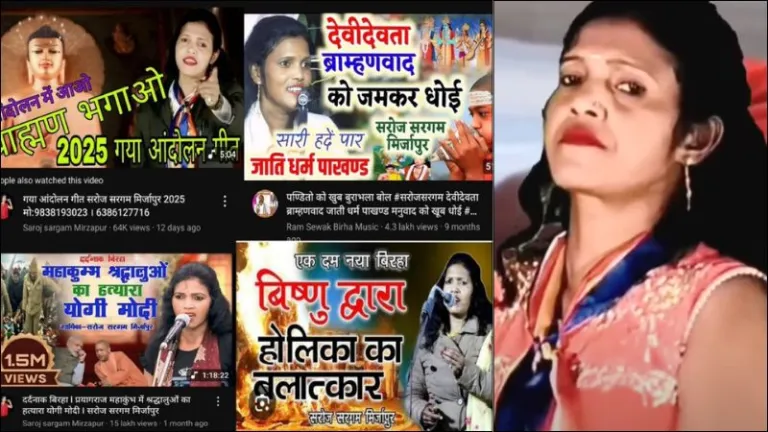
Case Summary
A woman named Saroj Sargam from Mirzapur, who runs a YouTube channel titled Saroj Sargam Mirzapur, repeatedly insulted Hindu gods and goddesses through vulgar and abusive videos, sparking widespread outrage across the Hindu community. She lived in Prayagraj and described her work as creating “surprising content,” but her channel became infamous for spreading offensive songs, hate-filled speech, and obscenity directed at the Hindu faith. In one of her recent videos, Saroj Sargam referred to Maa Durga with degrading words such as prostitute and murderer, provoking anger nationwide. Six FIRs were registered against her, yet police action remained slow, leading Hindus to demand her immediate arrest. Instead of expressing remorse, Saroj Sargam published a letter on her channel, appealing to missionaries and their organisations to support her with resources and money in the face of these FIRs. She openly admitted that she sings what she calls “missionary historical songs” with the aim of awakening society, which in practice translates into systematic abuse of Hindu deities and the Brahmin community. Her videos carried deeply inflammatory titles, including one where she claimed, “Brahmins cut Shiva’s penis,” filled with crude insults against Lord Shiva, Brahmins, and the month of Shrawan. This video alone gathered 190,000 views within a month. In another post titled 'Come to the movement, drive away the Brahmins', she portrayed Brahmins as tyrannical and urged her followers to unite against them. The video was uploaded five months earlier and amassed over 610,000 views, showing how her channel grew rapidly by targeting Hindus. She also uploaded content advocating for “getting rid of Hinduism,” calling gods thieves and robbers, and urging their images to be thrown into the Ganga. Analysis of her channel reveals 40 videos over three years, most of them explicitly directed against Hinduism. Early content attracted little attention, but when she shifted focus to attacking Hindu gods and Brahmins, her viewership surged. With a subscriber base of 62,600, Saroj Sargam monetised hatred against Hindus, openly attacking faith and dignity while mocking the present government. Her repeated invective and public appeals for missionary support further exposed the organised nature of her actions. As anger intensified on social media, Hindu organisations and citizens across Uttar Pradesh demanded her arrest, tagging police and calling on the Yogi government to act swiftly.
Why it is Hate Crime ?
The primary category in this case is: Hate speech against Hindus. The subcategory under this is: Anti-Hindu slurs, mocking faith. Anti-Hindu slurs and the deliberate mocking of the Hindu faith owing to religious animosity involve the usage of derogatory terms, stereotypes, or offensive references to religious practices, symbols, or figures. One of the common anti-Hindu slurs used against Hindus is “cow-worshipper” and “cow piss drinker”. The intention of using this term is to demean and mock Hindus as a group and their religious beliefs since Hindus consider the cow holy. Additionally, some symbols and the slurs attached to them have a historical context that exacerbates the insult, hate, stereotyping, dehumanisation and oppression against Hindus. Cow worship has been used for centuries to denigrate Hindus, insult their faith and oppress Hindus specifically as a religious group. There has been overwhelming documentation about how cow slaughter has been used to persecute Hindus with cow meat being thrown in temples and places of worship. There has also been overwhelming documentation where cow meat (beef) has been force-fed to Hindus to either forcefully convert them to Islam or denigrate their faith. Apart from cow worship, the Swastika – which holds deep religious significance for the Hindus – has also been misinterpreted and distorted to use as a slur against Hindus. Similarly, the worship of the Shivling has been used by supremacist ideologies and religions to denigrate Hindus owing to religious animosity. Such slurs and denigration stem out of inherent animosity and hate towards Hindus and their faith, therefore, it is categorised as hate speech targeted at Hindus specifically owing to their religious identity. The other subcategory selected is: Subversion of scriptures. Subverting the religious scriptures of Hindus has particularly devastating consequences. Subversion of the scriptures of Hindus is often done to justify or promote hatred, discrimination, or violence against specific individuals or groups of Hindus. Religious scriptures are often nuanced and those who harbour religious animosity towards Hindus often misquote or misrepresent the scripture to legitimise their animosity and hate towards the faith and its adherents. Any such misquoting of scriptures or subversion to justify hate, violence and discrimination against Hindus owing to religious animosity is hate speech and is categorised as such. The other subcategory selected is: Anti Hindu subversion and prejudice. Hate speech is defined as any speech, gesture, conduct, writing, or display that is prejudicial against a specific individual and/or group of people, which is leading to or may lead to violence, prejudicial action or hate against that individual and/or group. Media plays a specific and overarching reach in perpetuating prejudicial attitudes towards a community owing to unfair, untrue coverage and/or misrepresentation/misinterpretation, selective coverage and/or omission of facts of/pertaining to issues affecting a specific religious group. This type of bias can dehumanise the victim group, making it easier for others to justify harmful actions against them, which aligns with the objectives of hate speech laws aimed at preventing such harm. It is often observed that the media takes a prejudicial stand against the Hindu community driven by their need to shield the aggressor community which happens to be a numeric minority, however, is the one perpetrating violence against Hindus. For example, the media is often quick to contextualise religiously motivated crimes against Hindus, omit or misrepresent facts that point towards religiously motivated hate crimes, justify and/or downplay religiously motivated hate crimes or simply present fake news to stereotype Hindus. Such media bias leads to the denial of persecution and is often used to dehumanise Hindus, leading to justification for violence against them. For example, the media covered several fake allegations of Hindus targeting Muslims and forcing them to chant Jai Shree Ram. Most of these cases were proved false and fabricated after police investigation. These fake news reports were subsequently never retracted or clarified. Such fake news led to the justification of violence and dehumanisation of Hindus based on the argument that since Hindus targeted Muslims and forced them to chant Jai Shree Ram, the dehumanisation of Hindus and violence against them was par for the course and merely a retaliation. Such media bias leads to prejudicial portrayal of Hindus and offers a justification for violence against them and therefore, is considered hate speech under this category. This case has been added to the tracker because it represents a clear and deliberate instance of hate speech directed at Hindus, not only through vulgar personal expression but as part of a sustained, monetised, and organised pattern of abuse against Hindu faith, its deities, and its adherers. The subcategory “Anti-Hindu slurs, mocking faith” fits precisely here. Her use of derogatory terminology mirrors long-established patterns of hate speech against Hindus, where sacred practices and deities are deliberately debased to strip Hindus of dignity and respect. Just as slurs like “cow piss drinker” have historically been used to humiliate Hindus for venerating the cow, Sargam’s videos employ obscenity and distortion of revered figures like Lord Shiva and Maa Durga to project Hindus as immoral, backward, or contemptible. Such rhetoric is not random—it emerges from deep-seated animosity and functions as a tool of religious humiliation. The hate element is reinforced by her call to action. In videos such as Come to the movement, drive away the Brahmins, she went beyond insults to mobilise her audience against an entire Hindu community, labelling them tyrannical and urging their expulsion. This reflects the classic pattern of hate propaganda, where speech is used to encourage hostility and social division, escalating beyond mockery into an open incitement against Hindus. Saroj Sargam’s repeated videos, vulgar language, and public appeals for support in the face of FIRs exemplify deliberate, organised, and ideologically motivated attacks on Hinduism. By referring to Maa Durga with degrading slurs and calling her a prostitute and murderer, she directly insulted one of the most sacred figures in Hindu worship, creating widespread outrage and fear within the community. Furthermore, her video in which she claims “Brahmins cut Shiva’s penis” constitutes not only an obscene and vulgar attack but also a subversion of Hindu scriptures. This video deliberately misrepresented the sacred narratives associated with Lord Shiva and distorted religious teachings to demean Hindus. Misrepresenting scriptures to degrade deities and religious practices is a direct form of hate speech, as it undermines the spiritual authority and cultural significance of these traditions while encouraging contempt for the faith. In addition to targeting deities, Saroj Sargam explicitly vilified the Brahmin community, portraying them as tyrannical and calling for their expulsion. While caste-specific abuse may appear micro-targeted, in the broader context of anti-Hindu animosity, attacks on Brahmins function as attacks on the Hindu collective identity. Anti-Hindu perpetrators, including those aligned with leftist and Islamist platforms, often weaponise identity politics to target Hindus as a religious group, subsuming caste, region, or linguistic identity beneath the overarching marker of Hindu religiosity. In such frameworks, the hate is not directed at caste distinctions but at the Hindu faith itself, using Brahmins as symbolic representatives of Hinduism. This clearly represents anti-Hindu subversion and prejudice. Historical examples reinforce this pattern, like on May 19, 2020, a Dalit family in Kishanganj, Bihar, was attacked by a local Bhim Army unit for displaying Hindu symbols and worshipping deities, including the desecration of a temple. Similarly, on June 29, 2021, in Saharanpur, Uttar Pradesh, a Hindu named Saurabh Sharma was assaulted by Bhim Army members, who threatened the Brahmin community while inflicting severe physical harm. These incidents demonstrate that hostility towards caste sub-groups like Brahmins is often a surrogate for broader anti-Hindu sentiment, where religious identity remains the primary target. Saroj Sargam’s channel, with 62,600 subscribers and over 40 videos targeting Hinduism, reflects a systematic and monetised strategy of spreading hatred, obscenity, and prejudice against Hindus. Her repeated invective, including calls to “drive away Brahmins” and videos advocating the eradication of Hinduism, aligns with a pattern of anti-Hindu subversion and prejudice, which combines religious denigration, stereotyping, and organised dissemination of offensive content. By portraying Hindu deities as thieves or morally corrupt figures, urging the disposal of sacred images in the Ganga, and using slurs rooted in historical misrepresentation, she amplifies animosity against Hindus, making her actions a textbook example of religiously motivated hate speech. Moreover, the dissemination of such content on a widely accessible digital platform underscores the danger posed by her actions. The combination of vulgarity, misrepresentation of scriptures, and targeting of Brahmins as proxies for Hindu religiosity illustrates a conscious strategy of inciting prejudice, dehumanisation, and animosity towards Hindus. Her work not only offends religious sentiments but also contributes to a cultural environment where hatred against Hindus is normalised and legitimised, further justifying physical and social aggression against the community. In conclusion, Saroj Sargam’s actions represent a multi-layered hate crime against Hindus. By attacking deities such as Maa Durga and Lord Shiva, subverting the scriptures, abusing and targeting the Brahmin community, and amplifying these attacks through a monetised online channel, she has directly assaulted the religious identity and faith of Hindus as a collective. The case illustrates how anti-Hindu actors, often employ caste and regional distinctions as tools while keeping the Hindu religious identity as the principal target. This demonstrates a deliberate strategy to undermine and demean Hinduism and justifies the inclusion of this incident in the Hinduphobia Tracker.


Case Status
Complaint registered


Perpetrators Details
Perpetrators
Others
Perpetrators Range
One Person
Perpetrators Gender
female
 Sources




