Hindu religious festival prohibited in Muslim-majority area; Muslim community puts up signboard banning Garba in Kheda, Gujarat
 Kheda, Gujarat, India
  14 September, 2025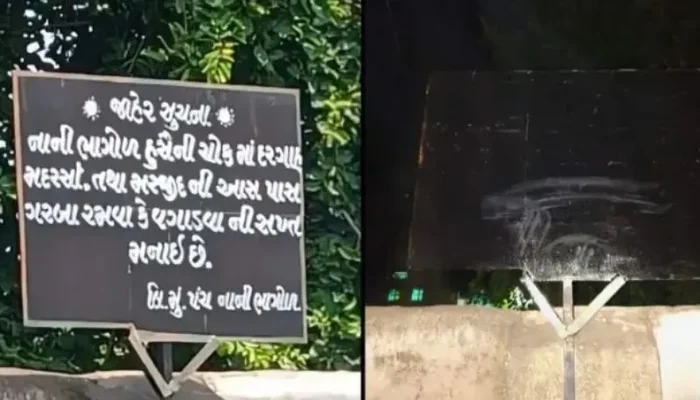
Case Summary
In Nani Bhagol village of Kheda district, Gujarat, communal tensions escalated after members of the Muslim community put up a signboard prohibiting the playing of Garba around a mosque, a dargah and a madrasa. The signboard was installed on the wall of private property at Hussaini Chowk, which is a Muslim-majority locality, by members of the local mosque committee and the Muslim Panch. The board stated that playing Garba or even playing Garba-related music was strictly prohibited near these Muslim religious structures. The incident sparked outrage across social media, as it took place just days before the start of the Navratri festival. As the news of the signboard became viral, local Hindu organisations, including Bajrang Dal, gathered at the spot and began protesting, describing the act as unconstitutional and against the democratic values of the country. They also submitted a written complaint to the Matar police station, stating that such prohibition violated Articles 14, 19, 26, 35, 153, 295 and 505 of the Indian Constitution, which protect religious freedom, equality and cultural practices. They further stated that the restriction went against Gujarati culture, calling it a jihadi mentality, and deeply hurt the religious sentiments of Hindus. After receiving the complaint, the police took immediate action and informed the mosque committee to remove the signboard. However, instead of taking the board down, the committee painted it black, erasing the text. The FIR was registered against two office-bearers of the Muslim Panch, President Ayubkhan Usmankhan Pathan and Vice President Yusufmiya Khokhar, under sections of the Bharatiya Nyaya Sanhita for deliberately outraging religious feelings. The police confirmed that the individuals responsible would be arrested after investigation.
Why it is Hate Crime ?
This case has been added to the tracker under the primary category of - Restriction/ban on Hindu practices. Within it, the tertiary category selected is - Restriction on expression of Hindu identity. An example of the state-affected prejudicial and targeted orders against the Hindu community would be a government denying the right of a Hindu or a group of Hindus to hold a religious procession owing to the animosity of non-Hindu groups. Denial of the religious right of the Hindus to assuage the non-Hindu group which harbours animosity to a point where it could lead to violence against Hindus is not only a failure of law and order but is a prejudicial order against Hindus, denying them their fundamental rights to express their religious identity. An example of a hate crime against Hindus by a non-Hindu would be a non-Hindu institution forcing its Hindu employees to abandon religious symbols that a Hindu would wear as an expression of faith owing to inherent prejudice against the faith professed by the victim or a non-Hindu group of people restricting a Hindu group from constructing a place of worship simply because the demography of the area in which the temple is being built is dominated by non-Hindus. Such actions are driven by religious animosity and/or prejudice against Hindus and their faith and would therefore be categorized as a hate crime. This case has been added to the tracker because members of the Muslim community put up a signboard at Hussaini Chowk prohibiting the playing of Garba or even Garba-related music near a mosque, a dargah and a madrasa. It is important to understand that Garba or the Navratri festival is not merely a cultural event, but it is also a religious and devotional celebration dedicated to Goddess Amba, making it an integral part of Hindu religious practice, especially in Gujarat. By prohibiting Hindu religious events, the perpetrators displayed clear religious intolerance and bigotry. The act conveyed that a Hindu religious festival holds less value and could be restricted simply because it took place in a Muslim-majority area or near Muslim religious structures. This not only reflected deep-seated prejudice but also was an attempt to assert religious dominance and restrict the outward expression of Hindu identity. This act of intimidation directly targeted the religious practices and faith of the Hindu community, aiming to suppress their right to celebrate their religious events in public areas. By restricting Hindus from performing Garba, the perpetrators sought to exclude the community from exercising their fundamental rights, including their right to express their religious beliefs openly. This not only infringed upon the constitutional right to freedom of religion but also sent a broader message of exclusion and intolerance to the wider society. Such actions are discriminatory and indicative of religious hatred. Therefore, this incident is being categorised as a religiously motivated hate crime against Hindus. It must be noted that the signboard was placed in a Muslim-majority area, a zone perceived by Muslim residents as their exclusive stronghold. Such actions are rooted in a mindset of Islamic superiority, where Muslims in Muslim-dominated localities attempt to assert dominance by dictating what Hindus can or cannot do in these areas. The prohibition of a Hindu religious festival in such areas represents the ghettoisation of public spaces, making Hindus feel unwelcome or unsafe. It restricted the outward display of Hindu religious expression and reinforced boundaries of dominance, marginalising Hindus and undermining their right to celebrate and express their faith openly. Such actions are a direct assault on both religious freedom and social harmony, as they create an environment where Hindus are intimidated into avoiding areas marked by Muslim control. Disclaimer: The Hinduphobia Tracker records incidents based on when the incident or provocation occurred. In this case, the report does not provide the exact date when the signboard was installed. Therefore, for documentation purposes, the date of the incident has been recorded as 15 September 2025, when the Hindu organisations became aware of the board and filed a complaint.


Case Status
Complaint registered


Perpetrators Details
Perpetrators
Muslim Extremists
Perpetrators Range
From 2 To 5
Perpetrators Gender
male
 Sources




