Hindu temple attacked, idols desecrated by miscreants in Bangladesh amidst ongoing persecution of Hindus
 Kushtia District, Bangladesh
  13 September, 2025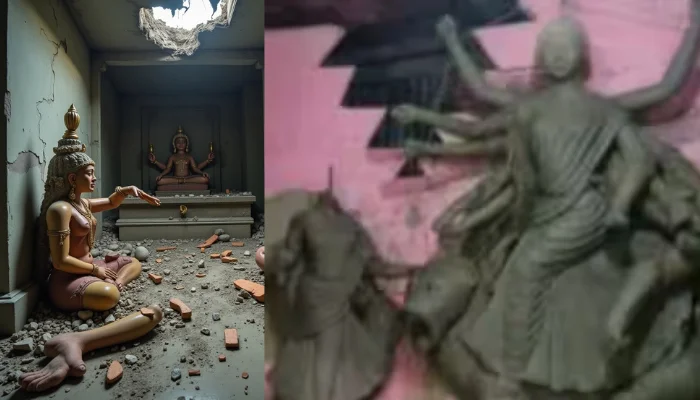
Case Summary
A Hindu temple named Shwarupdah Palpara Sri Sri Rakhha Kali temple in Mirpur upazila of the Kushtia district, Bangladesh, was vandalised by unidentified miscreants. The attackers also desecrated the idols of Hindu deities. According to media reports, this incident occurred just ahead of the Durga Puja celebrations, a Hindu religious festival. The temple committee president, Amaresh Ghosh, said that the miscreants broke the heads and hands of the idols of Lord Kartikeya and Goddess Saraswati. He explained, “At the time of the incident, there was no electricity in the area, and it was raining lightly. Taking advantage of this situation, the idols were vandalised. Even though the temporary tin‑shed temple is guarded daily, the damage was done during the load‑shedding.” The attackers also stole the CCTV camera and memory card from the temple. Badal Kumar Dey, former secretary of the temple committee, said, “For the past three years, we had been organising Durga Puja here. This incident, occurring ahead of Durga Puja, has left us in a state of fear.” Confirming the development, Mominul Islam, officer‑in‑charge of Mirpur Police Station, said, “We immediately reached the spot after receiving the news. A detailed report will be provided after the investigation.” This case serves as a stark reminder of the continued persecution of Hindus in Bangladesh, which has only increased manifold since the fall of Sheikh Hasina’s Awami League government on August 5, 2024. After her violent ouster, Bangladesh plunged into chaos as Islamist extremists took advantage of the political turmoil to unleash a wave of terror and violence against the Hindu community. The Islamist mobs have attacked Hindu homes, burned them to the ground, and abducted women in a horrific descent into anarchy. Several temples have been destroyed in various parts of the Islamic country in a major crackdown on Hindus. Reports have exposed how Muslim students forced around 60 Hindu teachers, professors, and government officials to resign. Exiled Bangladeshi activist Asad Noor has also revealed that the minority Hindu community is now being coerced into joining ‘Jamaat-e-Islami’. Hindu religious events have been repeatedly targeted. On 6th September, a procession carrying Lord Ganesha’s idol was attacked in Chittagong. Ahead of Durga Puja, multiple incidents of idol vandalism occurred, including attacks in Mymensingh, Pabna, Rajshahi, Kishoreganj, and Dhaka. On 29th November, a violent Muslim mob attacked three temples in Patharghata, Chittagong, immediately after Jumma Namaz. The crackdown on Hindu voices has also escalated. On 30th November, Hindu journalist Munni Saha was arrested in Dhaka. Muslim mob attacks have increased in Bangladesh, for example, on 22nd May 2025, a Muslim mob carried out arson attacks selectively on Hindu homes in Dahar Mashihati village in Abhaynagar upazila in Jessore district of Bangladesh. Even ISKCON leader Chinmoy Krishna Das Prabhu and his aides have been targeted, and attempts have been made to ban ISKCON and suppress Hindu protests through sedition charges. These arbitrary actions point to a systematic pattern of persecution under Muhammad Yunus’s interim government.
Why it is Hate Crime ?
This case has been added to the tracker under the primary category, which is- Attack on Hindu religious representations. Within this, the subcategory selected is- Desecration of Hindu religious symbols. Icons and symbols or a religious representation of a spiritual ideal are widely revered in Hinduism. Iconography is of vital significance in the Hindu milieu. It helps connect people’s spiritual beliefs with the real world. Iconography within the Hindu faith takes several shapes and forms. Murtis are of most significance to Hindus, to which daily rituals, prayers and offerings are done. Besides the murtis, there are several other symbols which have deep significance in the Hindu faith – the Om and Swastika for example. Since these Hindu religious symbols hold paramount importance in Hinduism, any desecration of symbols, icons, murtis, religious representations and manifestations, is driven by animosity towards the faith itself which manifests itself through these murtis, icons and symbols. Therefore, any desecration of these Hindu religious symbols and representations is considered religiously motivated hate crimes under this category. The other subcategory selected is- Attack on Temples. In Hinduism, a temple is the abode of the Deity. The Deity in the Temple is consecrated, thereby, making it a real, breathing entity. Hindus believe that not just the Deity but the temple premises itself are sacred to Hindus since Hindus hold the faith that the entire Temple space is an amalgamation of the divine energy of the deity. Given the central significance of Temples in Hindu Dharma, any attack against a Hindu Temple or its peripheral premises is an attack on the faith itself and is born out of animosity towards the faith, of which, the Temple is a central tenet. Any manner of attack against a Temple and/or its premises would therefore be considered a religiously motivated hate crime. The removal of Sheikh Hasina from power in Bangladesh on August 5, 2024, escalated the persecution and marginalisation of the Hindu minority in the predominantly Islamic nation, intensifying what can be described as a silent genocide. Since her exile, Muslim radicals have carried out unchecked atrocities against Hindus, including physical violence, the destruction of temples and religious symbols, and the systematic displacement of Hindus from their ancestral lands. Hundreds of attacks on Hindu temples, shops, and businesses have been recorded following Sheikh Hasina's removal as Prime Minister. Many Hindus have been brutally murdered or injured in Muslim mob attacks. Amidst this, reports emerged of a Kali temple being attacked and the temple idols being desecrated by miscreants. This case was added to the tracker as the perpetrators targeted a Hindu temple—an institution of immense religious and spiritual importance in the Hindu faith. Temples are not merely physical structures; they are sanctified spaces believed to embody the divine presence of Hindu deities. Acts of violence against such spaces are not isolated incidents of destruction but reflect underlying hostility towards Hindu beliefs and identity. The attack also involved the deliberate desecration of Hindu religious symbols. The idols of Goddess Saraswati and Lord Kartikeya were desecrated by the perpetrators. In Hinduism, deities’ idols are not simply artistic representations; they are revered manifestations of the divine. Their destruction is therefore a direct assault on the religious sentiments of Hindus and a profound act of disrespect. Such acts of desecration are a result of deep-seated animosity towards Hinduism and the Hindu community, making it a religiously motivated crime. The timing of this crime further exposes its malicious intent. The desecration takes place just ahead of Durga Puja, one of the most revered and widely celebrated festivals among Hindus. Durga Puja commemorates the victory of Goddess Durga over the demon Mahishasura, symbolising the triumph of good over evil, and is observed with great devotion and preparation by millions of Hindus. By targeting and desecrating the idols of Goddess Saraswati and Lord Kartikeya, who are worshipped alongside Goddess Durga shortly before this holy festival, the perpetrators seek to disrupt religious celebrations, cause distress within the Hindu community, and openly display their hostility. The timing is not coincidental but a deliberate attempt to wound Hindu religious practices and sentiments at their most sacred moment. As this assault was directed at sacred idols and a consecrated Hindu place of worship, it is a religiously motivated hate crime against the Hindu community. In this case, although the perpetrators remained unknown, the act itself stemmed from hatred towards Hinduism. For this reason, the case is being categorised under the hate crime database.


Case Status
Complaint filed


Perpetrators Details
Perpetrators
Unknown
Perpetrators Range
Unknown
Perpetrators Gender
unknown
 Sources




