Hindu man lured and deceived into converting to Christianity, says more than 450 Hindu villagers were targeted thorugh inducements and denigration of Hinduism
 Ganganagar, Rajasthan, India
  16 September, 2014
Case Summary
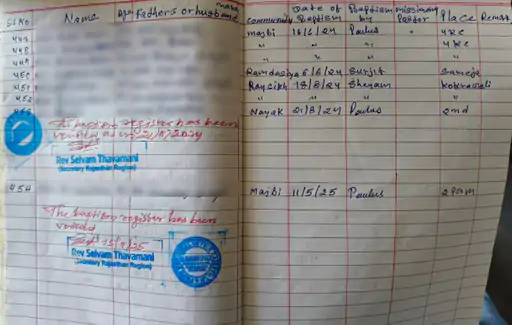
A Hindu man named Sandeep (23) filed a complaint with the Anupgarh police, stating that he had been coerced into converting from Hinduism to Christianity. The incident occurred in Ward No. 14 of the Anupgarh police station area, Rajasthan. A case was registered under the supervision of Station House Officer (SHO) Ishwar Jangid, following which two accused, Pastor Paulus (Polash) Barjo (47) and Aryan, were detained. According to the complaint, Sandeep came into contact with Aryan, a bike spare parts shop owner near Anupgarh railway station, and his father Vinod Kumar, both of whom are named in the FIR. During a routine visit to their shop a month prior, the father-son duo lured Sandeep with promises of marriage and subsequently introduced him to Pastor Barjo, the area-in-charge of the Friends Missionary Prayer Band (FMPB) in Anupgarh. Approximately 20 days before filing the complaint, Barjo reportedly told Sandeep that conversion to Christianity would please God and secure him a marriage partner. He then led Sandeep to a canal in Prem Nagar, where he was compelled to undergo a ritual immersion, symbolising conversion to Christianity. After the conversion, Sandeep stated that he was subjected to sustained psychological harassment and was pressured by the accused to recruit additional Hindus into Christianity. When the coercion escalated, he approached the police and also informed representatives of the Vishwa Hindu Parishad (VHP). During interrogation, Pastor Barjo revealed that he had converted 454 Hindus between 2008 and 2025. Registers containing the details of converted individuals were recovered from his residence. Barjo disclosed that he had converted to Christianity in 1995 in his native village of Katingale, Jharkhand, along with his elder brother. In 2003, he formally joined the FMPB in Chennai after completing an interview and a year-long training in Jhansi. He was subsequently deployed to Rajasthan, initially stationed in Sikar district, later in Anupgarh (2008–2016), and again after his return in 2022. At the time of his arrest, he was residing in the home of co-accused Vinod Kumar. Barjo further revealed that the FMPB assigns its workers a fixed annual target of 20 conversions, in return for which they are provided with a monthly salary of 9,000 rupees, allowances, and financial support for rent, food, travel, and children’s education. He admitted that his methods focused on visiting poor, vulnerable Hindu families, where he used promises, inducements, and psychological persuasion to encourage conversion. Along with his local associates, including Shyamlal and Surjeet, Barjo had established a network of facilitators across Anupgarh and nearby villages, many of whom had themselves previously undergone conversion. The investigation also uncovered that large swathes of land had been purchased for the construction of a church. Vinod Kumar reportedly donated 3.5 lakh rupees toward this project, and public donations were being sought for further development. The case provoked a strong reaction from Hindu organisations. VHP District Secretary Krishna Rao stated that Barjo and his associates were systematically converting Hindus and even used derogatory language against Hindu deities. The VHP staged protests and demanded stringent legal action, stating that they would not tolerate such activities. At the time of writing the report, police confirmed that the investigation was ongoing, with efforts to identify and reach out to other victims who may have been entrapped in the conversion network. The case drew state-level attention, highlighting organised patterns of proselytisation, financial inducement, and religious coercion targeting Hindus in vulnerable socio-economic positions.
Case Images
Why it is Hate Crime ?
This incident has been added under the primary category- Predatory proselytisation. Under this, the first subcategory selected is- Conversion/ attempts to convert by inducement. Predatory Proselytisation is not just limited to threat, harassment, force and violence, but it also has contours of stealth. In several cases, the Hindu victim is exploited to convert, with non-Hindus taking advantage of their poverty. In such cases, the Hindu victim who is suffering financially is offered monetary benefits, including lucrative offers for jobs, health treatment, education, etc, to induce the victim into changing his/her religion. In such cases, the religious identity of the victim and the aim to disenfranchise him from his faith form the heart of the crime. Also, taking advantage of and exploiting an individual’s economic vulnerabilities is widely acknowledged as exploitation, forms of which are often penalised by law. Such cases therefore are considered religiously motivated hate crimes since the victim’s religious identity forms the very heart of the crime itself. The second subcategory relevant here is- Proselytisation by grooming, brainwashing, manipulation or subtle indoctrination, and within this, the tertiary category selected is- Pattern of targeting Hindus. Religious brainwashing essentially means the often subtle and forcible indoctrination to induce someone to give up their religious beliefs to accept contrasting regimented ideas. Religious grooming or brainwashing also involves propaganda and manipulation. It involves the systematic effort, driven by religious malice and indoctrination, to persuade “non-believers’ to accept allegiance, command, or doctrine to and of a contrasting faith. Cases of such grooming or brainwashing are far more nuanced than direct threats, coercion, inducement and violence. In such cases, it is often seen that there is repeated, subtle and continual manipulation of the victim to induce disaffection towards their own faith and acceptance of the contrasting faith of the perpetrator. While subtle indoctrination is widely acknowledged as predatory, an element which is often understated in such conversions or the attempts of such conversion is the role of loyalty and trust which might develop between the perpetrator and the victim. Fiduciary relationships are often abused to affect such religious conversion. For example, an educator transmitting religious doctrine of a competing faith to a Hindu student. The Hindu student is likely to accept what the teacher is transmitting owing to existence of the fiduciary relationship. The exploitation of the fiduciary relationship to religiously indoctrinate victims would also be included in this category. Since the underlying animosity towards the victim’s faith forms the basis of predatory proselytization, such cases are considered religiously motivated hate crimes. The third subcategory selected is- Attempting to convert/converting by denigrating Hinduism. In several cases, Hindus are converted or an attempt is made to convert Hindus by denigrating their faith, Hinduism. In such cases, the Hindus associate with the non-Hindu perpetrators often by choice and then, the attempt to convert them by insulting their faith, showing the faith down etc begins. An example of this would be a non-Hindu gathering where the Hindus are attending the gathering of their own free will. However, once they attend the gathering, there is an explicit attempt to convert them by abusing their faith and hailing the faith of the perpetrator. The denigration of the Hindu faith is often based on misrepresentation of the Hindu faith, its doctrine and scriptures and insult to espoused traditions if not blatant lies about Hindu beliefs and ways. Such conversions or attempts at conversions are driven by animosity towards the Hindu faith and are therefore documented as religiously motivated hate crimes. The Anupgarh case represents a clear instance of predatory proselytisation that qualifies as a hate crime targeting Hindus for their religious identity. Hate crimes are not limited to physical attacks but also include systematic efforts to exploit vulnerabilities, undermine a community’s beliefs, and erode its cultural continuity. Here, the conversion activity was not incidental but institutional, carried out under the Friends Missionary Prayer Band (FMPB) with defined annual targets, salaries, and allowances provided to Pastor Paulus (Polash) Barjo in exchange for conversions. This demonstrates an organized strategy of targeting Hindus exclusively, revealing deliberate religious animosity and hostility. Conversion was achieved primarily through inducements. Sandeep, the complainant, was lured with promises of marriage, personal fulfillment, and divine favor if he abandoned Hinduism for Christianity. Such tactics, combined with financial incentives offered to the missionaries, show coercive exploitation of personal and social vulnerabilities rather than genuine religious choice. At the same time, Hindu organizations reported that the accused used derogatory language toward Hindu deities, which demonstrates denigration of Hinduism as part of the conversion process. This combination of inducement and religious insult underscores that the effort was not about spiritual transformation but about weakening Hindu faith and identity. The methods also reveal subtle indoctrination and brainwashing. Barjo and his associates repeatedly targeted poor and destitute Hindu families, visiting them regularly, applying psychological pressure, and convincing them that conversion would solve their problems. After Sandeep’s forced ritual immersion, he was pressured to act as a recruiter for further conversions, showing how victims were manipulated into perpetuating the cycle. This coercive indoctrination and psychological manipulation form a key feature of brainwashing techniques. Taken together, the case shows that this was not an act of free will but a systematic, incentive-driven, and coercive campaign directed at Hindus. It used inducements, denigration of Hinduism, and brainwashing to dismantle the faith of vulnerable individuals. By explicitly targeting Hindus and attempting to replace their religion with another, the case constitutes a hate crime rooted in Hinduphobia and warrants inclusion in the Hinduphobia Tracker. Disclaimer: Although the case was reported in September 2025, the Hinduphobia Tracker records incidents based on when the conversion activity first began rather than when it was formally reported. Since the organised conversion network in this case has been active for the past 14 years, the date of the incident has been recorded as 17 September 2014.
Victim Details
Total Victim
455
Deceased
0
Gender
- Male 0
- Female 0
- Third Gender 0
- Unknown 455
Caste
- SC/ST 0
- OBC 0
- General 0
- Unknown 455
Age Group
- Minor 0
- Adult 0
- Senior Citizen 0
- Unknown 455


Case Status
Case sub-judice


Perpetrators Details
Perpetrators
Christian Extremists
Perpetrators Range
From 2 To 5
Perpetrators Gender
male
 Sources




