Hindu women and children lured to convert to Islam by offering money, clothes, and ration supplies
 Bharatpur, Rajasthan, India
  13 September, 2025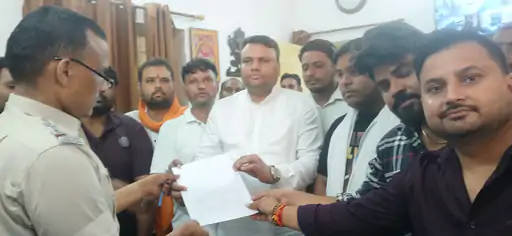
Case Summary
Women and children in Koli Mohalla of Subhash Nagar Colony, Bharatpur, Rajasthan, were targeted for illegal religious conversion on September 14, 2025. At the house of Munni Devi, wife of the late Bhagwat Koli, individuals attempted to convert Hindu women and minors by offering money, clothes, and ration supplies. Members of the Vishwa Hindu Parishad (VHP) and Bajrang Dal arrived at the spot after receiving information and prevented the conversion activity. A Bible and bottles of ‘Holy Water’ were seized, while one person fled with an unknown bag. Following the intervention, VHP district president Vishnu Saini, Bajrang Dal district convenor Shubham Sainthara, and co-convenors Keshav and Navneet lodged a written complaint at Kotwali police station. Based on the complaint, the police arrested Hari Om Koli, aged 25, son of Uday Chand, and Yogesh Koli, aged 21, son of Laxman Singh, both residents of Bakery Wali Gali, Mathura Gate. The two admitted that they were conducting prayers. The case remained under investigation. The incident occurred shortly after Rajasthan’s new anti-conversion law came into force on 9 September 2025. The legislation prohibits religious conversion and stipulates imprisonment ranging from 7 to 14 years, with up to 20 years of imprisonment if the victim is a woman, minor, Scheduled Caste, Scheduled Tribe, or disabled person.
Why it is Hate Crime ?
The primary category in this case is: Predatory proselytisation. The subcategory under this is: Conversion/ attempts to convert by inducement. Predatory Proselytisation is not just limited to threat, harassment, force and violence, but it also has contours of stealth. In several cases, the Hindu victim is exploited to convert, with non-Hindus taking advantage of their poverty. In such cases, the Hindu victim who is suffering financially is offered monetary benefits, including lucrative offers for jobs, health treatment, education, etc, to induce the victim into changing his/her religion. In such cases, the religious identity of the victim and the aim to disenfranchise him from his faith form the heart of the crime. Also, taking advantage of and exploiting an individual’s economic vulnerabilities is widely acknowledged as exploitation, forms of which are often penalised by law. Such cases, therefore, are considered religiously motivated hate crimes since the victim’s religious identity forms the very heart of the crime itself. The other subcategory relevant here is- Proselytisation by grooming, brainwashing, manipulation or subtle indoctrination, and within this, the tertiary category selected is- Conversion of minor. Religious brainwashing essentially means the often subtle and forcible indoctrination to induce someone to give up their religious beliefs to accept contrasting regimented ideas. Religious grooming or brainwashing also involves propaganda and manipulation. It involves the systematic effort, driven by religious malice and indoctrination, to persuade “non-believers’ to accept allegiance, command, or doctrine to and of a contrasting faith. Cases of such grooming or brainwashing are far more nuanced than direct threats, coercion, inducement and violence. In such cases, it is often seen that there is repeated, subtle and continual manipulation of the victim to induce disaffection towards their own faith and acceptance of the contrasting faith of the perpetrator. While subtle indoctrination is widely acknowledged as predatory, an element which is often understated in such conversions or the attempts of such conversion is the role of loyalty and trust which might develop between the perpetrator and the victim. Fiduciary relationships are often abused to affect such religious conversion. For example, an educator transmitting religious doctrine of a competing faith to a Hindu student. The Hindu student is likely to accept what the teacher is transmitting owing to existence of the fiduciary relationship. The exploitation of the fiduciary relationship to religiously indoctrinate victims would also be included in this category. Since the underlying animosity towards the victim’s faith forms the basis of predatory proselytization, such cases are considered religiously motivated hate crimes. This case has been added to the tracker because it represents a clear example of predatory proselytisation, carried out through inducement and economic exploitation. In Bharatpur, the women and children of a Hindu household were approached with the promise of money, clothing, and ration supplies, all offered as incentives to abandon their faith and adopt another. Such inducements were not incidental acts of charity, but deliberate instruments designed to manipulate individuals facing economic vulnerability. By presenting these material benefits as conditional upon religious conversion, the perpetrators sought to dismantle the victims’ agency and override their genuine consent. Another point to highlight in this case is that the victims are also minors. Hence, it negates any genuine element of consent or voluntary change of faith from the outset. Children, due to their ongoing emotional and cognitive development, are especially susceptible to manipulation and indoctrination, making them easy targets for those seeking to exploit religious or social vulnerabilities. When such acts are perpetrated against minors of a specific faith, in this case, Hindus, using abduction and coercion tactics, then they are clear instances of hate crimes and clear violations of both human rights and child protection norms. Consent obtained through such inducement cannot be regarded as legitimate. When a woman or a child is compelled to consider changing religion in order to access food or financial support, the choice no longer arises from conviction but from necessity. It strips the individual of free will by placing survival against belief. The crime here lies not merely in the offering of material benefits but in the calculated targeting of a Hindu family’s vulnerabilities to alter their religious identity. This calculated effort to fracture their faith underlines why the case is recorded as a hate crime. It demonstrates how predatory proselytisation undermines religious freedom by turning economic hardship into a tool for coerced conversion, where the victim’s Hindu identity itself becomes the point of attack.


Case Status
Arrested


Perpetrators Details
Perpetrators
Christian Extremists
Perpetrators Range
From 2 To 5
Perpetrators Gender
male
 Sources




