Hindu man targeted and threatened by Muslims for hoisting saffron flag, later harassed and assaulted by police
 Durg, Chhattisgarh, India
  2 September, 2025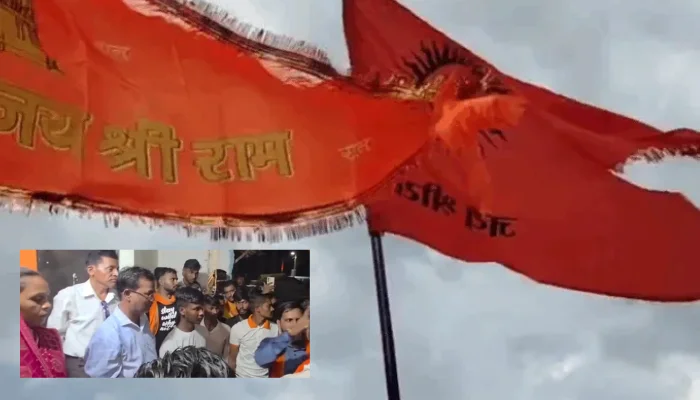
Case Summary
In Durg, Chhattisgarh, a controversy erupted in which a Hindu man named Kaushal Nishad was targeted and threatened by a Muslim man named Aslam Khan and his accomplice. The victim was threatened for hoisting a saffron flag depicting Lord Ram at his own house. Following this, police officers also harassed, assaulted, and targeted the victim at the behest of the Muslim accused. According to media reports, on the day of Eid‑e‑Milad, Aslam Khan objected to Kaushal Nishad hoisting the saffron flag. Following this, the Muslim accused informed the police and objected to the flag being raised. Two police officers, head constable Mahesh Devangan and constable Ramkrishna Das, intervened and stopped the Hindu victim from hoisting the flag. Following this, Kaushal was abused and beaten by the police. The victim’s wife, Neha Nishad, stated that Aslam Khan had threatened to murder both her husband and her during the confrontation. The incident created an atmosphere of tension in the village. Following this, Bharatiya Janata Yuva Morcha (BJYM) state president Rahul Tikaria reached Machandur village and hoisted the saffron flag again at Kaushal Nishad’s house with due rituals. Workers of BJYM also recited the Hanuman Chalisa in front of the house. A video showing the police misbehaving with Kaushal circulated widely on social media, attracting increasing attention. As the controversy grew, the Durg Police Administration became alert. Taking cognisance of the matter, Durg SP Vijay Agarwal took action against the two policemen involved in the dispute, while a heavy police force was deployed in the area to prevent further incidents. Tight security was arranged around Machandur village, and police monitored all activities. Reacting to the incident, BJYM president Rahul Tikaria said that on the day of Anant Chaturdashi, Army Jawan Kaushal Nishad was hoisting the saffron flag at his home, but was beaten and abused by the police. He described the act as unacceptable. He added that on the instructions of Home Minister Vijay Sharma, the flag had been reinstalled and reiterated that BJYM would stand firmly against anyone who insulted the Hindu flag and traditions. Army Jawan Kaushal Nishad said that policemen attempted to forcibly take him to the police station and even threatened that he would lose his job. The administration reinforced security measures to maintain peace, and the situation was brought under control. Following this, an FIR was registered against Aslam Khan, his accomplice and the two police officers under various sections of the BNS.
Why it is Hate Crime ?
The primary category selected in this case is- Attack not resulting in death. Within this, the subcategory selected is- Attacked for Hindu identity. In several cases, Hindus are attacked merely for their Hindu identity without any perceived provocation. A classic example of this category of religiously motivated hate crime is a murder in 2016. 7 ISIS terrorists were convicted for shooting a school principal in Kanpur because they got ‘triggered’ seeing the Kalava on his wrist and tilak that he had put. In this, the Hindu victim had offered no provocation except for his Hindu religious identity. The motivation for the murder was purely religious, driven by religious supremacy. Such cases where Hindus are targeted merely for their religious identity would be documented as a hate crime under this category. Another primary category is- Restriction/ban on Hindu religious practices. The subcategory selected is- Restriction on expression of Hindu identity. An example of the state-affected prejudicial and targeted orders against the Hindu community would be a government denying the right of a Hindu or a group of Hindus to hold a religious procession owing to the animosity of non-Hindu groups. Denial of the religious right of the Hindus to assuage the non-Hindu group which harbours animosity to a point where it could lead to violence against Hindus is not only a failure of law and order but is a prejudicial order against Hindus, denying them their fundamental rights to express their religious identity. An example of a hate crime against Hindus by a non-Hindu would be a non-Hindu institution forcing its Hindu employees to abandon religious symbols that a Hindu would wear as an expression of faith owing to inherent prejudice against the faith professed by the victim or a non-Hindu group of people restricting a Hindu group from constructing a place of worship simply because the demography of the area in which the temple is being built is dominated by non-Hindus. Such actions are driven by religious animosity and/or prejudice against Hindus and their faith and would therefore be categorized as a hate crime. Another primary category selected is- Hate Speech against Hindus. The subcategory selected is- Violent Threats. Violent threats, explicit, implicit or implied, is the most dangerous form of hate speech since it goes beyond discriminatory and prejudicial language to express the intent of causing harm to an individual or a group of people based on their religious identity and faith. There could be several different kinds of threats that are issued to Hindus based on religious animosity. An explicit threat would mean the direct threat of violence towards an individual Hindu, a group of Hindus or Hindus at large. Physical violence, death threats, threats of destruction of property belonging to Hindus and threats of genocide would mean explicit threats against Hindus for their religious identity. Implicit threats may not be a direct threat but implied through the use of symbols of actions – for example – in the Nupur Sharma case, other than explicit threats, there were also implicit threats when Islamists took to the streets to burn and beat her effigies. It implies that they want to do the same to Nupur Sharma – thereby is considered an implicit threat. Violent threats can be delivered in person, through letters, phone calls, graffiti, or increasingly through social media and other online platforms. It would be important to understand that a threat – explicit or implicit, online or offline – to an individual who happens to be a Hindu does not qualify as a religiously motivated threat. Such a threat, while vile and dangerous, could be owing to non-religious reasons and/or personal animosity. To qualify as a religiously motivated threat, it would need to exhibit an indication that the individual is being targeted for religious reasons and/or owing to his/her religious identity as a Hindu. This case was a hate crime against a Hindu man because he was specifically targeted, threatened, and assaulted for his religious identity. The only reason the Muslim accused confronted the Hindu victim, Kaushal Nishad, was because he had hoisted a saffron flag with the depiction of Lord Ram at his house, a clear expression of his Hindu faith. By objecting to this symbol, the accused singled him out directly on the grounds of religion. The act itself demonstrated religious animosity and hostility towards Hindu identity and its symbols. The accused did not stop merely at objecting. He went further by informing the police in order to maximise pressure, harassment, and intimidation against Kaushal for displaying his religious flag. This escalation highlighted a deeper intent to suppress the victim’s freedom of religious expression and to punish him for displaying a Hindu identity. By pressing the police to act against the victim for the peaceful act of raising a saffron flag, the perpetrator revealed a deliberate expression of animosity against the Hindu faith and practices. This was not simply a personal quarrel but a premeditated attempt to silence an expression of Hindu belief. The arrival and intervention of the police, who harassed, abused, and physically assaulted Kaushal, further restricted his ability to express his religious identity. The fact that both the Muslim accused and the police acted in tandem to suppress the hoisting of the saffron flag showed layered opposition to the public expression of Hindu faith. The demand that the victim remove his flag—an emblem of his religion—was nothing less than an attempt to erase his expression of identity under the weight of intimidation. The involvement of the state machinery under pressure from the Muslim accused amplified the religious animosity faced by the Hindu victim. The victim’s wife, Neha Nishad, also stated that the Muslim accused, Aslam Khan, had threatened to kill her husband and herself for hoisting the saffron flag. This extended threat against the entire family emphasised that the hostility was anchored not in any dispute of law but because of their Hindu identity and their determination to honour a Hindu religious symbol. Such intimidation further underscored the existence of religiously motivated animosity. Finally, the fact that the victim was physically assaulted, abused, and threatened by the police at the behest of the Muslim accused confirmed the depth of targeted hostility against him for his Hindu faith. When viewed in totality, these actions—religious objection, misuse of police intervention, physical assault, threats to life, and efforts to silence religious identity—were rooted in religious animosity. Therefore, this incident qualified as a hate crime against a Hindu man for his faith and expression of belief. Given that this case meets the parameters of a religiously motivated crime, it is being added to the hate crime database. Disclaimer: Although in this case both the police and the Muslim accused acted as perpetrators, for purposes of documentation in the Hinduphobia Tracker, the perpetrators are recorded as Muslim extremists. This is because they first raised objections to the Hindu flag, and it was their actions which triggered police intervention and subsequent targeting and assault of the Hindu victim. Given that, along with Kaushal, even his wife was issued death threats by the Muslim accused, we are keeping the victim count as '2'.
Victim Details
Total Victim
2
Deceased
0
Gender
- Male 1
- Female 1
- Third Gender 0
- Unknown 0
Caste
- SC/ST 0
- OBC 0
- General 0
- Unknown 2
Age Group
- Minor 0
- Adult 2
- Senior Citizen 0
- Unknown 0


Case Status
Complaint registered


Perpetrators Details
Perpetrators
Muslim Extremists
Perpetrators Range
From 2 To 5
Perpetrators Gender
male
 Sources




