Anti-Hindu fake news: Leftist media portal claims Muslim man attacked for refusing to chant ‘Jai Shri Ram’, police label it misleading
 Bankura, West Bengal, India
  7 September, 2025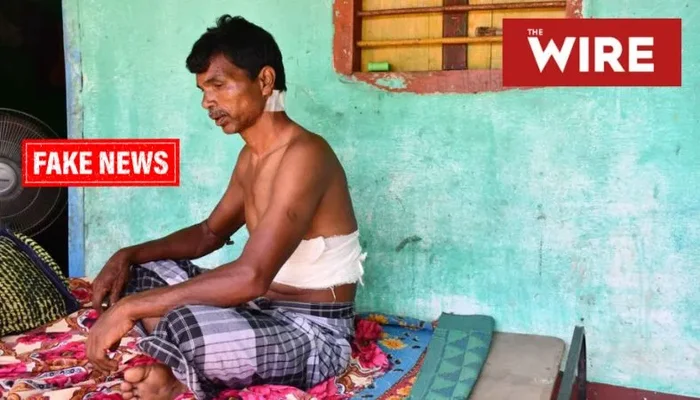
Case Summary
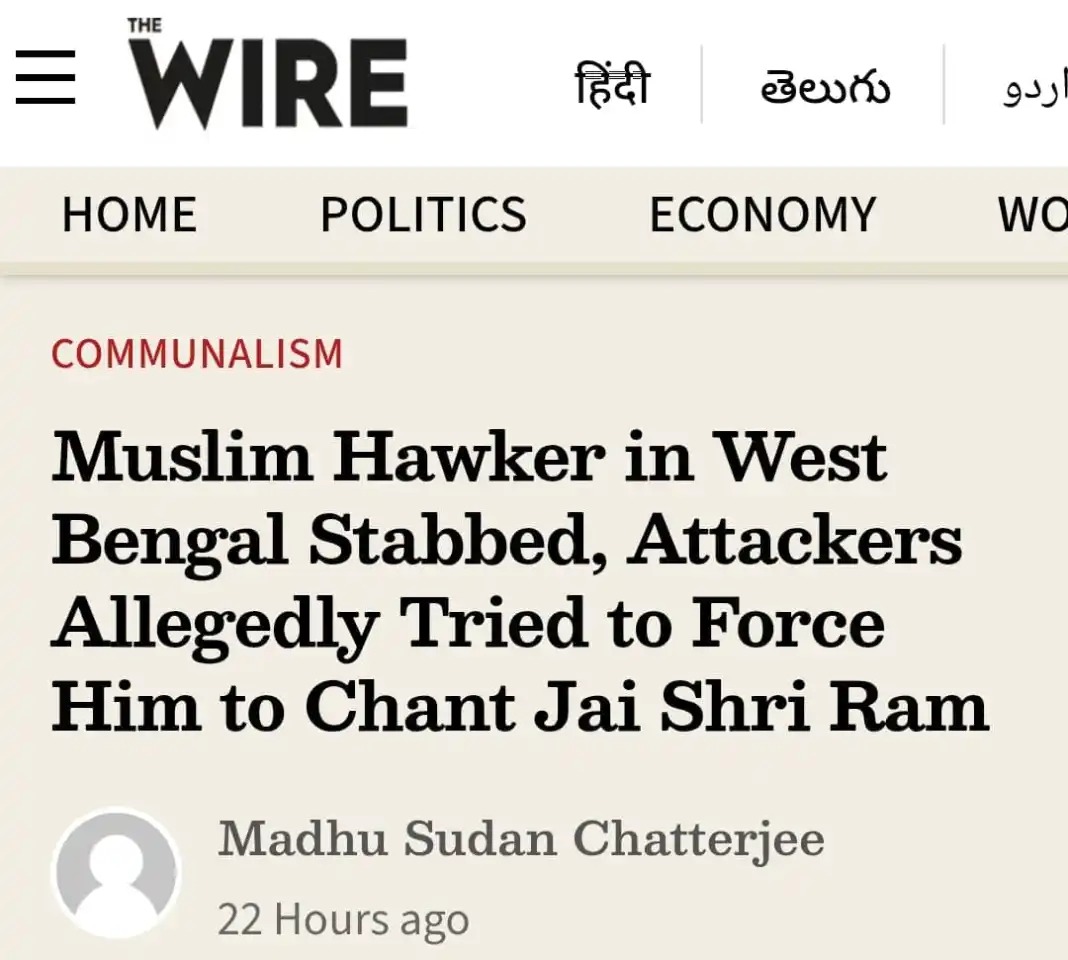
A deliberate anti-Hindu fake news story was circulated by a leftist media outlet, The Wire, which claimed that a Muslim hawker in Bankura, West Bengal, had been forced to chant ‘Jai Shri Ram’ during an assault. On 6th September in Bankura district of West Bengal, a Muslim hawker named Maimur Ali Mandal was attacked with a knife after refusing to give Rs 200 to a drug addict who confronted him. The attacker stabbed the Muslim hawker in the neck and stomach when he refused to hand over the money. The Wire subsequently published a report on 8th September portraying the incident as communal, claiming that the Muslim hawker was forced to chant ‘Jai Shri Ram’ and when he refused, he was stabbed. The media outlet also claimed, “Mandal says that the accused (attacked) also hurled abusive remarks targeting his community.” The Wire overemphasised the religious identity of the victim to falsely portray the incident as communal. The report, in an effort to support the Trinamool Congress Party in West Bengal, framed the incident as part of a rising Hindutva threat in West Bengal ahead of the elections. This false narrative was designed to malign the Hindu religious slogan and portray the BJP as poisoning the atmosphere. However, the Bankura police investigated the matter and confirmed that there was no communal angle, calling such claims factually incorrect and misleading. They stated that the incident was criminal in nature, not religious, and that allegations that the Muslim hawker Mandal was forced to chant ‘Jai Shri Ram’ were unsubstantiated. The attacker was arrested within an hour and taken into custody. Despite the police clarification, The Wire continued to circulate its narrative, spreading misinformation and defaming Hindu religious expression.
Case Images
Why it is Hate Crime ?
This case has been added to the tracker under the primary category- Hate speech against Hindus. Within this, the sub-category selected is- Anti-Hindu subversion and prejudice. Under this, the tertiary category selected is - Anti-Hindu fake news or downplaying. Hate speech is defined as any speech, gesture, conduct, writing, or display that is prejudicial against a specific individual and/or group of people, which is leading to or may lead to violence, prejudicial action or hate against that individual and/or group. Media plays a specific and overarching reach in perpetuating prejudicial attitudes towards a community owing to unfair, untrue coverage and/or misrepresentation/misinterpretation, selective coverage and/or omission of facts of/pertaining to issues affecting a specific religious group. This type of bias can dehumanise the victim group, making it easier for others to justify harmful actions against them, which aligns with the objectives of hate speech laws aimed at preventing such harm. It is often observed that the media takes a prejudicial stand against the Hindu community driven by their need to shield the aggressor community which happens to be a numeric minority, however, is the one perpetrating violence against Hindus. For example, the media is often quick to contextualise religiously motivated crimes against Hindus, omit or misrepresent facts that point towards religiously motivated hate crimes, justify and/or downplay religiously motivated hate crimes or simply present fake news to stereotype Hindus. Such media bias leads to the denial of persecution and is often used to dehumanise Hindus, leading to justification for violence against them. For example, the media covered several fake allegations of Hindus targeting Muslims and forcing them to chant Jai Shree Ram. Most of these cases were proved false and fabricated after police investigation. These fake news reports were subsequently never retracted or clarified. Such fake news led to the justification of violence and dehumanisation of Hindus based on the argument that since Hindus targeted Muslims and forced them to chant Jai Shree Ram, the dehumanisation of Hindus and violence against them was par for the course and merely a retaliation. Such media bias leads to prejudicial portrayal of Hindus and offers a justification for violence against them and therefore, is considered hate speech under this category. This case has been added to the tracker because leftist media outlet The Wire deliberately spread a false and harmful narrative against the Hindu community and their sacred religious slogans of ‘Jai Shri Ram’. They falsely claimed that a Muslim hawker was attacked and forced to chant the slogan ‘Jai Shri Ram’, after which he was stabbed by the attacker. Through such misrepresentation, The Wire attempted to portray Hindus as violent aggressors and the slogan itself as a tool of intimidation, despite the clear statements by the police denying the incident as communal. Such a deliberate attempt to communalise a purely criminal incident, in which a drug addict attacked the victim, reflects deep animosity towards Hindus and malicious intent to tarnish their identity. Such deliberate misreporting goes beyond mere journalistic negligence. It constitutes hate-driven defamation rooted in jealousy, prejudice, and animosity towards Hindus. For Hindus, ‘Jai Shri Ram’ is an expression of faith and devotion, yet in this fabricated report, it was weaponised and presented as a tool of intimidation and violence. This amounts to religious defamation, where a sacred chant was reduced to an expression of Hindu aggression, which can lead to hostility and violence against the Hindu community. By overemphasising the religious identities of the victim and the accused, they subtly claimed the incident to be an act of communal violence. The Wire not only maligned a religious expression but also provoked suspicion, anger, and mistrust against ordinary Hindus who use such slogans. This case cannot be dismissed as a mere isolated instance of journalistic lapse. It reflects a broader trend in which left-leaning media outlets consistently amplify unverified narratives that cast Muslims as perpetual victims while portraying Hindus as aggressors. The repeated circulation of such fabrications demonstrates a clear intent to shape public perception in a manner that vilifies Hindus. These were not accidental errors, but deliberate elements of a disinformation campaign designed to present the Hindu community in a negative light. Such actions are a result of deep-seated animosity towards the Hindu community, making it a religiously motivated crime. Instead of presenting the truth, that the attack was criminal in nature and committed in a drug-induced rage, without any communal motive, The Wire deliberately overemphasised the religious identities and shifted the focus to communal hatred. Instead of focusing on the reality, where a man was attacked by a drug addict, The Wire chose to fabricate a Hindu angle while ignoring the verified facts and police statements. Stories like these do not just spread misinformation; they create stereotypes that make it easier to excuse hatred and discrimination against Hindus. The intention behind such irresponsible reporting could only have been to provoke Hindus and display contempt toward their faith. This incident reflects a broader pattern of deep-seated hostility toward Hinduism, often disguised as journalistic freedom or freedom of speech, but actually driven by deliberate animosity against Hindus and their beliefs. Furthermore, even after the story was exposed as false and unsubstantiated by the police, no apology or correction was ever issued. The refusal to retract the fabricated narrative shows that the goal was never to report facts but to spread anti-Hindu propaganda. Therefore, the spread of this fabricated narrative clearly falls under hate speech. Given that such reckless behaviour stems from profound disdain for the Hindu religion, this case rightly deserves to be documented in the hate tracker.


Case Status
Complaint not filed


Perpetrators Details
Perpetrators
Others
Perpetrators Range
Unknown
Perpetrators Gender
unknown
 Sources




