Hindu woman and children converted to Islam with promises of free food, clothing and education; husband attacked attempting to rescue children
 Kushinagar, Uttar Pradesh, India
  3 September, 2025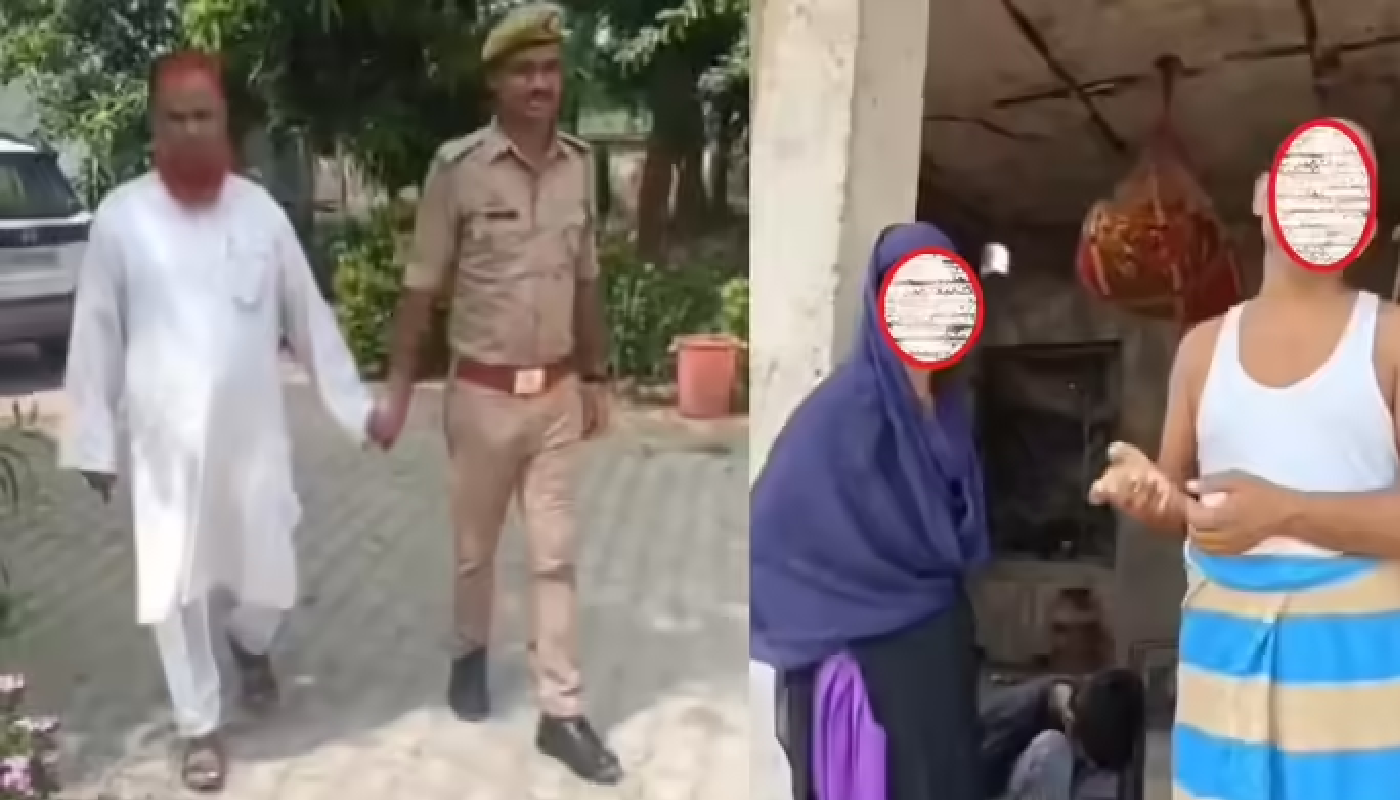
Case Summary
A Hindu woman and her children were converted to Islam during her husband’s imprisonment in Kushinagar, Uttar Pradesh. Mahendra Kushwaha, a resident of Mansha Chhapar village under the Hanumanganj police station area, returned home on 04 September 2025 after serving a 10-year jail sentence in a rape case, only to find his entire family converted. His wife, Rabri Devi, had embraced Islamic customs, changed her attire to a burqa, and was offering namaz five times a day. His sons had been enrolled in a madrasa, and his elder son, Vipin, aged 14, had been renamed Noor Alam. When Mahendra attempted to bring his sons home from the madrasa, staff members pushed him away, assaulted him, and issued death threats. Shocked by the ordeal, Mahendra lodged a complaint with the police. Investigations revealed that the madrasa principal, Mujibur Rahman, had lured Rabri Devi and her children into conversion by exploiting the family’s financial struggles during Mahendra’s imprisonment. Rahman offered free food, clothing, and education as inducements, ultimately converting the family. On 08 September 2025, police arrested Rahman, recovered a stolen motorcycle from him, and sent him to jail following a complaint. Further investigations were underway to uncover additional conspirators. Reports suggest that after Mahendra’s arrest, one of his children died, leading villagers to claim the family was under the shadow of black magic. Rabri Devi’s visits to dargahs increased during this period, and over the years, her faith and lifestyle underwent a complete transformation under Rahman’s influence. Mahendra, devastated by the betrayal and manipulation, vowed to reclaim his family, saying, “A mountain of sorrow has fallen on us. Now I am out of jail and can earn a living to support them. They were lured away in my absence. I will bring them back and provide for them.”
Why it is Hate Crime ?
The primary category in this case is: Predatory Proselytisation. The subcategory under this is: Conversion/ attempts to convert by inducement. Predatory Proselytisation is not just limited to threat, harassment, force and violence, but it also has contours of stealth. In several cases, the Hindu victim is exploited to convert, with non-Hindus taking advantage of their poverty. In such cases, the Hindu victim who is suffering financially is offered monetary benefits, including lucrative offers for jobs, health treatment, education, etc, to induce the victim into changing his/her religion. In such cases, the religious identity of the victim and the aim to disenfranchise him from his faith form the heart of the crime. Also, taking advantage of and exploiting an individual’s economic vulnerabilities is widely acknowledged as exploitation, forms of which are often penalised by law. Such cases therefore are considered religiously motivated hate crimes since the victim’s religious identity forms the very heart of the crime itself. The second subcategory under this is: Proselytisation by grooming, brainwashing, manipulation or subtle indoctrination. Under this, the tertiary category is: Conversion of minor. Religious brainwashing essentially means the often subtle and forcible indoctrination to induce someone to give up their religious beliefs to accept contrasting regimented ideas. Religious grooming or brainwashing also involves propaganda and manipulation. It involves the systematic effort, driven by religious malice and indoctrination, to persuade “non-believers’ to accept allegiance, command, or doctrine to and of a contrasting faith. Cases of such grooming or brainwashing are far more nuanced than direct threats, coercion, inducement and violence. In such cases, it is often seen that there is repeated, subtle and continual manipulation of the victim to induce disaffection towards their own faith and acceptance of the contrasting faith of the perpetrator. While subtle indoctrination is widely acknowledged as predatory, an element which is often understated in such conversions or the attempts of such conversion is the role of loyalty and trust which might develop between the perpetrator and the victim. Fiduciary relationships are often abused to affect such religious conversion. For example, an educator transmitting religious doctrine of a competing faith to a Hindu student. The Hindu student is likely to accept what the teacher is transmitting owing to existence of the fiduciary relationship. The exploitation of the fiduciary relationship to religiously indoctrinate victims would also be included in this category. Since the underlying animosity towards the victim’s faith forms the basis of predatory proselytisation, such cases are considered religiously motivated hate crimes. Another category in this case is: Attack not resulting in death. The subcategory under this is: Attacked for opposing radicals or trying to save victim. In several cases, Hindus are attacked for opposing religiously motivated crimes being committed against a fellow Hindu or simply for voicing an opinion opposing radical elements, who either have in the past or continue to persecute Hindus. In such cases, the initial attack against the victim, against which the Hindu was trying to defend the victim, would also need to be classified as a religiously motivated hate crime. Since the initial crime itself was religiously motivated and the subsequent crime of attempting to save the victim or speaking against the radical elements ends up inviting a violent attack, it would also be classified as a religiously motivated hate crime under this category. This case has been documented in the Hinduphobia Tracker because it embodies the full spectrum of predatory proselytisation, a phenomenon in which conversion is achieved through calculated exploitation, manipulation, and hostility towards Hindu identity. Mahendra Kushwaha testified that his wife and two minor children had been systematically converted to Islam. During his incarceration, the family’s vulnerability was weaponised by Mujibur Rahman, the principal of a local madrasa, who used material inducements such as food, clothing, and free education to lure them away from their Hindu faith. This was not a simple matter of religious persuasion but a deliberate effort to exploit their economic hardship and social isolation, ensuring their gradual disengagement from their ancestral beliefs. The case illustrates how sustained grooming and manipulation erode the spiritual and cultural identity of vulnerable individuals. Rabri Devi’s increased association with dargahs and eventual adoption of Islamic practices reflect a slow but deliberate indoctrination process. Her children, both minors, were drawn into this scheme, with the elder son forcibly renamed and placed in a madrasa. The exploitation of trust and authority, particularly through the educator-student relationship, demonstrates the calculated use of fiduciary positions to erode religious loyalty. This dynamic is characteristic of predatory proselytisation, where conversion is not merely an act of free will but the product of sustained psychological conditioning. It is also notable that two minor children were converted to Islam. This means the element of consent and genuine change of conscience was missing ab initio. Minors, due to their young age and lack of maturity, are particularly vulnerable to manipulation and coercion. They may not have the ability to fully understand the implications of converting to another religion. The hostility underlying this case became even more apparent when Mahendra attempted to reclaim his children from the madrasa. Rather than being permitted access, he was assaulted and threatened with death, a reaction that starkly reveals the sectarian hatred driving the perpetrators. The attack signalled a refusal to recognise his parental rights and a violent rejection of his Hindu identity, further emphasising the religious malice at the heart of the crime. By combining inducement, grooming, and outright violence, this case demonstrates how proselytisation is often accompanied by systemic hatred toward Hinduism. The conversion of minor children adds a grave layer of severity, underscoring the deliberate attempt to sever future generations from their cultural and religious heritage. Recording such incidents in the Hinduphobia Tracker is vital to illustrating how coercive religious conversion is not only a violation of personal freedom but also an expression of targeted hostility against Hindu society. Disclaimer: It is important to clarify that none of the media sources covering this case have specified the exact date when the victims' ordeal began. The earliest date mentioned is September 04, 2025, when Mahendra came back home after his prison term. Since Hinduphobia Tracker records the incident based on when the victim’s ordeal began and not when it was reported, we have considered the date of the incident as September 04, 2025, though the media reported the incident on May 09, 2025. Description: The number of victims has been set to 4, because Mahendra, along with his wife and two sons, were victims of forced conversion and assault.
Victim Details
Total Victim
4
Deceased
0
Gender
- Male 3
- Female 1
- Third Gender 0
- Unknown 0
Caste
- SC/ST 0
- OBC 0
- General 0
- Unknown 4
Age Group
- Minor 2
- Adult 2
- Senior Citizen 0
- Unknown 0


Case Status
Arrested


Perpetrators Details
Perpetrators
Muslim Extremists
Perpetrators Range
One Person
Perpetrators Gender
male
 Sources




