Hanuman Chalisa recitation during Ganpati Visarjan attacked by Muslim men, Hindu devotees injured
 Burhanpur, Madhya Pradesh, India
  6 September, 2025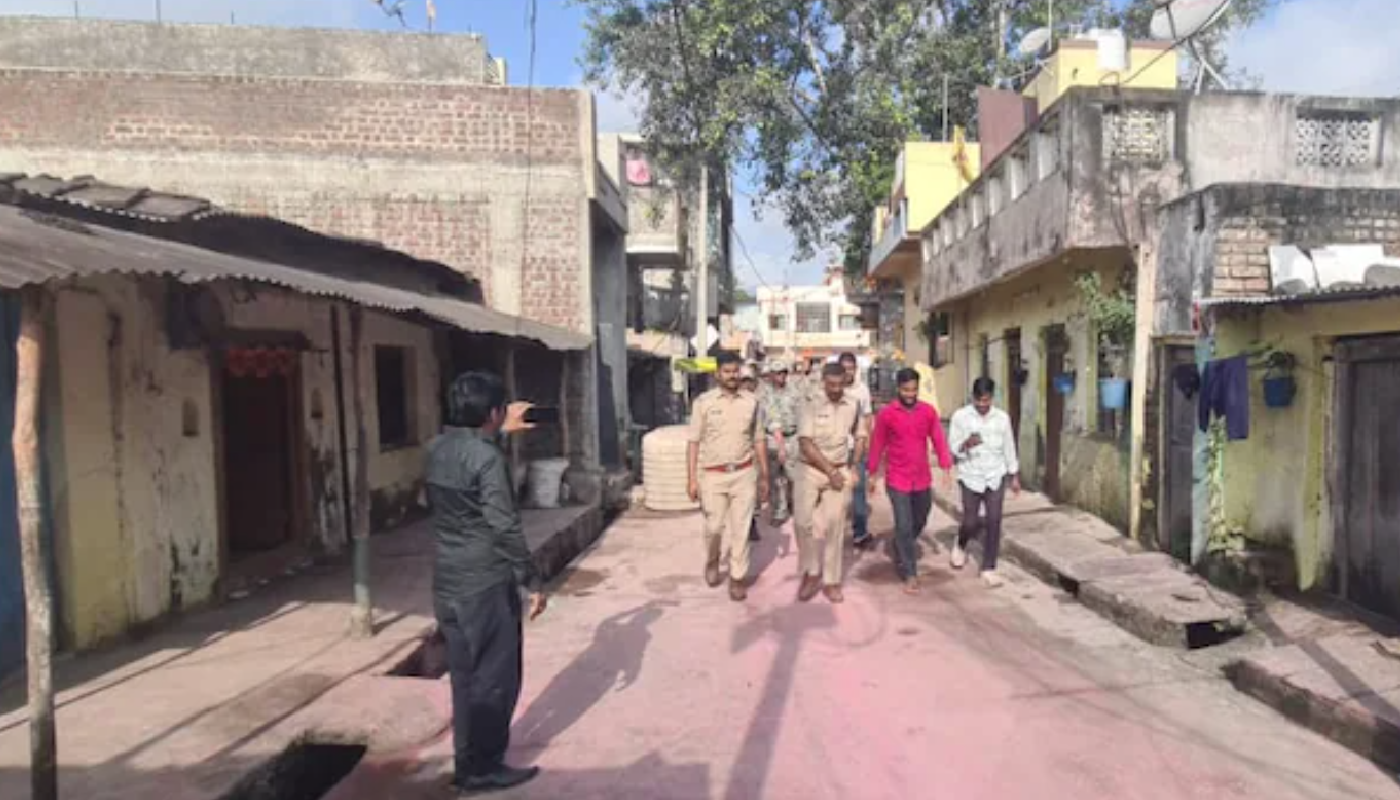
Case Summary
A Hindu religious gathering was attacked with stones during Ganesh Visarjan in Biroda village of Burhanpur district, Madhya Pradesh. The incident occurred on 7 September 2025 when Hindus were reciting the Hanuman Chalisa near a pandal as part of the immersion rituals. As soon as the recitation ended, members of the Muslim community began pelting stones, leading to chaos and a clash between the two sides. The attack left at least seven Hindus injured, all of whom were rushed to the district hospital for treatment. The violence created panic in the village as residents fled for safety. Police forces quickly reached the spot and deployed additional personnel in the area to maintain order. Seven accused were detained so far, and further arrests were expected based on CCTV footage. Local Bharatiya Janata Party MLA Archana Chitnis visited Lalbagh police station following the attack and stated that a similar incident had taken place in Biroda village a year earlier. She criticised the administration for failing to act against those responsible at the time and stressed the need for strict action against the perpetrators to restore trust and security in the community. Authorities confirmed that the violence erupted after Muslim youths targeted the Hanuman Chalisa recitation that followed Ganesh Visarjan rituals. Investigations were underway to determine the full extent of involvement and motive behind the attack.
Why it is Hate Crime ?
The primary category in this case is: Attack not resulting in death. The subcategory under this is: Attack on religious procession. The outward celebration and display of religious symbols in an intrinsic part of Hinduism. Religious processions on various festivals are age-old traditions and a way to manifest faith and form a part of the religious practices of Hindus. On several occasions, such religious processions come under attack by non-Hindu mobs, in a manifestation of their animosity towards Hinduism and their practices. The reasons cited for such violent attacks are many and range from crossing a non-Hindu resident-dominated area to playing loud music, crossing from an area where there is a religious structure of another faith etc. The violent attacks are triggered by the outward display of religiosity by Hindus. The attacks are mainly a manifestation of religious supremacist doctrine which believes that idolatry, essentially the Hindu faith, is one that deserves to be annihilated since the very tenets of Hinduism, its practices and traditions are considered a sin in those doctrines. Since these attacks emanate from intrinsic and doctrinal animosity towards Hindus and Hinduism, it is considered a religiously motivated hate crime under this category. Another subcategory under the category is: Attack on Hindu devotees. Hindu devotees are a few of the easiest targets of religiously motivated hate crimes because during the festival/procession/puja etc, for non-Hindus it is easy to profile their victims on the basis of religion. Hindu devotees come under attack on several occasions by individual non-Hindus or mobs of non-Hindus owing to their animosity against Hinduism, its symbols and tradition/practices. There are several instances of Hindu devotees being attacked while they worship in temples or temporary religious structures, during religious processions, doing bhajan/kirtan/puja in their own homes, in the residential society etc. These attacks are perpetrated by non-Hindus primarily because of their animosity towards Hindus and their faith. In some cases, the trigger for the violence may be non-religious, however, there are two elements that make these hate crimes. First, the Hindus who come under attack are attacked violently while indulging in religious activity. Whether they are in a place of worship or not is immaterial to the crime. When individuals are attacked while indulging in religious practices, the attack in itself is a hindrance to their freedom to practice religion and therefore constitutes a hate crime. Secondly, religious supremacist doctrines and ideologies deem religious practices of Hindus to be offensive ab initio since they are considered “sinful” by these ideologies, worthy to be annihilated by force or coercion. Driven by these religious supremacist ideologies and doctrines, the attacks against Hindu devotees stem from intrinsic animosity towards Hinduism. In some cases, the trigger for the violence may be non-religious, however, it develops into a religiously motivated crime during the course of the violence. Since these attacks stem from animosity towards Hindus and Hinduism, they are considered religiously motivated hate crimes under this category. The other relevant subcategory is- Communal clash/attack. Communal clash is a form of collective violence that involves clashes between groups belonging to different religious identities. For a communal clash between Hindus and non-Hindus to qualify as a religiously motivated hate crime, the trigger of the violence itself would have to be anti-Hindu in essence. For example, if there is a Hindu religious procession that comes under attack from a non-Hindu mob and after the initial attack, Hindus retaliate in self-defence, leading to a communal clash between the two religious communities. While at a later stage, both communities are involved in the clash/violence, the initial trigger of the violence was by the non-Hindu mob against the Hindus and therefore, it could safely be termed as an anti-Hindu violence. Further, the trigger would also have to be religiously motivated. In the cited example, the attack by the non-Hindu mob was against religious processions and therefore, can be concluded to be religiously motivated. In some cases, the trigger may be non-religious, however, it develops into religious violence against Hindus at a later stage. In such cases too, the foundational animosity towards Hindus becomes the motivating factor of the crime and therefore, it would be classified as a religiously motivated hate crime against Hindus under this category. This case has been added to the tracker as it exemplifies a recurring pattern of targeted hostility against Hindu religious processions, reflecting a deep-rooted ideological antagonism rather than any spontaneous or circumstantial provocation. The Ganesh Visarjan rituals, which have been celebrated for centuries as a visible affirmation of Hindu faith and tradition, were disrupted not through verbal opposition or administrative objection but through outright violence, demonstrating an intent to intimidate and suppress Hindu religious expression. The attack was not an isolated act but part of a broader trend in which mobs, primarily drawn from the Muslim community, have repeatedly chosen physical aggression as a means of asserting dominance over public Hindu religious practice. This case fits squarely within three distinct but interlinked subcategories of religiously motivated crimes: attacks on religious processions, attacks on Hindu devotees and communal attack. The outward visibility of Hindu worship, whether through public tableaux, kirtan, or immersion rituals, often provokes aggression from individuals and mobs influenced by doctrines that view idolatry and Hindu customs as inherently offensive. The incident underscores a clear imbalance in social tolerance: the outward celebration of Hinduism, whether through the chanting of Hanuman Chalisa or the movement of religious tableaux, has increasingly been met with stone pelting, organised intimidation, and threats, especially in localities where religious demographics are contested. In this case, Hindu devotees were assaulted at a moment of deep religious engagement, demonstrating not only physical aggression but also an intent to obstruct their constitutional freedom to worship. These acts cannot be reasonably attributed to disputes over music volume, route selection, or administrative permissions, as is often argued, but rather to an ideological belief system that devalues idolatry and openly calls for its eradication. Such doctrinal hostility has, over time, translated into a pattern of aggression aimed at curtailing Hindu religious visibility in the public sphere. By documenting this attack, the tracker highlights not only the immediate harm inflicted on individuals and the disruption of a peaceful celebration but also the broader climate of fear it engenders. This hostility is not reactive but strategic, rooted in a worldview that views Hindu devotional expression as inherently offensive and subject to suppression. Disclaimer: The number of perpetrators in this case has been set to 7 because 7 perpetrators were arrested following the incident. Police continued to investigate the case and stated that more arrests could be made. Therefore, currently, the number of perpetrators is set to 7, and further changes will be made depending on further updates.
Victim Details
Total Victim
7
Deceased
0
Gender
- Male 0
- Female 0
- Third Gender 0
- Unknown 7
Caste
- SC/ST 0
- OBC 0
- General 0
- Unknown 7
Age Group
- Minor 0
- Adult 0
- Senior Citizen 0
- Unknown 7


Case Status
Case sub-judice


Perpetrators Details
Perpetrators
Muslim Extremists
Perpetrators Range
From 5 to 10
Perpetrators Gender
unknown
 Sources




