Identity politics weaponised against Hindus: Indian politician claims tribals are ‘not Hindus’
 Chhindwara, Madhya Pradesh, India
  2 September, 2025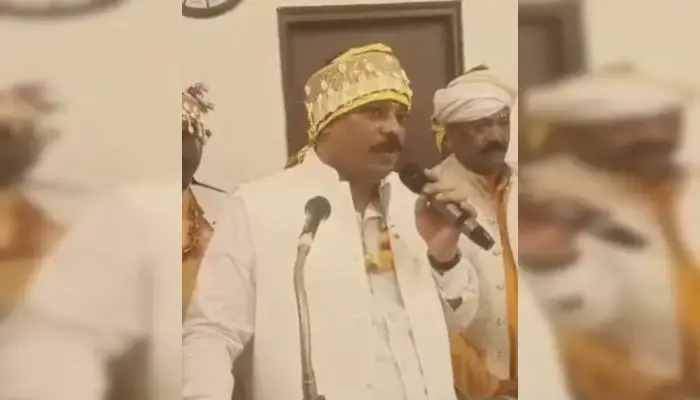
Case Summary
Hindu religious sentiments were insulted by senior Congress leader Umang Singhar, who denied the Hindu identity of the tribal community and publicly asserted that tribals were separate from Hindus. The incident occurred during a meeting of the Madhya Pradesh Tribal Social Development Council in Chhindwara, where Singhar declared that he proudly identified as a tribal and not a Hindu, emphasising that he had maintained this position for years. He referred to Shabari, who offered berries to Lord Ram, as belonging to the tribal community and claimed that tribals were the original inhabitants who must preserve their distinct identity, regardless of the government in power. Singhar further claimed, "The original inhabitants of this country are tribals... Why do the BJP or RSS want to stop us from worshipping nature?" He claimed that the BJP and RSS people want to erase our tribal identity and subsume us within Hinduism. The ruling Bharatiya Janata Party (BJP) sharply criticised these remarks, with Chief Minister Mohan Yadav stating that the Congress was working against Hindus and Hindutva. He stated that such statements insult Hindutva and lead to the denial and erasure of Hinduism within the tribal society. He condemned the remarks, describing them as shameful and unacceptable, and warned that the public would not forgive attempts to create divisions between Hindus and tribals.
Why it is Hate Crime ?
This case has been added to the tracker under the primary category of: - Hate speech against Hindus. Within it, the sub-category selected is: - Anti-Hindu slurs, mocking faith. Anti-Hindu slurs and the deliberate mocking of the Hindu faith owing to religious animosity involve the usage of derogatory terms, stereotypes, or offensive references to religious practices, symbols, or figures. One of the common anti-Hindu slurs used against Hindus is “cow-worshipper” and “cow piss drinker”. The intention of using this term is to demean and mock Hindus as a group and their religious beliefs since Hindus consider the cow holy. Additionally, some symbols and the slurs attached to them have a historical context that exacerbates the insult, hate, stereotyping, dehumanisation and oppression against Hindus. Cow worship has been used for centuries to denigrate Hindus, insult their faith and oppress Hindus specifically as a religious group. There has been overwhelming documentation about how cow slaughter has been used to persecute Hindus with cow meat being thrown in temples and places of worship. There has also been overwhelming documentation where cow meat (beef) has been force-fed to Hindus to either forcefully convert them to Islam or denigrate their faith. Apart from cow worship, the Swastika – which holds deep religious significance for the Hindus – has also been misinterpreted and distorted to use as a slur against Hindus. Similarly, the worship of the Shivling has been used by supremacist ideologies and religions to denigrate Hindus owing to religious animosity. Such slurs and denigration stem out of inherent animosity and hate towards Hindus and their faith, therefore, it is categorised as hate speech targeted at Hindus specifically owing to their religious identity. The other sub-category selected is - Subversion of Scriptures. Subverting the religious scriptures of Hindus has particularly devastating consequences. Subversion of the scriptures of Hindus is often done to justify or promote hatred, discrimination, or violence against specific individuals or groups of Hindus. Religious scriptures are often nuanced and those who harbour religious animosity towards Hindus often misquote or misrepresent the scripture to legitimise their animosity and hate towards the faith and its adherents. Any such misquoting of scriptures or subversion to justify hate, violence and discrimination against Hindus owing to religious animosity is hate speech and is categorised as such. This case has been added to the tracker because the Congress leader's statements claiming that tribals are distinct from Hindus were a deliberate attempt to undermine and insult Hindu religious sentiments, aimed at dividing the Hindu society across caste lines. It sought to undermine and delegitimise the Hindu identity of tribal communities. Tribals and Dalits are an inseparable part of the Hindu collectivity because their traditions, practices, and ways of life are deeply rooted in the broader Hindu civilizational framework. The rituals of tribals, such as nature worship, ancestor veneration, and reverence for sacred groves, align with the Vedic and Puranic traditions. Similarly, Dalit communities have historically preserved unique forms of devotion, bhakti traditions, folk deities, and regional festivals that are fully integrated into the Hindu spiritual landscape. Hindu texts, saints, and reformers have also consistently acknowledged tribals and Dalits as integral to the dharmic fold. The attempt to separate tribals and Dalits from Hindu identity often comes from external ideological or political forces seeking to fragment the unity of Hindu society. In reality, both groups share the same festivals, pilgrimages, temples, and spiritual practices as other Hindus, while maintaining their local distinctiveness within the larger Hindu umbrella. Thus, tribals and Dalits are not just a part but an essential foundation of the Hindu collectivity, preserving some of the most ancient, unbroken traditions of Sanatan Dharma. By declaring that tribals were “not Hindus” and saying that they must preserve a separate identity, he directly attacked the historical and religious connections between tribal traditions and Hinduism. Such remarks go beyond political discourse and constitute an attack on religious sentiments, as they aim to erode the collective spiritual and cultural identity of Hindus. Singhar’s claims about Shabari, in the Ramayana, who was a tribal devotee of Lord Ram, were also factually misleading and textually incorrect. Shabari in the Ramayana was very much a Hindu figure. She is depicted as a tribal woman who devoted her life to the service of Lord Ram. Despite her humble background, she attained a place of honour in the epic because of her unflinching devotion (bhakti). The episode where Shabari offers tasted berries to Lord Ram symbolises the essence of Hindu dharma, where sincerity of faith and love for the divine matter more than ritual or social status. Her story also shows that tribal traditions and practices were never outside the Hindu fold but deeply integrated into it. Shabari’s devotion is celebrated across Hindu traditions, demonstrating that bhakti and spiritual merit are not limited by caste, community, or region. Far from being separate, tribal identities like hers are presented in the Ramayana as central examples of what it means to live as a Hindu. Therefore, by claiming that Shabari’s tribal identity excludes her from Hinduism, Singhar misrepresented Hindu texts and selectively distorted religious history. The Congress leader's statement must not be considered a mere political statement; it had a clear motive to divide Hindu society along micro-identities such as caste and region. In doing so, Singhar's thoughts aligned with several leftists and Islamists, who often weaponise identity politics to target Hindus. It attempts to weaken the unifying factor (Hindu religious identity) of Indian society, which transcends caste distinctions and geographical boundaries, by creating a perception that tribals should distance themselves from Hinduism. For such leaders, especially the Congress party as well, the micro identities of caste, region, and language are secondary; their real target is Hinduism, as a religious identity. Their goal is to divide the Hindu society across fictitious caste, anti-Brahmanism, or rhetoric about social hierarchies. For example, the 2015 Karnataka caste survey and the 2024 Telangana caste survey, both of which were conducted by the Congress government, created divisions within Hindu society under the guise of social equity. Therefore, within this context, Singhar’s speech was a deliberate attempt to fragment the Hindu society by promoting a narrative of division, targeting religious identity rather than political or social issues. Such actions not only seek to fragment Hindu society along caste lines but also aim to diminish its collective religious identity. His remarks constitute hate speech because they were intended to demean, marginalise, and create animosity toward Hindus by exploiting caste lines.


Case Status
Complaint not filed


Perpetrators Details
Perpetrators
State and Establishment
Perpetrators Range
One Person
Perpetrators Gender
male
 Sources




