Hindu man physically assaulted for religious conversion by Muslim man, threatened with death for refusing
 Tikamgarh, Madhya Pradesh, India
  2 April, 2025
Case Summary
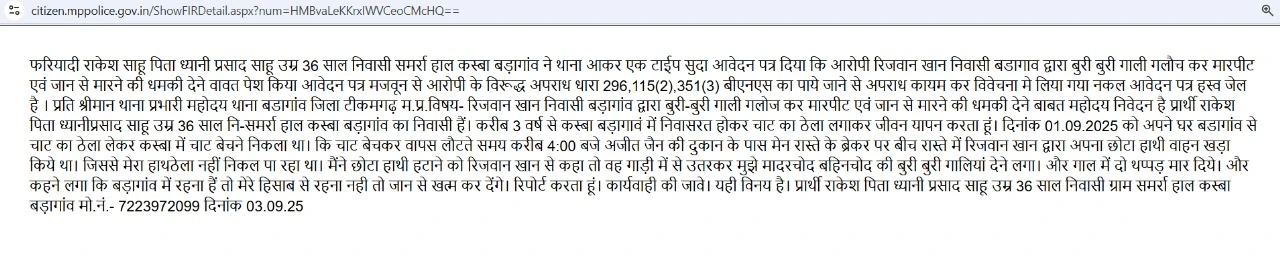
In Tikamgarh district of Madhya Pradesh, a Hindu man named Rakesh Sahu was pressured, threatened and physically assaulted for religious conversion by a Muslim man named Rizwan Khan. According to media reports, the Hindu man stated that he, along with his family, resides in a rented house in Baragaon. He lodged a complaint stating that he and his family had been pressured to convert to Islam for the past six months by the Muslim accused. Rakesh, who earned his livelihood by running a chaat stall, stated that he had set up his stall near a shop. Rizwan Khan, along with two of his accomplices, came and abused him, obstructed him from taking out his stall, and physically assaulted him, declaring that if he wished to live in the village, he would have to convert to Islam. Rizwan threatened to kill him and his family if he refused conversion. Terrified by the threat, Rakesh did not set up his stall that day, but later approached the police and filed a complaint. The matter sparked strong reactions from Hindu organisations, including Vishwa Hindu Parishad and Bajrang Dal, who staged a protest at the police station demanding strict action against the accused. Police stated that the accused was arrested and the matter was under investigation. It is further important to note here that the FIR does not mention a conversion angle, and the police also claimed that no conversion angle exists and instead described it as a dispute between two parties.
Case Images
Why it is Hate Crime ?
This case has been added to the tracker under the primary category of - Predatory Proselytisation. Within it, the sub-category selected is - Harassment, threats, coercion for conversion. Harassment covers a wide range of behaviours of an offensive nature. It is commonly understood as behaviour that demeans, humiliates, and intimidates a person, including threats and coercion. Harassment and threats, in this case, find their root on discriminatory grounds which has the effect of nullifying a person’s rights or infringing upon his freedom to exercise his right specifically owing to the victim’s religious identity. Verbal and physical threats and psychological or physical harassment are often used against Hindu victims because they choose to practice their professed religion. Religious harassment also includes forced and involuntary conversions by harassment, threats or coercion. Coercion includes intimidatory tactics like force-feeding a Hindu victim beef to convert to another religion, forceful circumcision etc. In several cases documented, non-Hindu perpetrators or those who harbour specific animosity towards Hinduism, harass victims simply based on their religious identity. Such cases often also include harassment to ensure the Hindu victim abandons his/her professed religion and adopts the religion of the perpetrator. Such cases where Hindu victims are harassed to convert to the perpetrator’s religion are rooted in animosity towards the victim’s religious identity and are therefore documented as religiously motivated hate crimes. The second primary category selected here is - Attack not resulting in death. Within it, the sub-category selected is - Attacked for refusal to convert. When there is pressure, threat or coercion employed upon the Hindu victim to convert to a different religion, in several cases, the victim refuses to succumb to the pressure/threats. Once the victim refuses, the perpetrator proceeds to attack/assault the victim owing to his/her refusal to convert. In such cases, the pressure/threat/intimidation/coercion/violence itself is driven by animosity towards the victim’s Hindu faith. The violence then is another hate crime driven by the victim’s refusal to abandon his professed faith, Hinduism, and convert to the religion of a non-Hindu perpetrator. Since the victim’s faith is at the heart of the pressure to convert and the ensuing violence towards the victim, such cases are considered religiously motivated hate crimes. This case has been added to the tracker because the Hindu man was pressured, threatened and physically assaulted for religious conversion by the Muslim accused. For the past six months, the accused was pressuring and harassing the victim to convert to Islam. The accused verbally abused, threatened to kill, and physically assaulted the victim in order to force conversion. He verbally abused him, obstructed his means of livelihood, threatened to kill him and his family, and used physical intimidation to break his resolve. This sustained pattern of coercion underscores that the crime was not a random or isolated incident but a deliberate effort to impose religious conversion through intimidation and violence. Such acts demean, humiliate, and psychologically torment Hindu victims simply for choosing to remain in their faith. The coercion here directly targeted the victim's Hindu identity and attempted to nullify his right to freely practice his religion. The threats and harassment were not random but specifically designed to break his religious will, making this a religiously motivated hate crime against Hindus. The incident is on the lines of a wider pattern of religiously motivated hate crimes where Hindus are specifically targeted or met with hostility for refusal to convert to another faith or abandon Hinduism. Such actions stem from inherent hostility towards the victim's professed faith, since Abrahamic faiths believe that any non-adherent to the faith is subject to being dehumanised until they convert. This is not random violence; it is systematic, targeted, and rooted in religious animosity. Since such predatory actions stem from doctrinal animosity towards the Hindu faith and its adherents, this case is being documented as a religiously motivated hate crime. It is also pertinent to note here that the police claimed that there was 'no conversion angle' in the case, and the FIR also didn’t mention any conversion angle. The police, in many such cases, where the motive behind the crime is obvious but not explicitly mentioned, deny that the crime committed was in any way motivated by a religious bias or say that there was ‘no communal angle’ to the crime, and they even refuse to register an FIR in that regard. Several factors are generally at play here. Many a time, the police downplay incidents of low-level communal crime because it is their jurisdiction which comes under question. The police also often say that there was ‘no communal angle’ to a crime when there was one because they wish to ensure that, owing to the crime already committed, there is no further flare-up in the area. Likewise, the Left media is also inclined to emphasise this "no communal angle" trope, especially wherever the victim of the crime is a Hindu. However, only a police statement or a media report, for instance, cannot be enough to determine whether there is a communal angle present in the crime that has been committed. In fact, to determine whether the crime is communal in nature or not, we need to give emphasis to the ground realities. For example, in the case of Rinku Sharma, the Bajrang Dal activist who was mercilessly stabbed in his house in front of his family members in Delhi’s Mangolpuri area in the year 2021, the leftist media and the leftist ecosystem had tried to peddle that there was no communal angle to the crime. Even the police denied that the crime was communal in nature. However, Opindia spoke to several people who are on the ground with the family of Rinku Sharma, and we were told that the communal tension in the area is palpable. The family of Rinku Sharma has said that the Muslims of the area held a grudge against Rinku ever since he celebrated the Ram Mandir verdict. Like the case of Rinku Sharma, those cases where even if the police have denied a communal angle or the leftist media have gone on an overdrive to peddle the ‘no communal angle’ trope, the ground reality, like the victim’s family or relative's testimonies, make it clear that there was an obvious religious bias that led to the crime, will be documented in this tracker. Disclaimer: Media reports state that the victim was being pressured for conversion for the past six months, though no exact date or month is provided. Thus, to document this case, we have used an indicative date—March 3, 2025—as a placeholder to represent the beginning of her suffering. While media coverage of the incident emerged on September 3, 2025, the Hinduphobia Tracker records the incident based on when the victim’s ordeal began, not when it was reported.
Victim Details
Total Victim
1
Deceased
0
Gender
- Male 1
- Female 0
- Third Gender 0
- Unknown 0
Caste
- SC/ST 0
- OBC 1
- General 0
- Unknown 0
Age Group
- Minor 0
- Adult 0
- Senior Citizen 0
- Unknown 1


Case Status
Arrested


Perpetrators Details
Perpetrators
Muslim Extremists
Perpetrators Range
One Person
Perpetrators Gender
male
 Sources




