Minor Hindu students prohibited from wearing tilak and kalava by Muslim school teacher in Madhya Pradesh
 Khargone, Madhya Pradesh, India
  2 September, 2025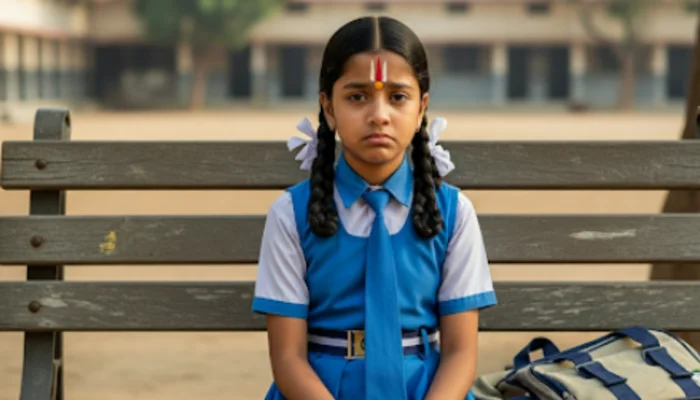
Case Summary
In Khargone district, Madhya Pradesh, minor Hindu students were prohibited from wearing tilak and kalava by Muslim teacher named Shahrukh Pathan. According to reports, the accused was a guest teacher in the Sandipani School in Bistan, and was posted in Class 2. He objected to minor Hindu students of Class 9 from wearing tilak on their forehead and kalava (sacred thread) on their wrists. This angered the students and their parents, who strongly objected to such actions. Members of the local Sakal Hindu Samaj (a Hindu organisation) gathered in large numbers at the school, met principal Balram Bhanwar and demanded the removal of the teacher. They stated that such actions hurt Hindu religious sentiments and this was an attempt to distance children from their traditions. As tensions escalated, Pathan was made to apologise for his actions. He also submitted a written apology in which he admitted his mistake. The Sakal Hindu Samaj insisted on his removal, while the school principal confirmed that the matter had been reported to higher authorities and assured that further action would be taken according to official rules.
Why it is Hate Crime ?
This case has been added to the tracker under the primary category - Restriction/ban on Hindu religious practice. Within this, the subcategory selected is- Restriction on expression of Hindu identity. An example of the state-affected prejudicial and targeted orders against the Hindu community would be a government denying the right of a Hindu or a group of Hindus to hold a religious procession owing to the animosity of non-Hindu groups. Denial of the religious right of the Hindus to assuage the non-Hindu group which harbours animosity to a point where it could lead to violence against Hindus is not only a failure of law and order but is a prejudicial order against Hindus, denying them their fundamental rights to express their religious identity. An example of a hate crime against Hindus by a non-Hindu would be a non-Hindu institution forcing its Hindu employees to abandon religious symbols that a Hindu would wear as an expression of faith owing to inherent prejudice against the faith professed by the victim or a non-Hindu group of people restricting a Hindu group from constructing a place of worship simply because the demography of the area in which the temple is being built is dominated by non-Hindus. Such actions are driven by religious animosity and/or prejudice against Hindus and their faith and would therefore be categorized as a hate crime. The other primary category selected here is- Predatory Proselytisation. Under this, the sub-category selected is- Proselytisation by grooming, brainwashing, manipulation or subtle indoctrination. Religious brainwashing essentially means the often subtle and forcible indoctrination to induce someone to give up their religious beliefs to accept contrasting regimented ideas. Religious grooming or brainwashing also involves propaganda and manipulation. It involves the systematic effort, driven by religious malice and indoctrination, to persuade “non-believers’ to accept allegiance, command, or doctrine to and of a contrasting faith. Cases of such grooming or brainwashing are far more nuanced than direct threats, coercion, inducement and violence. In such cases, it is often seen that there is repeated, subtle and continual manipulation of the victim to induce disaffection towards their own faith and acceptance of the contrasting faith of the perpetrator. While subtle indoctrination is widely acknowledged as predatory, an element which is often understated in such conversions or the attempts of such conversion is the role of loyalty and trust which might develop between the perpetrator and the victim. Fiduciary relationships are often abused to affect such religious conversion. For example, an educator transmitting religious doctrine of a competing faith to a Hindu student. The Hindu student is likely to accept what the teacher is transmitting owing to existence of the fiduciary relationship. The exploitation of the fiduciary relationship to religiously indoctrinate victims would also be included in this category. Since the underlying animosity towards the victim’s faith forms the basis of predatory proselytization, such cases are considered religiously motivated hate crimes. This case has been added to the tracker because minor Hindu students were prohibited from wearing tilak and kalava by their Muslim teacher. It is important to understand here that the tilak or kalava are not merely decorative things; they hold profound spiritual and cultural significance for Hindus. They are emblems of Hindu religious identity, often worn during prayers, rituals, and as a daily affirmation of faith. Forcing Hindu students to remove these religious symbols is a deliberate effort to erase their religious identity and expression. Such an act is deeply disrespectful and is an attack on the core values and practices of Hinduism. These actions cannot be seen in isolation. They represent a wider pattern where Hindu children are pressured, prohibited, and punished for practising their religion. Such actions constitute common tactics in environments where subtle or overt pressure is used to alienate Hindu children from their religious identity. It serves as the first step in a larger pattern of grooming, where consistent alienation of students from their faith makes a child more susceptible to abandoning his faith and embracing another religion. Such acts leave Hindu children in a state of confusion about whether their religious practices are wrong or unacceptable in society. At an impressionable age, when children are still forming their sense of self, being told that their sacred symbols cannot be worn creates inner conflict and weakens their connection to their faith. Over time, this can instill a sense of shame or embarrassment about openly practicing Hinduism, making them hesitant to uphold their traditions in public spaces. Moreover, when such prohibitions come from an authority figure, such as a teacher, the impact is even more damaging. The child perceives it as a message that their religion is inferior or something to be hidden. This not only undermines their self-confidence but also plants seeds of alienation from their cultural roots. In the long run, these subtle forms of manipulation, especially when directed at minors, can gradually create disaffection toward their own religion and lay the groundwork for future conversion. It is also important to recognise that minors, by definition, cannot provide informed consent or undergo a genuine change of conscience. Children are still developing emotionally, cognitively, and socially, making them especially vulnerable to external influence and far less capable of critically evaluating or understanding such manipulation. The Muslim teacher purposely targeted and exploited this vulnerability of the victim. Subtle tactics used by such figures are often difficult for parents to detect, making it harder to safeguard children against religious grooming. Thus, it is a case of religiously motivated hate involving the targeting of Hindu practices and suppression of religious freedom, targeting minor Hindu students. Here, it is important to mention that in 2022, a massive controversy had erupted in Karnataka, which took a national form, after Muslim women had insisted that they should be allowed to wear burqas and hijabs in their schools and classrooms. At that time, the argument given by several politicians, social commentators, Hindu activists and even the judiciary was that schools had the right to enforce uniform rules, since wearing uniforms brought harmony and equality in the classroom, and therefore, schools not allowing girls to wear hijab in the classroom was not religious discrimination, but merely an enforcement of widely accepted uniform norms. The pseudo-secularists and leftist groups may argue that a similar line of reasoning should be applied in this case. However, it becomes important to mention here that most uniform codes focus on standardising clothing and accessories like shoes, belts, and hair. A tilak and kalava do not change the appearance of the uniform itself. This religious symbol is benign and does not cause disruption or harm, raising serious concerns about the motivations behind such enforcement. When an ostensibly secular institution imposes restrictions specifically targeting Hindu religious symbols, it reflects institutional prejudice against Hinduism. This form of targeted suppression echoes broader patterns where Hindu practices are curtailed under the guise of neutrality or discipline, often to appease other religious groups. The actions of the school authorities amount to religious discrimination and are consistent with the framework of a hate crime, where Hindus are penalised solely for adhering to their Hindu religious practices. Since an underlying religious animosity leads to such biased behaviour, this incident warrants inclusion in the tracker. Disclaimer: The Hinduphobia Tracker records incidents based on when the victim’s ordeal began. However, in this case, the report does not provide specific details regarding when the accused prohibited the students from wearing a tilak and a kalava. Therefore, for documentation purposes, the date of the incident has been recorded as the date it was reported in the media - September 3, 2025.


Case Status
Complaint filed


Perpetrators Details
Perpetrators
Muslim Extremists
Perpetrators Range
One Person
Perpetrators Gender
male
 Sources




