Insult to Hindu religious sentiments: Hindu activists attacked after opposing cow slaughter on Ganesh Chaturthi in Bilaspur
 Bilaspur, Chhattisgarh, India
  26 August, 2025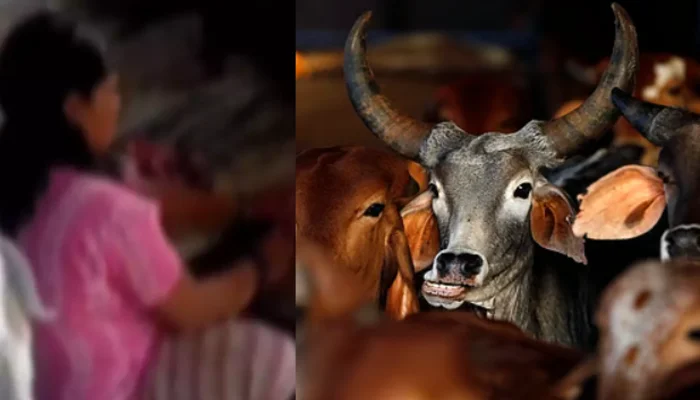
Case Summary
In the Dorkibhatha area of Bilaspur, Chhattisgarh, tensions escalated in the area when a video surfaced of a woman slaughtering beef on the auspicious day of Ganesh Chaturthi. The footage quickly went viral, resulting in local youths and Gau Rakshak Dal (a Hindu organisation) reaching the spot and staging a protest. However, this led to a violent confrontation as people from the locality, who were with the accused, attacked them with sticks and weapons, leaving four members of Gau Rakshak Dal seriously injured. The situation escalated rapidly, and soon a large crowd gathered, escalating tensions in the area. Police were informed, but they arrived late, by which time the violence had already broken out and resentment had spread among the Gau Raksha activists. They expressed their anger at the delayed police response, stating that had the police acted promptly, the attack could have been prevented. Additional police forces from nearby police stations were deployed to control the situation and pacify the crowd. The police took several individuals, including the woman seen in the video, into custody for interrogation. A sample of beef recovered from the site was also sent for examination, and a case was registered against the accused. Meanwhile, the accused defended themselves, claiming that they had not slaughtered a cow but were engaged in their traditional profession of extracting meat from an animal. They further claimed that the cow had already died and was handed to them by a cattle keeper.
Why it is Hate Crime ?
This case has been added to the tracker under the primary category of - Attack on Hindu religious representations. Within it, the sub-category selected is - Defiling religious customs. Sanatan Dharma is not a religion of one book, which is to say that while it has religious scriptures that form the central tenets of the faith, there are several traditions followed through thousands of years, mostly passed from generation to generation orally. There are several such customs and traditions that are followed by various Hindus and Hindu sects. Defiling of these traditions and customs is a breach of an individual or group’s religious practices. Such practices can range from dietary restrictions like not eating non-vegetarian food for a certain period of the year, not eating non-vegetarian food at all, not eating beef since the cow is considered holy in Hinduism, the sanctity of religious customs followed in the house (like many ISCKON devotees), etc. Any malicious action leading to the breach of such traditions or defilement of these traditions owing to animosity towards the faith or for the sake of activism stems not only from the lack of faith in the religion itself but also from disregard for the faith of the devotees who follow the customs/traditions and implicit bias against the faith, the tradition itself. Since these specific traditions are central to the faith of the devotees of that specific sect of Hindus, any non-compliance with these traditional rules would be considered a religiously motivated hate crime. The second primary category selected is - Attack not resulting in death. Within it, the sub-category selected is - Attacked for supporting/being part of perceived Hindu party/org or working for Hindu community. In several cases, Hindus are attacked specifically or tangentially for their association with parties or organisations perceived to be pro-Hindu and/or for working in favour of the Hindu community. One of the classic cases was the attack against a Bharatiya Janata Party Yuva Morcha (BJYM) worker Praveen Nettaru. Nettaru was attacked and hacked to death for his association with Hindu organizations and his work for the Hindu community. He was murdered by PFI, a terror organization which aimed to commit a genocide of Hindus, target Hindu leaders specifically and turn India into an Islamic Nation. In such cases, it is possible that the immediate trigger for the violence is non-religious – either according to the perpetrator or the police. However, there are surrounding circumstances from which the conclusion can be reached that the victim was attacked for his association with a Hindu organization. In a similar case, Rinku Sharma was attacked by radicals. He was a member of Bajrang Dal and regularly worked for the Hindu community. While the police cited a different non-religious trigger for the attack, it is true that he was associated to a Hindu organization and the family of Rinku Sharma specifically attributed his gruesome murder to him working for Bajrang Dal and raising Jai Shree Ram slogans. Such cases are intrinsically driven by religious hate and would therefore be documented as a hate crime under this category. This case has been added to the tracker because a cow was slaughtered by a woman on the auspicious day of Ganesh Chaturthi, which is one of the most important Hindu religious festivals. It is a deeply cherished festival marked by purity, devotion, and community celebration. Devotees bring idols of Lord Ganesha into their homes and temples, observe fasts, maintain sanctity in their diet, and uphold strict religious customs during this time. The act of slaughtering a cow on such a sacred occasion was therefore not an ordinary act but a direct insult to Hindu religious sentiments. Such actions constitute a hate crime because they stem from animosity toward the Hindu faith and its religious festivals. It disrespects centuries-old traditions of worship and purity central to Ganesh Chaturthi. The intent was to violate Hindu practices, making this not just an attack on the festival but an assault on the religious customs of an entire community. Cow slaughter is not merely an act of meat consumption but carries a deep symbolic meaning that directly strikes at the core of Hindu religious beliefs. For Hindus, the cow is revered as a sacred being, a mother figure (Gau Mata) that nourishes and sustains life through her milk. This reverence is embedded in centuries of tradition, culture, and dharmic practice. When individuals or groups deliberately engage in cow slaughter, particularly in regions or contexts where they are fully aware of its sacred status, it cannot be seen as an innocent dietary choice. It becomes an act of defiance, provocation, and often a tool of humiliation directed at the Hindu community. The practice stems from sheer disrespect and disdain toward Hinduism because it targets what Hindus hold most sacred. Historical records show that during invasions and periods of Islamic rule, cow slaughter was used as a political weapon to assert dominance and to break the spirit of Hindu resistance. Even today, in many cases, slaughtering cows in Hindu-majority areas or during Hindu festivals is carried out not only for consumption but also as a statement of contempt, with the intent to insult and hurt Hindu sentiments. It is also important to note that cow slaughter is banned in Chhattisgarh under the Chhattisgarh Agricultural Cattle Preservation Act, 2004. Therefore, the actions of the accused were not only against Hindu religious sentiments but also downright illegal. Notably, Hinduphobia Tracker usually categorises most cow slaughter incidents under the "undecided" database because the religious motive is not always clearly established, even though the underlying provocation is often apparent. But this case stands apart. The slaughter of a cow specifically on the sacred festival of Ganesh Chaturthi makes the intent unmistakable. It was not a routine act but a deliberate attempt to mock and desecrate a holy occasion deeply revered by Hindus. Such an act reflects a deep-seated hostility and contempt toward the Hindu faith. Furthermore, when members of the Gau Rakshak Dal decided to protest against the act, they were brutally attacked, leaving four of them seriously injured. This showed that the violence was not only about defending the slaughter but also about suppressing Hindu voices that resisted it. The attack was meant to assert dominance, intimidate the wider Hindu community, and discourage them from ever raising their voice for protecting their faith. In sum, the cow was slaughtered on the sacred festival of Ganesh Chaturthi, and when Hindu organisations raised their voices in protest, they were met with violent attacks that left four people injured. This shows that the act was not accidental or incidental but deliberately provocative, aimed at both desecrating Hindu religious traditions and intimidating those who dared to oppose it. Taken together, these actions make it a clear example of a religiously motivated hate crime.


Case Status
Complaint registered


Perpetrators Details
Perpetrators
Unknown
Perpetrators Range
Unknown
Perpetrators Gender
unknown
 Sources




