Chandranath temple in Chittagong faces systematic encroachment attempts by Muslim groups seeking to erase Hindu pilgrimage site
 Chittagong District, Bangladesh
  31 March, 2023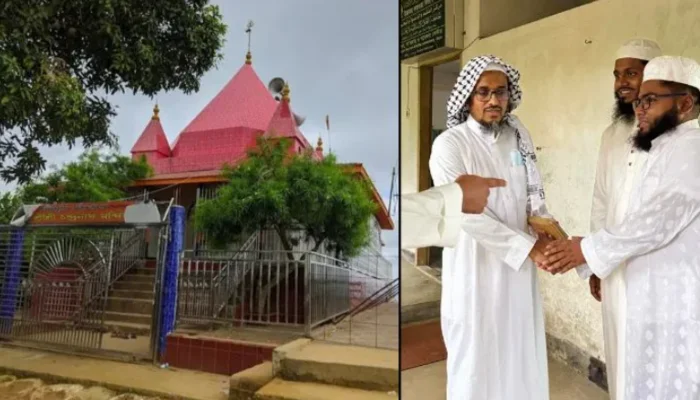
Case Summary
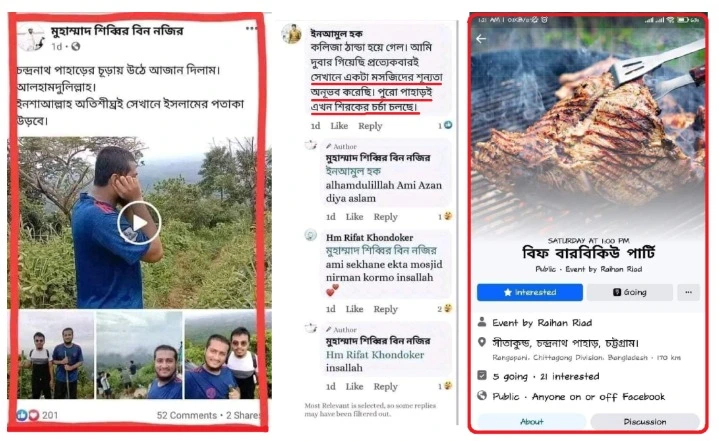
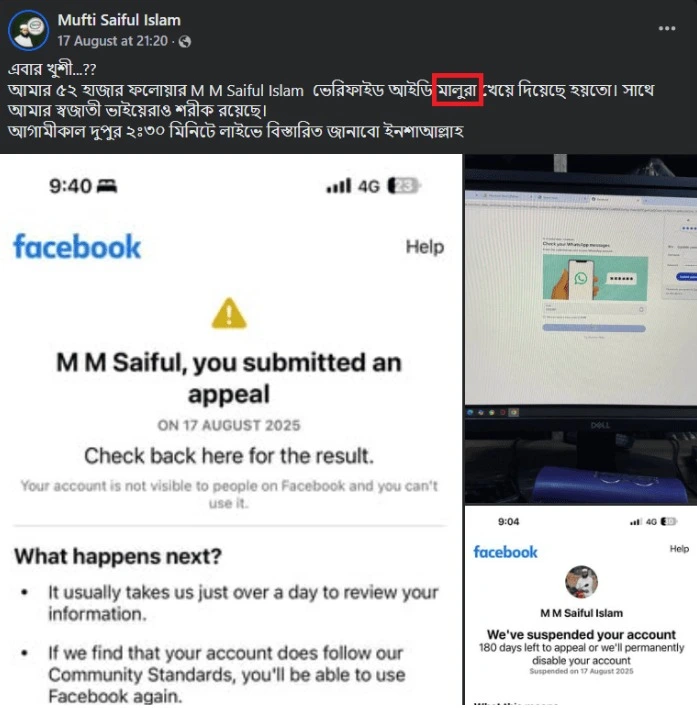
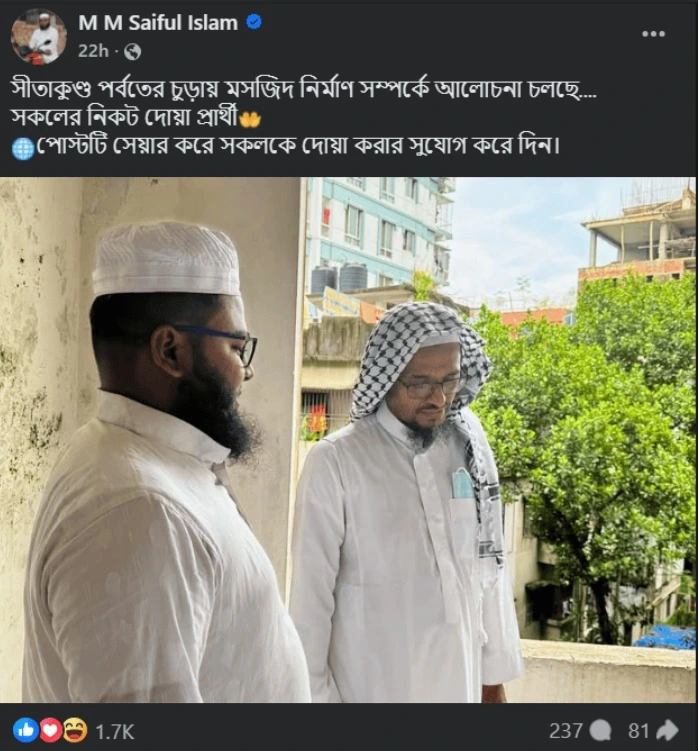
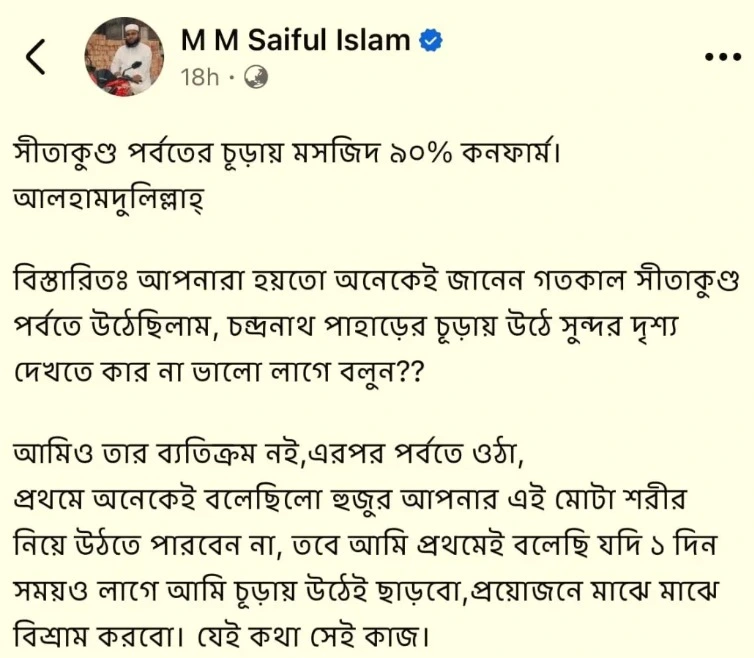
In the Sitakunda area of the Chittagong district, the Chandranath temple was facing threats of encroachment and desecration by the Muslim community. The Muslim community, led by M M Saiful Islam, was attempting to re-classify the Hindu pilgrimage site of Chandranath Hill as a ‘tourist spot’ to take over the sacred land and build mosques and prayer halls for ‘Muslim tourists.’ The Hindu temple, dedicated to Lord Shiva, is situated on Chandranath Hill and houses one of the 51 Shakti Peethas. While efforts to take control of the sacred land had been underway since at least December 2023, a renewed campaign was launched by M M Saiful Islam on 16 August 2025. Saiful, a radical Islamic preacher and Chairman of ‘SKM Shoe Shop’, declared on Facebook that the construction of a mosque on top of Chandranath Hill was 90% confirmed. He expressed frustration that he was not allowed to offer Namaz on the sacred Hindu land and pledged to ensure a dedicated space for Namaz on the hill. He claimed that “in a country with 93% Muslim population, there can be two temples on Chandranath Hill but not a single mosque. We, Muslims, are being treated like tenants and are not even allowed to pray.” After his hate-filled post went viral, his Facebook account with 52,000 followers was suspended. However, on 17 August, through another account, ‘Mufit Saiful Islam’, he confirmed the development and further went on to dehumanise the Hindu community, referring to them as ‘malu/malaun’. Saiful also met a Deobandi extremist named Harun Izhar, who has previously been associated with Hefazat-e-Islam Bangladesh. Izhar dubbed the Chandranath Hill a ‘so-called Hindu pilgrimage centre’, thereby insinuating that the status of the land was somehow disputed. Izhar, who was previously arrested in 2021, claimed that the plan is not to build a mosque near Hindu temples but in adjoining areas where Muslims go as ‘tourists.’ He then claimed that he had helped free Hindu lands in Chittagong from encroachment to lend credence to his claim that the mosque construction was not aimed at occupying the Chandranath Hill. He then went on to blame the entire controversy on political masters of the Hindu community and ‘communal forces’ in India. Furthermore, Harun Izhar was wanted in 11 cases, including a grenade attack in Lalkhan Bazar Madrasha, which was carried out by Hefazat-e-Islam Bangladesh in 2013. It is important to note that while the renewed campaign was launched by Saiful Islam, efforts to encroach upon the temple land had been ongoing since December 2023. Despite being a sacred pilgrimage destination, Chandranath Hill had been transformed into a trekking spot by the Muslim community, accompanied by a coordinated campaign to reclassify the site as a ‘tourist spot’ and build mosques and prayer halls for Muslim visitors. In December 2023, a Muslim man named Raihan Riad organised a ‘Beef Barbecue party’ at the Hindu pilgrimage site in a deliberate act of defilement, while several others expressed support for desecrating Chandranath Hill. Local Hindus distributed pamphlets calling for protection of the temple but were assaulted by a Muslim mob, as reported by human rights activist and exiled blogger Asad Noor. The mob, armed with sharp weapons, physically assaulted the Hindu devotees and threatened to shove the Hindu deities in the posterior of worshippers. In other incidents, Muslims performed Azaan on temple grounds, videos of which went viral on social media. One Islamist named ‘Tigers Tamim’ was seen placing his feet on the temple walls. In a Facebook post, a Muslim man named Mohammed Shibbir Bin Nazir was seen boasting about giving Azaan on Chandranath Hill. “Inshallah, the flag of Islam will fly here soon.” In February 2024, several videos emerged showing Muslim men raising Islamic slogans around the temple. On August 20, 2025, a Muslim man named Sheikh Osman Faruk unfurled the Taliban flag (white in colour and bearing the Kalma in the centre) at the Chandranath hill. He posted it on Facebook with the caption, "My first identity is that I am a Muslim. I am waving this Kalma flag at the peak of the Sitakunda hill." He then threatened Hindus and added, "Through my actions, I am giving out a clear message: This Hill doesn’t belong to anyone’s father." An official from the Bangladesh Hindu Buddhist Christian Unity Council noted that since April 2023, Muslim clerics had organised Namaz near the temple every Friday and promoted a false narrative that a mosque once existed on the hill and was demolished to build the temple. These incidents collectively demonstrated sustained and coordinated efforts by Islamist elements to encroach upon and transform Chandranath Hill, threatening its religious sanctity and the safety of the Hindu community.
Case Images


Why it is Hate Crime ?
This case has been added to the tracker under the primary category of - Attack on Hindu religious representations. Within it, the sub-category selected is - Encroachment or illicit takeover of temple land/land near temple. In Hinduism, a temple is the abode of the Deity. The Deity in the Temple is consecrated, thereby, making it a real, breathing entity. Hindus believe that not just the Deity but the temple premises itself are sacred to Hindus since Hindus hold the faith that the entire Temple space is an amalgamation of the divine energy of the deity. Not only the Temple but the Temple premises in its entirety are considered sacred by Hindus. In several cases, the premises of the Temple and/or religious centre are illicitly taken over by institutions belonging to other faiths – like the Waqf board or the Church. Other times, the temple property, land or the property of religious centres are illicitly encroached by non-Hindu groups. Any illicit take over or encroachment is a crime an initio, however, when non-Hindu groups illicitly take over or encroach the sacred land of Hindus, it is an affront to the Hindu community and is therefore classified as a religiously motivated hate crime under this category. The second sub-category selected here is - Abrahamic religious chanting outside Hindu religious places and/or during Hindu activities. In Hinduism, a temple is the abode of the Deity. The Deity in the Temple is consecrated, thereby, making it a real, breathing entity. Hindus believe that not just the Deity but the temple premises itself are sacred to Hindus since Hindus hold the faith that the entire Temple space is an amalgamation of the divine energy of the deity. Similarly, religious activities hold deep significance for Hindus, as they are intricately connected to their spiritual, cultural, and social lives. These practices encompass rituals, festivals, prayers, and pilgrimages that celebrate and honour various deities, fostering a sense of spiritual connection, community, and cultural continuity. Given the central significance of Temples and religious activities in Hindu Dharma, any aggressive Abrahamic chanting outside Temples or during religious activities negates the divinity of the religious space because the chanting itself negates the existence of any other God other than the God of the Abrahamic faith. Such chanting is specifically done to negate the faith of Hindus, establish religious supremacy, intimidate the devotees and mock the faith. Besides temples, such Abrahamic chanting outside any Hindu place of worship or religious structure or during any religious activity has the same effect. Since such acts are rooted in an inherent religious supremacist mentality driven by religious animosity, such crimes would be considered religiously motivated hate crimes under this category. The third sub-category relevant here is - Attack on temples. In Hinduism, a temple is the abode of the Deity. The Deity in the Temple is consecrated, thereby, making it a real, breathing entity. Hindus believe that not just the Deity but the temple premises itself are sacred to Hindus since Hindus hold the faith that the entire Temple space is an amalgamation of the divine energy of the deity. Given the central significance of Temples in Hindu Dharma, any attack against a Hindu Temple or its peripheral premises is an attack on the faith itself and is born out of animosity towards the faith, of which, the Temple is a central tenet. Any manner of attack against a Temple and/or its premises would therefore be considered a religiously motivated hate crime. The fourth sub-category selected here is - Desecration of Hindu religious symbol. Icons and symbols or a religious representation of a spiritual ideal are widely revered in Hinduism. Iconography is of vital significance in the Hindu milieu. It helps connect people’s spiritual beliefs with the real world. Iconography within the Hindu faith takes several shapes and forms. Murtis are of most significance to Hindus, to which daily rituals, prayers and offerings are done. Besides the murtis, there are several other symbols which have deep significance in the Hindu faith – the Om and Swastika for example. Since these Hindu religious symbols hold paramount importance in Hinduism, any desecration of symbols, icons, murtis, religious representations and manifestations, is driven by animosity towards the faith itself which manifests itself through these murtis, icons and symbols. Therefore, any desecration of these Hindu religious symbols and representations is considered religiously motivated hate crimes under this category. The fifth sub-category selected here is - Defiling religious customs. Sanatan Dharma is not a religion of one book, which is to say that while it has religious scriptures that form the central tenets of the faith, there are several traditions followed through thousands of years, mostly passed from generation to generation orally. There are several such customs and traditions that are followed by various Hindus and Hindu sects. Defiling of these traditions and customs is a breach of an individual or group’s religious practices. Such practices can range from dietary restrictions like not eating non-vegetarian food for a certain period of the year, not eating non-vegetarian food at all, not eating beef since the cow is considered holy in Hinduism, the sanctity of religious customs followed in the house (like many ISCKON devotees), etc. Any malicious action leading to the breach of such traditions or defilement of these traditions owing to animosity towards the faith or for the sake of activism stems not only from the lack of faith in the religion itself but also from disregard for the faith of the devotees who follow the customs/traditions and implicit bias against the faith, the tradition itself. Since these specific traditions are central to the faith of the devotees of that specific sect of Hindus, any non-compliance with these traditional rules would be considered a religiously motivated hate crime. The sixth sub-category selected here is - Breaking rules of place of worship. Sanatan Dharma is not a religion of one book, which is to say that while it has religious scriptures that form the central tenets of the faith, there are several traditions followed through thousands of years, mostly passed from generation to generation orally. One of these oral traditions or written traditions is the rules of specific temples. Certain temples have rules which are traditional rules, dependent on the worship of the presiding deities. These rules and traditions have been followed for thousands of years whether they find scriptural mention or not. Such traditions are based on the nature and rules of worship of the presiding deity of that temple. Any non-compliance of these traditions owing to animosity towards the faith or for the sake of activism stems not only from the lack of faith in the presiding deity but also disregard for the faith of the devotees of that deity/temple and implicit bias against the faith, the tradition and the deity itself. Since these specific traditions are central to the faith of the devotees of that specific temple and presiding deity, any non-compliance with these traditional rules would be considered a religiously motivated hate crime. The second primary category selected here is - Hate speech against Hindus. Within it, the sub-category selected is - Anti-Hindu slurs, mocking fatih. Anti-Hindu slurs and the deliberate mocking of the Hindu faith owing to religious animosity involve the usage of derogatory terms, stereotypes, or offensive references to religious practices, symbols, or figures. One of the common anti-Hindu slurs used against Hindus is “cow-worshipper” and “cow piss drinker”. The intention of using this term is to demean and mock Hindus as a group and their religious beliefs since Hindus consider the cow holy. Additionally, some symbols and the slurs attached to them have a historical context that exacerbates the insult, hate, stereotyping, dehumanisation and oppression against Hindus. Cow worship has been used for centuries to denigrate Hindus, insult their faith and oppress Hindus specifically as a religious group. There has been overwhelming documentation about how cow slaughter has been used to persecute Hindus with cow meat being thrown in temples and places of worship. There has also been overwhelming documentation where cow meat (beef) has been force-fed to Hindus to either forcefully convert them to Islam or denigrate their faith. Apart from cow worship, the Swastika – which holds deep religious significance for the Hindus – has also been misinterpreted and distorted to use as a slur against Hindus. Similarly, the worship of the Shivling has been used by supremacist ideologies and religions to denigrate Hindus owing to religious animosity. Such slurs and denigration stem out of inherent animosity and hate towards Hindus and their faith, therefore, it is categorised as hate speech targeted at Hindus specifically owing to their religious identity. The third primary category selected here is - Attack not resulting in death. Within it, the sub-category selected is - Attacked for opposing radicals or trying to save victim. In several cases, Hindus are attacked for opposing religiously motivated crimes being committed against a fellow Hindu or simply for voicing an opinion opposing radical elements, who either have in the past or continue to persecute Hindus. In such cases, the initial attack against the victim, against which the Hindu was trying to defend the victim, would also need to be classified as a religiously motivated hate crime. Since the initial crime itself was religiously motivated and the subsequent crime of attempting to save the victim or speaking against the radical elements ends up inviting a violent attack, it would also be classified as a religiously motivated hate crime under this category. This case has been added to the tracker because of the attempted illicit takeover and encroachment of the Chandranath Temple in Bangladesh. The temple land and its surrounding areas, including Sitakunda Hill, were not just a piece of property; they held deep religious significance for the Hindu community. For Hindus, both the temple and its land were the abode of the deity, embodying divine energy. Any form of encroachment or seizure of temple land was an attack on the religious rights and sentiments of Hindus, disrupting their ability to worship and maintain their sacred spaces. Any unauthorised occupation of this space, especially one that halts worship and religious observance, is a violation of that sanctity. Such actions are not only an encroachment in legal terms but a direct affront to the religious beliefs and collective identity of Hindus. Although encroachment was going on for quite some time, Saiful Islam renewed his campaign with full vigour, attempting to encroach upon the Chandranath Temple land with the aim of building a mosque. His actions showed clear religious animosity towards Hindu places of worship. He claimed that “there can be two temples on Chandranath Hill, but not a single mosque. We, Muslims, are being treated like tenants and are not even allowed to pray.” This framing of Muslims as victims was a deliberate strategy to mobilise supporters to take over the temple land. In cases like this, the takeover often starts with a mosque being created or reclassifying the temple as a ‘tourist spot.’ Saiful’s narrative was a way to gaslight Muslims into believing they were oppressed and therefore justified in taking over the Hindu site. Saiful also dehumanised the local Hindu community, calling them ‘malu/malaun.’ This term was a derogatory label used by extremist Muslims in Bangladesh to mark Hindus as “cursed,” “infidel,” or “enemy of Islam.” It was a slur designed to delegitimise the Hindu community, justify hostility, and incite aggression or violence, effectively giving ideological backing for the attempted takeover and asserting Islamic dominance over the site. While Saiful renewed his campaign in 2025, attempts to encroach on the temple land had been ongoing since December 2023. In December 2023, Muslims organised a ‘Beef Barbecue party’ at the temple in a deliberate act of defiling Hindu religious customs and provoking the community. In Hinduism, the cow is sacred and revered as a symbol of life and nurturing. Historically, cow slaughter has been used by non-Hindus to insult and intimidate the Hindu community, desecrate temples, and even pressure conversions. The choice of beef in this context reflected clear religious animosity, and when the Hindu community opposed this act, they were attacked by members of the Muslim community. In other incidents, Islamic slogans were raised near the temple, including chants like “Allahu Akbar,” Islamic flags were displayed, and Azaan was performed close to the temple grounds. These acts were designed to symbolically assert control over the Hindu site, intimidate worshippers, and undermine the sanctity of the temple. A temple is an institution that holds immense spiritual importance in the Hindu faith. For Hindus, temples are not mere physical structures; they are sanctified spaces that embody the divine presence of Hindu deities. Acts of violence or disrespect against such spaces are not isolated incidents of destruction but reflect underlying hostility towards Hindu beliefs and identity. This case is not an isolated instance but a long-standing pattern of targeted encroachment on Hindu temple lands, which historically dates back to the Islamic invasions of India. Throughout medieval history, temples were systematically desecrated, destroyed, or taken over by Islamic tyrants, and in many cases, mosques were erected in their place. These were deliberate efforts to assert religious dominance and humiliate the Hindus and their faith. Furthermore, the psychological impact of such attacks is immense. Devotees who visit temples seek solace, peace, and a sense of connection with the divine. When these sacred temples are targeted and desecrated, it shatters the sense of security and belonging that the Hindu community derives from its religious institutions. The pain caused by the desecration of the temple idols is not limited to the physical damage; it is a wound to the collective psyche of the Hindu community. Such attacks leave Hindu devotees feeling isolated, vulnerable, and marginalised. These incidents are not isolated acts of violence; they are rather premeditated attacks launched at the Hindu community and their sacred temples. Additionally, in a Muslim majority country like Bangladesh, Hindu religious places and symbols are often targets of Muslims due to the inherent hostility Islam has towards the Hindu faith. This incident is part of a wider and deeply troubling pattern of persecution of Hindus in Bangladesh. Attacks on temples, threats, and the displacement of Hindu families have become alarmingly common, with authorities frequently failing to protect the Hindu community or hold Muslim offenders to account. This further proves that it was not an isolated act of violence; it was a premeditated attack launched at the Hindu community and their sacred shrines. Since this attack was directed at both the Hindu temple and the temple idols, it is classified as a religiously motivated hate crime against the Hindu community. Disclaimer: It is important to clarify that the report does not specify the exact date when the encroachment began, but it mentions that the encroachment began in April 2023. Therefore, to document this case, the date of the incident has been recorded as 1 April 2023. While media coverage of the incident emerged later, the Hinduphobia Tracker records the incident based on when the victim’s ordeal began, not when it was reported.


Case Status
Unknown


Perpetrators Details
Perpetrators
Muslim Extremists
Perpetrators Range
Unknown
Perpetrators Gender
male
 Sources




