Pregnant Hindu woman brutally assaulted for being associated with a perceived Hindutva party; homes of other workers vandalised
 Cooch Behar, West Bengal, India
  6 August, 2025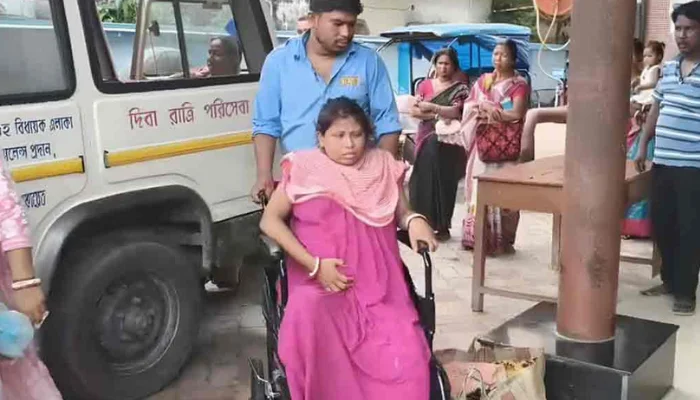
Case Summary
In Salmara village, in the Cooch Behar district of West Bengal, a pregnant Hindu woman, along with other BJP workers, was brutally attacked by members of the ruling Trinamool Congress (TMC) party. According to information available, the attackers kicked the heavily pregnant woman on her stomach, leaving her with critical injuries. According to media reports, the victim is 8 months pregnant. She is the daughter of BJP worker Jitendra Barman in the village. The TMC assailants, armed with lathis and bamboo sticks, attacked the residence of Jitendra Barman. The pregnant victim’s mother stated that TMC goons attacked their home. Following this, the victim’s mother was physically assaulted by the attackers. When the pregnant victim attempted to protect her mother, she was kicked in the stomach, causing her severe pain and distress. The assailants then began to vandalise the house, looting ₹1 lakh that had been set aside for her pregnancy expenses. They destroyed everything in the house, including the almirah. The victim’s mother, named Pampa Barman, the TMC Pradhan, her husband, Uttar Barman, and other TMC leaders were named as those who had launched the attack. She also stated that the attackers prevented them from going to the hospital, stopped reporters from reaching their residence, and blocked an ambulance at the market, refusing to allow it to reach their home. Only after the police arrived were they finally able to reach the hospital. Following this, the pregnant victim was admitted to the Cooch Behar Medical College Hospital. According to Avijit Barman, BJP president for Cooch Behar, the attack occurred after a complaint was made against 42 TMC supporters, including Udayan Guha. Following this incident, the TMC initially sought to downplay the incident as a result of internal rivalry within the BJP. Later, it claimed that ‘locals’ had beaten BJP workers for demanding Special Intensive Revision (SIR) and the National Register of Citizens (NRC). The West Bengal unit of the BJP posted on social media: “Pregnant woman kicked in the stomach for supporting BJP. An eight-month pregnant woman was brutally attacked in Cooch Behar’s Dinhata by TMC people. Her only ‘crime’? Believing in BJP!” Reports also state that the TMC goons attacked the homes of other BJP workers, such as Tarini Kanta Barman, Nazirhat-II GP member Juthika Barman, and Mahila Morcha leader Malina Barman. Their houses were vandalised.
Why it is Hate Crime ?
This case has been added to the tracker under the primary category- Attack not resulting in death. Within this, the subcategory selected is- Attacked for supporting/being part of perceived Hindu party/organisation or working for Hindu community In several cases, Hindus are attacked specifically or tangentially for their association with parties or organisations perceived to be pro-Hindu and/or for working in favour of the Hindu community. One of the classic cases was the attack against a Bharatiya Janata Party Yuva Morcha (BJYM) worker Praveen Nettaru. Nettaru was attacked and hacked to death for his association with Hindu organizations and his work for the Hindu community. He was murdered by PFI, a terror organization which aimed to commit a genocide of Hindus, target Hindu leaders specifically and turn India into an Islamic Nation. In such cases, it is possible that the immediate trigger for the violence is non-religious – either according to the perpetrator or the police. However, there are surrounding circumstances from which the conclusion can be reached that the victim was attacked for his association with a Hindu organization. In a similar case, Rinku Sharma was attacked by radicals. He was a member of Bajrang Dal and regularly worked for the Hindu community. While the police cited a different non-religious trigger for the attack, it is true that he was associated to a Hindu organization and the family of Rinku Sharma specifically attributed his gruesome murder to him working for Bajrang Dal and raising Jai Shree Ram slogans. Such cases are intrinsically driven by religious hate and would therefore be documented as a hate crime under this category. In this case, it's first important to state that this incident should be recognised as a hate crime against Hindus rather than simply a case of political rivalry between the BJP and the TMC. While some may be inclined to perceive the attack as politically motivated, it is important to note that the BJP is widely regarded as a Hindutva party. Consequently, attacks on its workers often carry an underlying religious animosity, targeting individuals not just for their political affiliation but for their religious identity. In this instance, the brutal assault on the pregnant woman in Salmara village took place specifically because of her association with the BJP, highlighting the deeply entrenched hatred for her religious beliefs. Such violence, particularly the act of kicking a pregnant woman, transcends mere political rivalry; it is an act of terror against a Hindu individual for supporting a party closely linked to her faith and its interests. This illustrates that attacks on Hindus, often disguised as political animosity, are in reality motivated by a deep-seated contempt for Hindu religious identity. Furthermore, the act of blocking the ambulance from reaching the victim’s house and preventing the family from going to the hospital starkly demonstrated the cruelty and intensity of religious animosity shown by the TMC goons towards the Hindu victims. By denying timely medical assistance to a pregnant woman in urgent need, the perpetrators abandoned all regard for human life and dignity. Such deliberate obstruction revealed not only a disregard for the victim's well-being but also the extreme lengths to which they were willing to go, driven by deep-seated hatred against Hindus. Moreover, the attackers from the TMC did not restrict themselves to a single victim. They targeted other BJP workers, all of whom were Hindus, and vandalised their homes. This widespread targeting of Hindu BJP workers represents a calculated effort to intimidate and injure members of the Hindu community, using the façade of political rivalry to mask religious hatred. Such acts of violence and vandalism against Hindus, simply for supporting a party perceived to be aligned with their religious interests and beliefs, demonstrate that the animosity was directed at their faith and religious identity, not merely their political affiliation. Another important point to highlight is that the TMC attempted to downplay the targeted attack, initially claiming that the attack resulted from internal BJP rivalry and later claiming that it was due to local anger over the implementation of the NRC and SIR. This demonstrates how the state government of West Bengal, led by the TMC, sought to whitewash and minimise the violence against Hindu BJP workers, obscuring the true religious motivations behind the attack. Every aspect of this crime, the selection of victims based on their Hindu faith and BJP association, the excessive violence used, the targeting of Hindu residences, and the whitewashing of the targeted attacks by the TMC, constitutes a hate crime driven by religious animosity. This was not a simple political dispute, but a deliberate attack aimed at oppressing and intimidating Hindus. The underlying religious hostility makes it imperative to recognise the incident as a hate crime, rather than a routine episode of political unrest. It is crucial to understand that such incidents are not isolated. This event forms part of a disturbing pattern of hostility towards Hindus and BJP workers in West Bengal, as evidenced during the violence that occurred in the aftermath of the 2021 Lok Sabha election results. The post-poll violence in West Bengal demonstrated repeated attacks on Hindu individuals and communities, especially those affiliated with the BJP, a party widely identified with Hindu interests. In the wake of elections, mob assaults, destruction of property, and targeted violence disproportionately affected Hindu neighbourhoods and BJP supporters across districts. These attacks, marked by brutality, murders, destruction of Hindu homes, and systemic intimidation, aim to suppress the political voice and religious identity of Hindus, particularly those openly supporting the BJP. Although such violence may outwardly appear as partisan political violence, the underlying ideological realities of West Bengal make it particularly Hinduphobic in nature. Hindu homes, temples, and businesses are frequently targeted. BJP workers, predominantly Hindus, face threats not only for their party loyalty but also for their religious identity. Women affiliated with the BJP have suffered attacks and sexual violence at the hands of TMC assailants. Furthermore, numerous cases of communal violence against Hindus in West Bengal reinforce this pattern. The Murshidabad violence and other incidents in Basirhat, Malda, Midnapore, and Uttar Dinajpur and the state response further exemplify the targeted attacks against Hindus and their systemic whitewashing. For instance, in the Basirhat case (March 2025), a Kali temple was vandalised and the idol desecrated. Following this, the police quickly dismissed the communal nature of the attack and labelled the perpetrator as “mentally unstable” without any serious investigation or due process. This is a familiar pattern used to neutralise public outrage and deflect attention from religiously motivated crimes against Hindus. In the aftermath of widespread anti-Hindu violence in Murshidabad and Malda (April 2025), which included incidents of arson, looting, and idol desecration, the West Bengal Police attempted to present the violence as “minor clashes” or “local disputes” unrelated to religion. Reports indicated that despite credible accounts of Hindu homes and temples being attacked, the police either failed to act in time or took a biased stance that allowed the violence to escalate. In many cases, police statements contradicted eyewitness reports and video evidence shared on social media. The bias of the state extends beyond inaction. There are increasing instances where the state actively suppresses Hindu religious expression. Hindus have been arrested simply for chanting “Jai Shri Ram”, a phrase vilified by sections of the administration and ruling party. Permission for Hindu processions—especially during festivals like Ram Navami or Hanuman Jayanti—is routinely denied on grounds of "law and order concerns", while Muslim religious gatherings face no such hurdles. Moreover, over the years, the Mamata-led government has issued numerous prejudicial directives, like orders restricting Durga Puja immersions, citing Muharram processions. Inaction on anti-Hindu mob violence in areas like Dhulian, Islampur, and Kaliachak. Public endorsements and appeasement of radical clerics and Islamist leaders, while dismissing concerns raised by Hindu groups as “communal provocation”. The systematic suppression of Hindu voices, the denial of communal violence, and the criminalisation of Hindu identity expressions such as “Jai Shri Ram” reflect not just administrative failure but a deeper ideological hostility toward the Hindu community. Given this background, an attack on BJP supporters in West Bengal, especially when the victims are Hindus, cannot be viewed in isolation as mere political rivalry. It is part of a consistent pattern where political violence overlaps with targeted religious hostility. The history of post-poll violence, anti-Hindu administrative actions, and overt communal appeasement by TMC establishes a strong basis for classifying such incidents as violence specifically targeting Hindus. While the West Bengal Police has downplayed the Malda (Ratua) incident as a minor dispute over the parking of a toto (e-rickshaw), such justifications fail to account for the escalation and the clearly targeted nature of the violence that followed. Even if, for the sake of argument, the initial provocation was non-religious in nature, the aftermath was unmistakably communal, with Hindu temples vandalised, Hindu-owned shops looted, houses attacked, and even cows stolen from Hindu cowsheds. This pattern highlights a persistent campaign by the state administration and the West Bengal government to suppress and marginalise the Hindu community because of their religious identity. Given that this case meets multiple criteria of a religiously motivated hate crime, it is being added to the hate crime database. Disclaimer: Media reports do not specify the total number of victims. They mention four BJP leaders whose homes were targeted, and a pregnant woman and her mother were attacked by the TMC goons. Therefore, for documentation purposes, the victim count is recorded as '6'. Reports did not specify the total number of attackers; however, they named two individuals—Pampa Barman and her husband Uttar Barman—along with other TMC goons. For documentation purposes, a conservative estimate has been adopted, and the perpetrator count is recorded as '2'.
Victim Details
Total Victim
6
Deceased
0
Gender
- Male 1
- Female 5
- Third Gender 0
- Unknown 0
Caste
- SC/ST 0
- OBC 0
- General 6
- Unknown 0
Age Group
- Minor 0
- Adult 6
- Senior Citizen 0
- Unknown 0


Case Status
Unknown


Perpetrators Details
Perpetrators
State and Establishment
Perpetrators Range
From 2 To 5
Perpetrators Gender
both
 Sources




