Hindus participating in religious procession targeted for conversion; Christian woman hands out de-addiction pamphlet praising Jesus Christ
 Pune, Maharashtra, India
  21 June, 2025
Case Summary
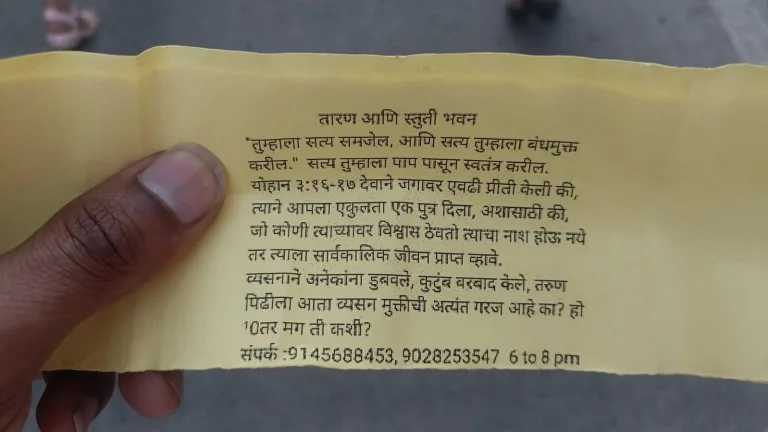
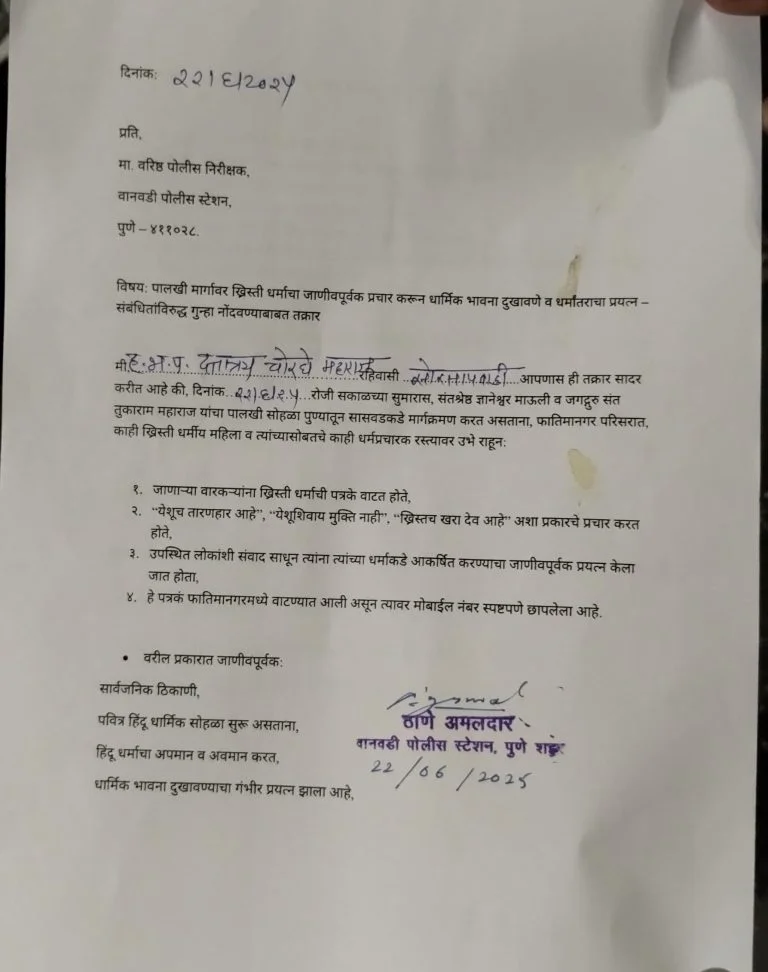
In Pune, Maharashtra, a Hindu religious procession known as the Ashadi Wari pilgrimage was disrupted by a Christian woman. The woman stopped Hindu devotees and attempted to lure them to convert to Christianity under the pretext of deaddiction. She handed out pamphlets to Warkaris, devotees of Lord Vithhal, containing Christian religious content. The Warkari sect is a Vaishnavite tradition of Hinduism rooted in the worship of Vithoba (Vitthal), a form of Krishna/Vishnu, and is geographically and culturally associated with Maharashtra. The annual Ashadi Wari procession attracts hundreds of thousands of Warkaris, who march towards the Pandharpur temple of Lord Vithhal. This procession holds immense spiritual and cultural significance in Maharashtra. The palkis (palanquins) of Sant Tukaram and Sant Dhyaneshwar, two famous Vaishnavite saints, are carried by devotees during this centuries-old pilgrimage on Ashadhi Ekadashi. According to media reports, the Warkari procession was passing through Fatima Nagar in Pune when a Warkari linked to the Hindu organisation named 'Shivpratishthan' caught a Christian woman distributing pamphlets with Bible verses to the Warkaris. She attempted to induce people to convert to Christianity under the pretext of freedom from addiction. The pamphlets, distributed in Marathi, featured statements such as "Jesus is the saviour" and included verses from the Bible. They addressed the problem of addiction damaging families and provided contact numbers for those wishing to become addiction-free. The pamphlets also encouraged people to pray to Jesus. A video of this incident went viral on social media. After the circulation of the viral video, Hindu Rashtra Samanvay Samiti, a Hindu organisation, registered a police complaint against the Christian woman for attempting to disrupt the Wari procession and lure Hindus with false promises. Dattatray Maharaj Chorge, Secretary of the Chintamani Prasadik Dindi, lodged a police complaint on 22nd June 2025 at the Vanwadi Police Station. Hindu Rashtra Samanvay Samiti’s Sachin Ghule, Hindu Janjagruti Samiti’s Shubham Donawade and Shashank Sonawane, and Hindu Dharmpremi’s Shivraj Donawade were present when the complaint was filed. The Hindu Rashtra Samanvay Samiti demanded that a case be registered against the perpetrator under Section 295A (hurting religious sentiments), Section 153A (spreading religious hatred), Section 298 (statements regarding religion with derogatory intent), Section 505(2) (creating enmity between religious communities), and the Maharashtra Freedom of Religion Act, 2023 for attempting to convert individuals to Christianity through fraudulent means.
Case Images
Why it is Hate Crime ?
This case has been added to the tracker under the primary category- Attack not resulting in Death. The subcategory selected is- Attack on religious procession. The outward celebration and display of religious symbols in an intrinsic part of Hinduism. Religious processions on various festivals are age-old traditions and a way to manifest faith and form a part of the religious practices of Hindus. On several occasions, such religious processions come under attack by non-Hindu mobs, in a manifestation of their animosity towards Hinduism and their practices. The reasons cited for such violent attacks are many and range from crossing a non-Hindu resident-dominated area to playing loud music, crossing from an area where there is a religious structure of another faith etc. The violent attacks are triggered by the outward display of religiosity by Hindus. The attacks are mainly a manifestation of religious supremacist doctrine which believes that idolatry, essentially the Hindu faith, is one that deserves to be annihilated since the very tenets of Hinduism, its practices and traditions are considered a sin in those doctrines. Since these attacks emanate from intrinsic and doctrinal animosity towards Hindus and Hinduism, it is considered a religiously motivated hate crime under this category. Another primary category selected is- Predatory Proselytisation. The subcategory selected is- Conversion/ attempts to convert by inducement. Predatory Proselytisation is not just limited to threat, harassment, force and violence, but it also has contours of stealth. In several cases, the Hindu victim is exploited to convert, with non-Hindus taking advantage of their poverty. In such cases, the Hindu victim who is suffering financially is offered monetary benefits, including lucrative offers for jobs, health treatment, education, etc, to induce the victim into changing his/her religion. In such cases, the religious identity of the victim and the aim to disenfranchise him from his faith form the heart of the crime. Also, taking advantage of and exploiting an individual’s economic vulnerabilities is widely acknowledged as exploitation, forms of which are often penalised by law. Such cases therefore are considered religiously motivated hate crimes since the victim’s religious identity forms the very heart of the crime itself. The other subcategory selected is- Proselytisation by grooming, brainwashing, manipulation or subtle indoctrination. Religious brainwashing essentially means the often subtle and forcible indoctrination to induce someone to give up their religious beliefs to accept contrasting regimented ideas. Religious grooming or brainwashing also involves propaganda and manipulation. It involves the systematic effort, driven by religious malice and indoctrination, to persuade “non-believers’ to accept allegiance, command, or doctrine to and of a contrasting faith. Cases of such grooming or brainwashing are far more nuanced than direct threats, coercion, inducement and violence. In such cases, it is often seen that there is repeated, subtle and continual manipulation of the victim to induce disaffection towards their own faith and acceptance of the contrasting faith of the perpetrator. While subtle indoctrination is widely acknowledged as predatory, an element which is often understated in such conversions or the attempts of such conversion is the role of loyalty and trust which might develop between the perpetrator and the victim. Fiduciary relationships are often abused to affect such religious conversion. For example, an educator transmitting religious doctrine of a competing faith to a Hindu student. The Hindu student is likely to accept what the teacher is transmitting owing to existence of the fiduciary relationship. The exploitation of the fiduciary relationship to religiously indoctrinate victims would also be included in this category. Since the underlying animosity towards the victim’s faith forms the basis of predatory proselytization, such cases are considered religiously motivated hate crimes. Another primary category selected in this case is- Attack on Hindu religious representations. Within this, the subcategory selected is- Defiling religious customs. Sanatan Dharma is not a religion of one book, which is to say that while it has religious scriptures that form the central tenets of the faith, there are several traditions followed through thousands of years, mostly passed from generation to generation orally. There are several such customs and traditions that are followed by various Hindus and Hindu sects. Defiling of these traditions and customs is a breach of an individual or group’s religious practices. Such practices can range from dietary restrictions like not eating non-vegetarian food for a certain period of the year, not eating non-vegetarian food at all, not eating beef since the cow is considered holy in Hinduism, the sanctity of religious customs followed in the house (like many ISCKON devotees), etc. Any malicious action leading to the breach of such traditions or defilement of these traditions owing to animosity towards the faith or for the sake of activism stems not only from the lack of faith in the religion itself but also from disregard for the faith of the devotees who follow the customs/traditions and implicit bias against the faith, the tradition itself. Since these specific traditions are central to the faith of the devotees of that specific sect of Hindus, any non-compliance with these traditional rules would be considered a religiously motivated hate crime. This incident at Pune’s Fatima Nagar is a clear example of a hate crime against Hindus, manifesting on multiple levels. The act directly targeted a major Hindu religious procession, the Ashadi Wari, by deliberately disrupting its passage and attempting to manipulate Hindu devotees to convert to Christianity. The Ashadi Wari is not merely a ritual; it holds immense religious and cultural significance for the Warkari Hindu community in Maharashtra. Rooted in centuries-old devotion to Vithoba (Vitthal), a form of Krishna/Vishnu, it gathers hundreds of thousands every year as they march with faith towards the Pandharpur temple. Any attempt to disrupt such a sacred procession is an affront to the religious sentiments and cultural identity of the Hindu community. Such instances demonstrate deep-seated religious hostility towards Hindu practices and values. The Christian perpetrator sought to lure Hindus into conversion under the pretence of deaddiction. This method, offering addiction recovery with strings attached to religious conversion, is inherently coercive and exploitative. Vulnerable individuals wrestling with addiction were targeted, not with genuine compassion, but with conditional assistance rooted in Christian proselytisation. This amounts to coercion, driven by religious animosity, intentionally targeting Hindus in a sacred religious procession and using their vulnerabilities to further a conversion agenda. Such inducements reveal the true, predatory nature of these acts, masking a determined effort to undermine Hindu faith. Such acts are rooted in animosity towards Hinduism and its adherents, making it a religiously motivated crime. Furthermore, the pamphlets distributed at the event carried statements such as “Jesus is the saviour” and instructed Hindus to pray to Jesus. Presenting such messages within the context of addiction recovery is manipulative; it equates to psychological pressure and brainwashing, exploiting emotional and existential struggles to foster dependency on another faith, in this case, Christianity. This manipulation is not merely accidental; it is a deliberate attempt to elevate Christianity over Hinduism, sow confusion, and push vulnerable Hindus towards conversion. Such behaviour demonstrates the religious motivation behind this crime, directly undermining the beliefs and spiritual autonomy of Hindu devotees. The act of deliberately disrupting the Wari procession through proselytisation was a clear desecration of a sacred Hindu custom. Introducing teachings from the Christian faith during a revered Hindu event was not an isolated accident; it was a calculated attempt to defile the sanctity of a profound religious gathering. This was not merely an exchange of beliefs, but a wilful violation of Hindu religious space and sentiments. Such acts of desecration, carried out by the Christian perpetrator, constituted a religiously motivated crime rooted in animosity towards Hinduism. Such acts of Christian proselytisation are inherently anti-Hindu, as Abrahamic faiths dehumanise non-adherents of their faith until they convert. This doctrinal hostility drives aggressive conversion attempts, demonstrating a deep-rooted animosity towards Hindu traditions and the Hindu community, making it a religiously motivated crime. Given that this case meets multiple parameters of a religiously motivated crime, it has been added to the hate crime database.


Case Status
Complaint filed


Perpetrators Details
Perpetrators
Christian Extremists
Perpetrators Range
One Person
Perpetrators Gender
female
 Sources




