Murti of Chhatrapati Shivaji Maharaj desecrated by Muslim man inside Hindu temple in Daund, Maharashtra
 Daund, Maharashtra, India
  25 July, 2025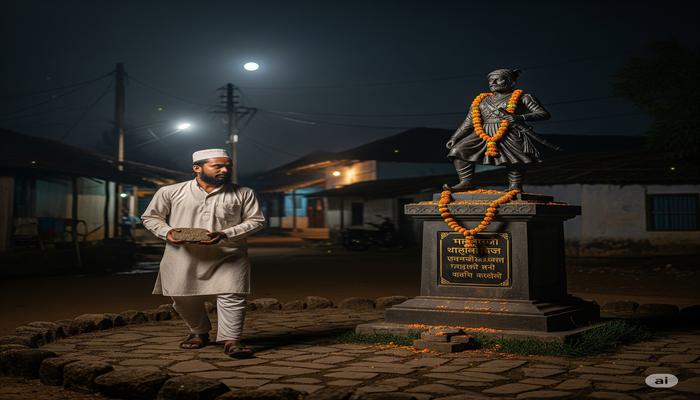
Case Summary
In Yavat village, Daund Taluka, Maharashtra, a murti of Chhatrapati Shivaji Maharaj was desecrated by a Muslim man. The Muslim accused, Amit Sayyad, consumed alcohol at a local tavern and later slept on the bench in the Nilkantheshwar temple. After that, he vandalised the murti of Chhatrapati Shivaji Maharaj installed at the Nilkantheshwar temple around 1:30 AM. He fled the scene, leaving behind his mobile phone and slippers. When Sayyad returned to the tavern the next day, a man advised him to flee instead of informing the police. This accomplice was also arrested. Sayyad was eventually found hiding in a sugarcane field and taken into custody. Both individuals were set to be produced in court. In response to the desecration, a wave of public outrage swept across the region. A bandh was observed throughout Daund taluka on Thursday, with most villages voluntarily shutting down. Police conducted flag marches in Yavat, and additional forces were deployed to maintain peace and order.
Why it is Hate Crime ?
This case has been added to the tracker under the primary category of: - Attack on Hindu religious representations. Within it, the sub-category selected is: - Desecration of Hindu religious symbol. Icons and symbols or a religious representation of a spiritual ideal are widely revered in Hinduism. Iconography is of vital significance in the Hindu milieu. It helps connect people’s spiritual beliefs with the real world. Iconography within the Hindu faith takes several shapes and forms. Murtis are of most significance to Hindus, to which daily rituals, prayers and offerings are done. Besides the murtis, there are several other symbols which have deep significance in the Hindu faith – the Om and Swastika for example. Since these Hindu religious symbols hold paramount importance in Hinduism, any desecration of symbols, icons, murtis, religious representations and manifestations, is driven by animosity towards the faith itself which manifests itself through these murtis, icons and symbols. Therefore, any desecration of these Hindu religious symbols and representations is considered religiously motivated hate crimes under this category. The other sub-category selected is - Attack on Temples. In Hinduism, a temple is the abode of the Deity. The Deity in the Temple is consecrated, thereby, making it a real, breathing entity. Hindus believe that not just the Deity but the temple premises itself are sacred to Hindus since Hindus hold the faith that the entire Temple space is an amalgamation of the divine energy of the deity. Given the central significance of Temples in Hindu Dharma, any attack against a Hindu Temple or its peripheral premises is an attack on the faith itself and is born out of animosity towards the faith, of which, the Temple is a central tenet. Any manner of attack against a Temple and/or its premises would therefore be considered a religiously motivated hate crime. The other sub-category selected is - Breaking rules of place of worship. Sanatan Dharma is not a religion of one book, which is to say that while it has religious scriptures that form the central tenets of the faith, there are several traditions followed through thousands of years, mostly passed from generation to generation orally. One of these oral traditions or written traditions is the rules of specific temples. Certain temples have rules which are traditional rules, dependent on the worship of the presiding deities. These rules and traditions have been followed for thousands of years whether they find scriptural mention or not. Such traditions are based on the nature and rules of worship of the presiding deity of that temple. Any non-compliance of these traditions owing to animosity towards the faith or for the sake of activism stems not only from the lack of faith in the presiding deity but also disregard for the faith of the devotees of that deity/temple and implicit bias against the faith, the tradition and the deity itself. Since these specific traditions are central to the faith of the devotees of that specific temple and presiding deity, any non-compliance with these traditional rules would be considered a religiously motivated hate crime. The other sub-category selected is - Defiling religious customs. Sanatan Dharma is not a religion of one book, which is to say that while it has religious scriptures that form the central tenets of the faith, there are several traditions followed through thousands of years, mostly passed from generation to generation orally. There are several such customs and traditions that are followed by various Hindus and Hindu sects. Defiling of these traditions and customs is a breach of an individual or group’s religious practices. Such practices can range from dietary restrictions like not eating non-vegetarian food for a certain period of the year, not eating non-vegetarian food at all, not eating beef since the cow is considered holy in Hinduism, the sanctity of religious customs followed in the house (like many ISCKON devotees), etc. Any malicious action leading to the breach of such traditions or defilement of these traditions owing to animosity towards the faith or for the sake of activism stems not only from the lack of faith in the religion itself but also from disregard for the faith of the devotees who follow the customs/traditions and implicit bias against the faith, the tradition itself. Since these specific traditions are central to the faith of the devotees of that specific sect of Hindus, any non-compliance with these traditional rules would be considered a religiously motivated hate crime. This incident qualifies as a hate crime against Hindus because it involves a direct attack on a sacred murti of Chhatrapati Shivaji Maharaj — a revered symbol of Hindu dharma and civilisational pride. Icons and symbols, or a religious representation of a spiritual ideal, are widely revered in Hinduism. Iconography is of vital significance in the Hindu milieu. It helps connect people’s spiritual beliefs with the real world. Iconography within the Hindu faith takes several shapes and forms. Therefore, any desecration of these Hindu religious symbols and representations is considered a religiously motivated hate crime. Chhatrapati Shivaji Maharaj is celebrated as a protector of Hindu culture and religion during a period when the Indian subcontinent was under the influence of the tyrannical Mughal rule. He established a Hindu kingdom and worked to revive and protect Hindu traditions, temples, and customs. He is seen as a saviour who defended Hindu traditions and practices from potential suppression, which is why he is venerated by Hindus. Desecration of such an icon — especially one as deeply embedded in the Hindu conscience as Chhatrapati Shivaji Maharaj — is not an isolated act of vandalism but a deliberate, targeted expression of hostility toward Hindu religious sentiments. It signifies contempt for the spiritual symbols that Hindus hold sacred and is intended to cause distress, provoke outrage, and assert dominance over the cultural space Hindus revere. The act occurred within the premises of Nilkantheshwar temple, a sacred space considered the abode of the Divine in Hindu thought. The temple is more than just a building; it is a consecrated site that houses divine presence and spiritual energy. Vandalising a murti inside a temple is an act of violence against the sanctity of the temple space itself, meant to provoke and injure religious sentiments. Such an attack is not merely criminal but a deliberate transgression into a sacred sphere, amounting to a hate crime against the Hindu faith, since the temple embodies the religious and cultural life of its adherents. The accused entered the temple in an intoxicated state, slept on the bench inside, and then committed an act of desecration. In Hindu traditions, purity is fundamental to temple entry and conduct within temple premises. Consuming alcohol before entering a temple, and sleeping within it, especially while intoxicated, violates longstanding religious norms observed by temple-goers and caretakers. Such blatant disregard for the sanctity of the space indicates not ignorance, but contempt for the religious discipline and decorum expected in a place of worship. This deliberate breach qualifies as a religiously motivated hate crime, as it is a violation driven by disrespect for Hindu temple traditions. The act of entering a Hindu temple while intoxicated and treating it as a casual resting place violates core religious customs regarding ritual purity, sanctity of space, and acceptable behaviour in sacred sites. Hinduism holds alcohol and intoxication to be ritually impure in most sects, especially in association with temple spaces. This act, therefore, amounts to a defilement of religious customs deeply respected and followed by Hindus across traditions. The conscious violation of these customs—particularly in such a sacred context—reflects bias, contempt, or provocation toward Hindu religious norms. As such, it rises to the level of a hate crime, attacking both communal practice and collective faith. Here, one could argue that the Muslim accused was drunk and therefore not in a right state of mind. But it is important to understand that intoxication does not absolve criminal intent when the act itself reveals deliberate targeting of a religious symbol. In this case, the accused specifically desecrated a murti of Chhatrapati Shivaji Maharaj — not an arbitrary object or unrelated property. Even under the influence of alcohol, target selection indicates motive. If the accused had no hostility or intention, his actions could have been erratic or aimless. Instead, the destruction was directed at a revered religious and cultural figure, revealing a deeper animosity rather than random behaviour. Such targeted destruction is not a random or drunken outburst but a conscious act of hostility against the faith and its public expressions. By attacking a symbol central to Hindu identity and devotion, the act expresses animosity toward the Hindu community as a whole, fulfilling the criteria of a religiously motivated hate crime.


Case Status
Arrested


Perpetrators Details
Perpetrators
Muslim Extremists
Perpetrators Range
One Person
Perpetrators Gender
male
 Sources




