Hindu students threatened and punished by school authorities for wearing kalava and tilak
 Indore, Madhya Pradesh, India
  3 August, 2025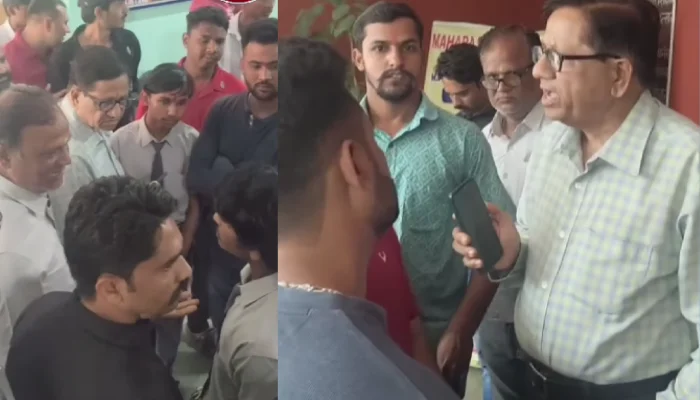
Case Summary
In Indore, Madhya Pradesh, Hindu students were disallowed, threatened, and punished for wearing a Tilak and Kalava (Raksha Sutra), both Hindu religious symbols, by the school authorities. According to reports, the incident occurred at the Malhar Rao Yashwant School in the Annapurna police station area. On the day of the incident, at around 10 am, the Hindu students of the school were asked to remove their Kalava, a sacred Hindu thread, and wipe off their Tilak, a sacred Hindu mark on the forehead, by the school principal. The matter reached the student department of Bajrang Dal, after which a large number of workers reached the school. Members of Bajrang Dal said that some students had complained that when they reached school with a Tilak and tied the Kalava, the principal refused to let them in and asked them to erase the Tilak. When the students protested this, they were threatened and punished. After receiving the complaint, officers and workers of the student department of Bajrang Dal arrived at the school and discussed the matter with the principal. The principal initially denied the allegations, but other victim students on the scene also came forward and kept their word before the activists. Annapurna police reached the spot, and when the situation worsened, they intervened and calmed the environment. Following the outrage, school director Ashok Bhargava and Principal Monika assured Bajrang Dal office bearers that there would be no restriction on students coming with a Tilak and Kalava.
Why it is Hate Crime ?
This case has been added to the tracker under the primary category- Attack not resulting in death. Within this, the subcategory selected is- Attacked for Hindu identity. In several cases, Hindus are attacked merely for their Hindu identity without any perceived provocation. A classic example of this category of religiously motivated hate crime is a murder in 2016. 7 ISIS terrorists were convicted for shooting a school principal in Kanpur because they got ‘triggered’ seeing the Kalava on his wrist and tilak that he had put. In this, the Hindu victim had offered no provocation except for his Hindu religious identity. The motivation for the murder was purely religious, driven by religious supremacy. Such cases where Hindus are targeted merely for their religious identity would be documented as a hate crime under this category. Another primary category selected is- Restriction/ban on Hindu religious practice. Within this, the subcategory selected is- Restriction on expression of Hindu identity. An example of the state-affected prejudicial and targeted orders against the Hindu community would be a government denying the right of a Hindu or a group of Hindus to hold a religious procession owing to the animosity of non-Hindu groups. Denial of the religious right of the Hindus to assuage the non-Hindu group which harbours animosity to a point where it could lead to violence against Hindus is not only a failure of law and order but is a prejudicial order against Hindus, denying them their fundamental rights to express their religious identity. An example of a hate crime against Hindus by a non-Hindu would be a non-Hindu institution forcing its Hindu employees to abandon religious symbols that a Hindu would wear as an expression of faith owing to inherent prejudice against the faith professed by the victim or a non-Hindu group of people restricting a Hindu group from constructing a place of worship simply because the demography of the area in which the temple is being built is dominated by non-Hindus. Such actions are driven by religious animosity and/or prejudice against Hindus and their faith and would therefore be categorized as a hate crime. Another primary category relevant in this case is- Hate Speech against Hindus. Within this, the subcategory selected is- Violent Threats. Violent threats, explicit, implicit or implied, is the most dangerous form of hate speech since it goes beyond discriminatory and prejudicial language to express the intent of causing harm to an individual or a group of people based on their religious identity and faith. There could be several different kinds of threats that are issued to Hindus based on religious animosity. An explicit threat would mean the direct threat of violence towards an individual Hindu, a group of Hindus or Hindus at large. Physical violence, death threats, threats of destruction of property belonging to Hindus and threats of genocide would mean explicit threats against Hindus for their religious identity. Implicit threats may not be a direct threat but implied through the use of symbols of actions – for example – in the Nupur Sharma case, other than explicit threats, there were also implicit threats when Islamists took to the streets to burn and beat her effigies. It implies that they want to do the same to Nupur Sharma – thereby is considered an implicit threat. Violent threats can be delivered in person, through letters, phone calls, graffiti, or increasingly through social media and other online platforms. It would be important to understand that a threat – explicit or implicit, online or offline – to an individual who happens to be a Hindu does not qualify as a religiously motivated threat. Such a threat, while vile and dangerous, could be owing to non-religious reasons and/or personal animosity. To qualify as a religiously motivated threat, it would need to exhibit an indication that the individual is being targeted for religious reasons and/or owing to his/her religious identity as a Hindu. The other primary category selected here is- Predatory Proselytisation. Under this, the sub-category selected is- Proselytisation by grooming, brainwashing, manipulation or subtle indoctrination. Religious brainwashing essentially means the often subtle and forcible indoctrination to induce someone to give up their religious beliefs to accept contrasting regimented ideas. Religious grooming or brainwashing also involves propaganda and manipulation. It involves the systematic effort, driven by religious malice and indoctrination, to persuade “non-believers’ to accept allegiance, command, or doctrine to and of a contrasting faith. Cases of such grooming or brainwashing are far more nuanced than direct threats, coercion, inducement and violence. In such cases, it is often seen that there is repeated, subtle and continual manipulation of the victim to induce disaffection towards their own faith and acceptance of the contrasting faith of the perpetrator. While subtle indoctrination is widely acknowledged as predatory, an element which is often understated in such conversions or the attempts of such conversion is the role of loyalty and trust which might develop between the perpetrator and the victim. Fiduciary relationships are often abused to affect such religious conversion. For example, an educator transmitting religious doctrine of a competing faith to a Hindu student. The Hindu student is likely to accept what the teacher is transmitting owing to existence of the fiduciary relationship. The exploitation of the fiduciary relationship to religiously indoctrinate victims would also be included in this category. Since the underlying animosity towards the victim’s faith forms the basis of predatory proselytization, such cases are considered religiously motivated hate crimes. In this case, Hindu children were forced to remove their Tilak and Kalava, both of which are auspicious Hindu religious symbols. When they protested, they were threatened and punished by the principal and the school authorities. This is a clear example of religious intolerance and a hate crime against Hindu children. This act goes beyond mere disciplinary action and enters the realm of targeted hostility against Hindu students for their religious identity, raising serious questions about the protection of Hindus in educational institutions. The Tilak and Kalava are not merely decorative things; they hold profound spiritual and cultural significance for Hindus. It is an emblem of Hindu religious identity, often worn during prayers, rituals, and as a daily affirmation of faith. Forcing Hindu students to remove these religious symbols is a deliberate effort to erase their religious identity and expression. Such an act is deeply disrespectful and is an attack on the core values and practices of Hinduism. Moreover, this incident represents a clear restriction on the expression of the Hindu identity of Hindu children. The school authorities' action sends a chilling message that Hindu symbols are not welcome and that Hindu students would be punished or harassed for displaying them. This not only infringes upon a Hindu child’s fundamental right to religious expression but also sets a dangerous precedent for other Hindu students who may feel compelled to hide their faith to avoid similar treatment. The targeting of Hindu children specifically because of their Hindu identity further underscores the gravity of the incident. The authorities' actions were not random or based on a general school policy prohibiting all religious symbols; rather, it was directed to selectively target Hindu children for displaying visible religious markers associated with the Hindu faith. The school authorities hold a position of trust and responsibility, and their actions have a profound impact on the emotional and psychological well-being of their students. When authorities target and threaten children on the basis of their religious identity, it constitutes a grave abuse of power. Such actions contribute to an environment of intolerance towards Hindu children, their religion, and religious symbols. Another point to highlight is that the Hindu children were threatened and punished when they protested against the authorities. This showcases the element of intimidation and coercion involved in targeting the religious identity of the Hindu victims. This is not merely an act of discipline, but a deliberate attempt to suppress a particular religious identity through fear and punishment. Finally, the emotional trauma experienced by the children as a result of this incident cannot be overstated. Being singled out, humiliated, and threatened for expressing their faith can have a profound impact on the sense of self-worth and belonging of Hindu children. It sends a message that Hindu identities are less valued or even unwelcome. Such actions are common tactics in environments where subtle or overt pressure is used to alienate Hindu children from their religious identity. It serves as the first step in a larger pattern of grooming, where consistent ridicule and punishment for Hindu practices make a child more susceptible to abandoning their faith and embracing another under pressure. Such acts result in Hindu children being constantly insecure about their own religious identity. Such actions are rooted in bias and disdain for Hinduism, its adherents and its practices, making it a religiously motivated crime. Here, it is important to mention that in 2022, a massive controversy had erupted in Karnataka, which took a national form, after Muslim women had insisted that they should be allowed to wear burqas and hijabs in their schools and classrooms. That time, the argument that was given by several politicians, social commentators, Hindu activists and even the Judiciary was that that schools have the right to enforce uniform rules, since wearing uniforms bring harmony and equality in the classroom, and therefore, schools not allowing girls to wear hijab in the classroom is not religious discrimination, but merely an enforcement of widely accepted uniform norms. The pseudo-seculars and leftist groups may argue that a similar line of reasoning should be applied in this case. However, it becomes important to mention here that most uniform codes focus on standardising clothing and accessories like shoes, belts, and hair. A Tilak and Kalava don’t change the appearance of the uniform itself. This religious symbol is benign and does not cause disruption or harm, raising serious concerns about the motivations behind such enforcement. When an ostensibly secular institution imposes restrictions specifically targeting Hindu religious symbols, it reflects institutional prejudice against Hinduism. This form of targeted suppression echoes broader patterns where Hindu practices are curtailed under the guise of neutrality or discipline, often to appease other religious groups. The actions of the school authorities amount to religious discrimination and are consistent with the framework of a hate crime, where Hindus are penalised solely for adhering to their Hindu religious practices. Since this case meets multiple parameters of a religiously motivated crime, it is being added to the hate crime database.


Case Status
Unknown


Perpetrators Details
Perpetrators
Others
Perpetrators Range
One Person
Perpetrators Gender
female
 Sources




