Hindu women targeted for conversion through deceptive healing meeting in Mau, Uttar Pradesh
 Mau, Uttar Pradesh, India
  1 August, 2025
Case Summary
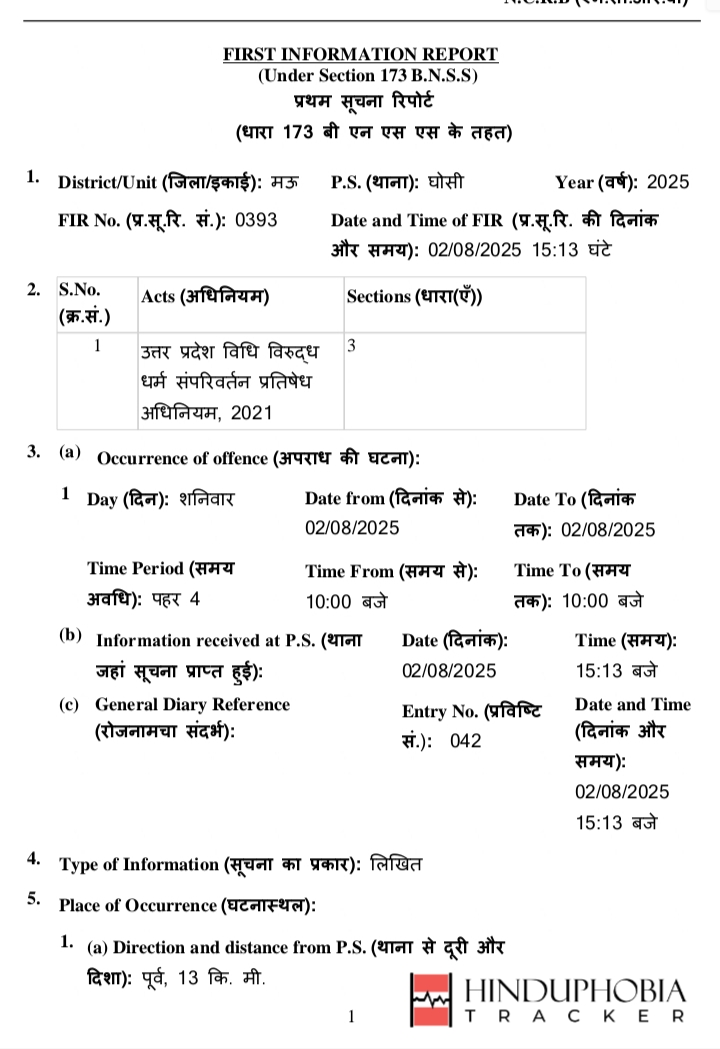
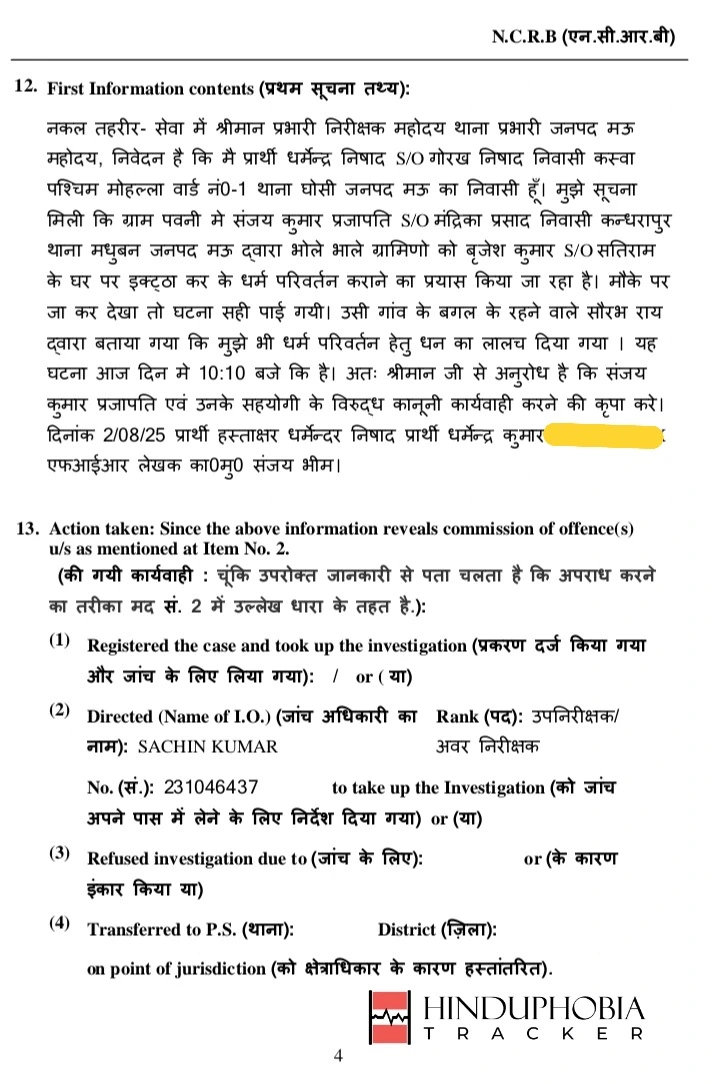
In the Mau district, Uttar Pradesh, Christian missionaries attempted to convert Hindu women to Christianity under the pretext of a “healing meeting”. The accused also offered inducements. Hinduphobia Tracker obtained a copy of the FIR. It was filed by Dharmendra Nishad. According to the FIR, Dharmendra received information about an ongoing conversion activity in Pavani village, where Sanjay Kumar Prajapati was gathering villagers at the house of Brijesh Kumar (son of Satiram) and attempting to convert them. Upon reaching the location at around 10:10 AM, he witnessed the activities himself. Another villager, Saurabh Rai, informed him that he too had been offered money as an incentive to convert. According to reports, Hindu women from villages had gathered there. Bajrang Dal district convenor Pranshu Singh, along with his supporters, arrived at the venue and reported that the organisers were orchestrating mass religious conversions. He stated that the event was being used to mislead and convert innocent Hindu villagers, primarily women, by promising miraculous healing. He confirmed that the copy of the Bible was found at the scene. Based on the complaint, Ghosi police registered an FIR against Sanjay Kumar Prajapati and his associates. Two individuals were taken into custody, and legal proceedings have been initiated. The Circle Officer of Ghosi confirmed that efforts were underway to convert people by misleading them and offering incentives.
Case Images
Why it is Hate Crime ?
This case has been added to the tracker under the primary category of: - Predatory proselytisation. Within it, the sub-category selected is: - Conversion/ attempts to convert by inducement. Predatory Proselytisation is not just limited to threat, harassment, force and violence, but it also has contours of stealth. In several cases, the Hindu victim is exploited to convert, with non-Hindus taking advantage of their poverty. In such cases, the Hindu victim who is suffering financially is offered monetary benefits, including lucrative offers for jobs, health treatment, education, etc, to induce the victim into changing his/her religion. In such cases, the religious identity of the victim and the aim to disenfranchise him from his faith form the heart of the crime. Also, taking advantage of and exploiting an individual’s economic vulnerabilities is widely acknowledged as exploitation, forms of which are often penalised by law. Such cases therefore are considered religiously motivated hate crimes since the victim’s religious identity forms the very heart of the crime itself. The other sub-category selected is - Proselytisation by grooming, brainwashing, manipulation or subtle indoctrination. Religious brainwashing essentially means the often subtle and forcible indoctrination to induce someone to give up their religious beliefs to accept contrasting regimented ideas. Religious grooming or brainwashing also involves propaganda and manipulation. It involves the systematic effort, driven by religious malice and indoctrination, to persuade “non-believers’ to accept allegiance, command, or doctrine to and of a contrasting faith. Cases of such grooming or brainwashing are far more nuanced than direct threats, coercion, inducement and violence. In such cases, it is often seen that there is repeated, subtle and continual manipulation of the victim to induce disaffection towards their own faith and acceptance of the contrasting faith of the perpetrator. While subtle indoctrination is widely acknowledged as predatory, an element which is often understated in such conversions or the attempts of such conversion is the role of loyalty and trust which might develop between the perpetrator and the victim. Fiduciary relationships are often abused to affect such religious conversion. For example, an educator transmitting religious doctrine of a competing faith to a Hindu student. The Hindu student is likely to accept what the teacher is transmitting owing to existence of the fiduciary relationship. The exploitation of the fiduciary relationship to religiously indoctrinate victims would also be included in this category. Since the underlying animosity towards the victim’s faith forms the basis of predatory proselytization, such cases are considered religiously motivated hate crimes. In this case, Hindu villagers, particularly women, were targeted for conversion to Christianity by offering false promises of healing and offering monetary incentives. The use of healing as a cover for conversion constitutes a hate crime against Hindus because it exploits the physical and emotional vulnerability of Hindu women, particularly those suffering from illness or distress. By presenting Christian prayer as a miraculous cure, the organisers implicitly demean Hindu spiritual traditions and practices, suggesting they are ineffective or false. This deceptive approach targets faith itself, aiming to weaken the spiritual confidence of Hindus and lure them into a different religion under false pretences. Such tactics are not acts of compassion but deliberate attempts to undermine and replace Hindu belief through manipulation. Similarly, offering money to induce religious conversion is a targeted form of exploitation rooted in contempt for the Hindu faith. It preys on economically weaker sections of Hindu society, commodifying religion and presenting conversion as a transaction. By using financial incentives to tempt Hindus to abandon their dharma, the organisers demonstrate clear religious hostility. This is not charitable assistance but a calculated strategy to dismantle Hindu identity through coercion and manipulation, qualifying it as a hate crime aimed at erasing the faith and cultural continuity of the Hindu community. The so-called “healing meeting” was not a one-time, spontaneous act of conversion, but a calculated and organised event designed to subtly induce disaffection towards Hindu dharma. It exploited the vulnerability of over 400 Hindu women by promising relief from suffering through Christian prayer, presenting it as a superior spiritual solution—without openly acknowledging the religious agenda behind it. This pattern reflects classic brainwashing and manipulation: the repeated suggestion that one’s current faith is ineffective, while another offers healing, comfort, and salvation. It is not based on dialogue or consent, but on emotional conditioning and religious propaganda. Furthermore, the structure of the event reflects elements of fiduciary manipulation. The organiser positioned himself as a spiritual guide or healer—a figure expected to be trustworthy and benevolent. Many attendees, suffering and desperate, were drawn to this perceived care and concern, and were thus more open to absorbing the underlying messages of Christian superiority. This emotional trust was betrayed to erode their confidence in Hindu beliefs and replacing them with the doctrine of another religion. The entire process was subtle yet strategic, emotionally charged yet disguised as benevolence—fitting squarely within the definition of religious grooming and subtle indoctrination. Given that such predatory proselytisation was aimed exclusively at Hindus, particularly women, the case reflects a religiously motivated targeting and therefore constitutes a hate crime under this category.


Case Status
Arrested


Perpetrators Details
Perpetrators
Christian Extremists
Perpetrators Range
From 2 To 5
Perpetrators Gender
male
 Sources




