Hindu men attacked and obstructed from performing cremation rites by Muslim mob in Rajasthan
 Beawar, Rajasthan, India
  27 July, 2025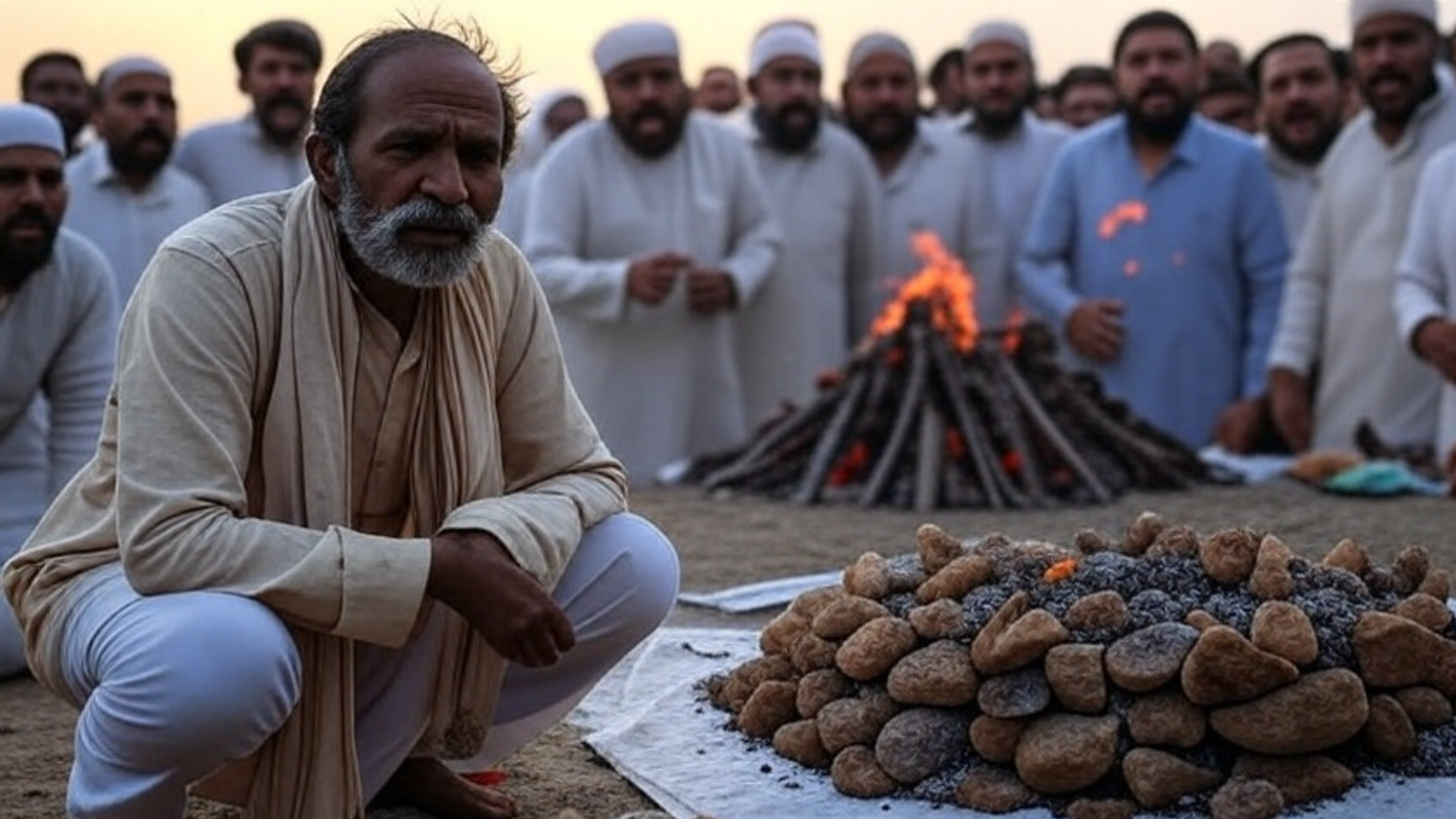
Case Summary
In Rajasthan’s Beawar region, two Hindu men, Roshan from Saradhna village and Kalu Singh, were separately obstructed from performing the cremation of their respective fathers, in line with Hindu rites. Both incidents occurred within the broader context of growing religious coercion targeting the Cheeta-Mehrat community in parts of Ajmer, Bhilwara, Rajsamand, Pali, and Beawar. In Saradhna, Kalu Singh attempted to cremate his father following traditional Hindu customs. However, a group of Muslim men from the village, emboldened by Islamist influence, intervened and demanded that the body be buried as per Islamic practice. When Roshan refused, the mob resorted to stone-pelting. In the days that followed, his dairy booth was boycotted by villagers, forcing him to shut it down and switch to driving a water tanker for survival. Separately, Rakesh faced identical pressure when his father passed away. Locals insisted that the body be buried. Prem stood firm in his Hindu identity and insisted on cremation. The situation escalated to the point that police were called in to ensure the cremation could take place safely. Prem later revealed that Badiya village had no cremation ground until he personally arranged for one through official channels. These events were part of a larger trend reported in the region, where radical Islamic clerics, many from outside Rajasthan, were attempting to impose Islamic norms on historically Hindu-practising OBC communities like the Cheeta-Mehrats and Kathats. Although segments of these communities adopted partial Islamic customs centuries ago, their marriage, worship, and death rituals remained predominantly Hindu. Village after village was witnessing the rise of new mosques and madrasas. Islamic preachers were influencing villagers to adopt names, dress codes, and practices strictly in line with Islamic orthodoxy. Resistance is being met with intimidation, ostracism, and in several cases, economic and social punishment. The Hinduphobia Tracker has already documented a case where in Suhawa village, Sajjan Kathat, a Hindu man, was expelled from his own village after he refused to circumcise his young son. This demand was made by local Muslim men who had recently begun enforcing stricter Islamic practices across the village. Sajjan was banned from accessing his farmland, denied water, excluded from social gatherings, and left entirely cut off from his ancestral land. Local leader Chhotu Singh Chauhan, head of the Rajasthan Cheeta-Mehrat Hindu Magra-Merwara Mahasabha, reported that organised conversion campaigns were underway, specifically targeting OBC Hindu communities under the guise of religious purification.
Why it is Hate Crime ?
The primary category under this is: Attack not resulting in death. The subcategory under this is: Attacked for Hindu identity. In several cases, Hindus are attacked merely for their Hindu identity without any perceived provocation. A classic example of this category of religiously motivated hate crime is a murder in 2016. 7 ISIS terrorists were convicted for shooting a school principal in Kanpur because they got ‘triggered’ seeing the Kalava on his wrist and tilak that he had put. In this, the Hindu victim had offered no provocation except for his Hindu religious identity. The motivation for the murder was purely religious, driven by religious supremacy. Such cases where Hindus are targeted merely for their religious identity would be documented as a hate crime under this category. The other primary category selected is - Restriction/ban on Hindu practices. The sub-category selected is - Restriction on expression of Hindu identity. An example of the state-affected prejudicial and targeted orders against the Hindu community would be a government denying the right of a Hindu or a group of Hindus to hold a religious procession owing to the animosity of non-Hindu groups. Denial of the religious right of the Hindus to assuage the non-Hindu group which harbours animosity to a point where it could lead to violence against Hindus is not only a failure of law and order but is a prejudicial order against Hindus, denying them their fundamental rights to express their religious identity. An example of a hate crime against Hindus by a non-Hindu would be a non-Hindu institution forcing its Hindu employees to abandon religious symbols that a Hindu would wear as an expression of faith owing to inherent prejudice against the faith professed by the victim or a non-Hindu group of people restricting a Hindu group from constructing a place of worship simply because the demography of the area in which the temple is being built is dominated by non-Hindus. Such actions are driven by religious animosity and/or prejudice against Hindus and their faith and would therefore be categorized as a hate crime. In this case, obstruction of Hindu cremation rites constitutes a direct restriction on the expression of Hindu identity. Cremation, as prescribed in Hindu dharma, is a core religious obligation, and denying this rite strikes at the very heart of Hindu belief and practice. The pressure exerted by non-Hindu groups to bury the deceased according to Islamic norms, coupled with mob intimidation, stone-pelting, and economic boycott, demonstrates deliberate interference motivated by religious animosity. Such acts are not mere disputes over custom—they are targeted attempts to suppress the public and communal expression of Hindu faith. By preventing Hindus from performing sacred rites central to their identity, these perpetrators aimed to erase Hindu religious practice in favour of another, thereby qualifying as a religiously motivated hate crime. Also, the violence was not random but specifically aimed at stopping a Hindu ritual and enforcing burial under Islamic customs. This physical attack, rooted purely in religious animosity and the desire to suppress Hindu practices, mirrors other cases where Hindus have been targeted solely for expressing their faith. The assault was thus a direct act of aggression motivated by Hindu identity, fulfilling the criteria for a religiously motivated hate crime. These events are not anomalous; they must be understood within a broader and deepening trend across Rajasthan’s Ajmer, Bhilwara, Rajsamand, Pali, and Beawar districts, wherein segments of the Cheeta-Mehrat and Kathat communities, long characterised by a composite cultural identity, are being pressed into abandoning residual Hindu observances in favour of full Islamic conformity. The denial of cremation, under threat or imposition of Islamic alternatives, constitutes an attack on Hindu identity and an active suppression of religious freedom. These acts were neither symbolic nor inconsequential; they disrupted the essential rites of passage for the deceased and inflicted public humiliation and economic punishment upon the surviving family members for adhering to their dharma. The pattern in both cases bears the essential features of a religiously motivated hate crime. Here, the victims were not passive subjects of administrative oversight or local dispute; they were deliberately obstructed by persons who, driven by religious prejudice, sought to overwrite Hindu rituals with Islamic mandates. The systematic nature of these infringements, coupled with the role of external religious agitators, qualifies these incidents not as isolated social tensions but as deliberate assaults on Hindu religious expression and practice. Disclaimer: It is important to clarify that none of the media sources covering this case have specified the exact date on which the incident happened. Therefore, for documentation purposes, we have recorded the date based on when the incident was reported in the media.
Victim Details
Total Victim
2
Deceased
0
Gender
- Male 2
- Female 0
- Third Gender 0
- Unknown 0
Caste
- SC/ST 0
- OBC 0
- General 0
- Unknown 2
Age Group
- Minor 0
- Adult 0
- Senior Citizen 0
- Unknown 2


Case Status
Unknown


Perpetrators Details
Perpetrators
Muslim Extremists
Perpetrators Range
Unknown
Perpetrators Gender
unknown
 Sources




