Hindu youth lured into Christianity through financial incentives and mockery of Hindu scriptures
 Pimpri-Chinchwad, Maharashtra, India
  26 July, 2025
Case Summary
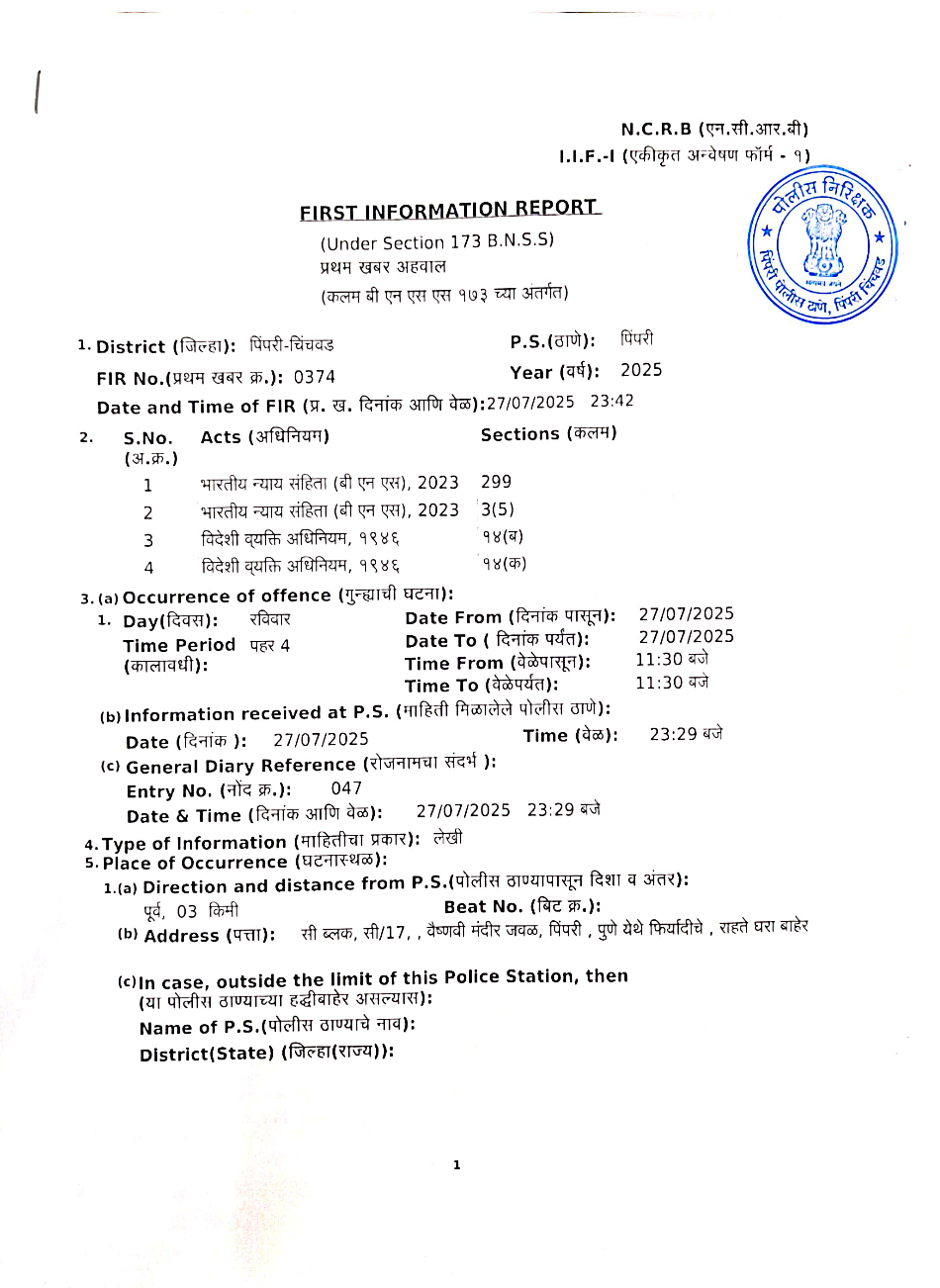
In Pimpri-Chinchwad, Maharashtra, a 27-year-old Hindu man named Sunny Dhanani was lured to convert to Christianity. The accused were two Christians, one of whom was a foreign national. The Hindu victim was enticed with financial incentives and manipulated into converting. The accused also denigrated Hinduism and Hindu scriptures. The accused were identified as Schaefer Javin Jacob (41), a resident of California, USA, and Steven Vijay Kadam (46), a resident of Raisoni Society, Pimpri. According to news reports, the Hindu victim lodged a complaint at the local police station. According to the complaint, Jacob and Kadam urged him to embrace Christianity, assuring him and his family of peace, wealth, mental well-being, and financial support in return. The accused presented themselves as religiously knowledgeable individuals. They maliciously quoted Hindu scriptures and portrayed Christianity as a superior path to salvation. Following this, the Hindu victim became suspicious, and he informed the police about this incident. Subsequently, both accused were arrested. The authorities also took a minor boy into custody, whose exact role in the case was yet to be clarified. It was suspected that he may have been used to gain the trust of families or to assist in meetings and outreach. The Hindu victim, Dhanani, in his FIR confirmed, “They told me that if I accepted Christianity, I would be happy, mentally peaceful, and financially stable. They also promised help from foreign sources.” The accused even used emotional manipulation and selective interpretation of Hindu religious texts as a tool to further their agenda of religious conversion. Police seized electronic devices and religious literature from the accused, which had been used for religious indoctrination. The police investigations also established that Jacob and Kadam were engaged in a wider effort to influence and convert Hindus, using WhatsApp, mobile calls, and face-to-face interactions to reach out to local families. Following this, the Pimpri-Chinchwad Police registered a case against the accused under multiple provisions of the Bharatiya Nyaya Sanhita (BNS) and the Foreigners Act. The accused were charged under Section 299 of the BNS, relating to deliberate and malicious acts intended to outrage religious feelings, and Section 3(5), for attempting to convert individuals through inducement. Additionally, Sections 14(b) and 14(c) of the Foreigners Act were invoked against the American national for engaging in activities that violated the conditions of his visa. A senior officer from Pimpri-Chinchwad Police remarked, “We are taking this matter seriously. Misuse of a tourist visa for religious propagation is a violation of national security norms and will be dealt with strictly.” Investigations also revealed that Jacob had been visiting India since 2016 on tourist and business visas, raising concerns over the potential misuse of visa provisions to conduct religious propagation under the guise of legitimate travel. Following this, the immigration authorities were also notified about this incident. The accused might face deportation and a permanent revocation of his visa. Meanwhile, investigations also began regarding the origin of the funds, the network supporting such activities, and whether other foreign nationals were involved.
Case Images
Why it is Hate Crime ?
This case has been added to the tracker under the primary category- Predatory Proselytisation. Within this, the subcategory selected is- Conversion/ attempts to convert by inducement. Predatory Proselytisation is not just limited to threat, harassment, force and violence, but it also has contours of stealth. In several cases, the Hindu victim is exploited to convert, with non-Hindus taking advantage of their poverty. In such cases, the Hindu victim who is suffering financially is offered monetary benefits, including lucrative offers for jobs, health treatment, education, etc, to induce the victim into changing his/her religion. In such cases, the religious identity of the victim and the aim to disenfranchise him from his faith form the heart of the crime. Also, taking advantage of and exploiting an individual’s economic vulnerabilities is widely acknowledged as exploitation, forms of which are often penalised by law. Such cases therefore are considered religiously motivated hate crimes since the victim’s religious identity forms the very heart of the crime itself. The other subcategory selected is- Proselytisation by grooming, brainwashing, manipulation, and subtle indoctrination. Within this, the tertiary category selected is - 'Pattern of targeting Hindus'. Religious brainwashing essentially means the often subtle and forcible indoctrination to induce someone to give up their religious beliefs to accept contrasting regimented ideas. Religious grooming or brainwashing also involves propaganda and manipulation. It involves the systematic effort, driven by religious malice and indoctrination, to persuade “non-believers’ to accept allegiance, command, or doctrine to and of a contrasting faith. Cases of such grooming or brainwashing are far more nuanced than direct threats, coercion, inducement and violence. In such cases, it is often seen that there is repeated, subtle and continual manipulation of the victim to induce disaffection towards their own faith and acceptance of the contrasting faith of the perpetrator. While subtle indoctrination is widely acknowledged as predatory, an element which is often understated in such conversions or the attempts of such conversion is the role of loyalty and trust which might develop between the perpetrator and the victim. Fiduciary relationships are often abused to affect such religious conversion. For example, an educator transmitting religious doctrine of a competing faith to a Hindu student. The Hindu student is likely to accept what the teacher is transmitting owing to existence of the fiduciary relationship. The exploitation of the fiduciary relationship to religiously indoctrinate victims would also be included in this category. Since the underlying animosity towards the victim’s faith forms the basis of predatory proselytization, such cases are considered religiously motivated hate crimes. The other subcategory selected is- Attempting to convert/ converting by denigrating Hinduism. In several cases, Hindus are converted or an attempt is made to convert Hindus by denigrating their faith, Hinduism. In such cases, the Hindus associate with the non-Hindu perpetrators often by choice and then, the attempt to convert them by insulting their faith, showing the faith down etc begins. An example of this would be a non-Hindu gathering where the Hindus are attending the gathering of their own free will. However, once they attend the gathering, there is an explicit attempt to convert them by abusing their faith and hailing the faith of the perpetrator. The denigration of the Hindu faith is often based on misrepresentation of the Hindu faith, its doctrine and scriptures and insult to espoused traditions if not blatant lies about Hindu beliefs and ways. Such conversions or attempts at conversions are driven by animosity towards the Hindu faith and are therefore documented as religiously motivated hate crimes. This case stands as a striking example of a hate crime targeting Hindus, clearly motivated by a sustained effort to undermine the religious beliefs and identity of the Hindu community through manipulation, inducement, and religious denigration. The nature of the conversion efforts and the wider impact on the Hindu community all indicate a targeted attack against Hindus as a group. When Christian evangelists and missionaries focus their efforts on converting members of a particular religion, in this case, a Hindu man, then it demonstrates a fundamental disregard for that faith. Conversion, especially when not based on personal conviction but rather on external persuasion or pressure, is not simply about sharing a different belief system. It is an attempt to undermine the values, traditions, and identity of the Hindu victim and the larger Hindu community. In this context, the Christian perpetrators specifically targeted a Hindu man, which suggests a lack of respect for Hinduism and its followers. Such actions are carried out with the intention of stripping Hindu victims of their faith, making it a religiously motivated crime. Firstly, the accused lured the Hindu victim by offering substantial financial incentives, foreign support, and assurances of security and well-being were used as tools of inducement. The act of offering incentives to encourage conversion shows that these incentives were not acts of kindness or charity. Instead, they were calculated moves to exploit the vulnerable Hindu victim because of his religion. By providing inducements to the Hindu man to change his faith, the Christian perpetrators were effectively blackmailing him. Such instances are seen in many cases where members of Christian missionary groups target socially and economically vulnerable Hindus to further their agenda of religious conversions. This form of coercion strips Hindus of their agency and dignity and enforces forced conversions. Such acts are not random or isolated incidents, but rather are premeditated efforts to undermine the Hindu faith, persuade Hindus to discard their own faith, and convert to Christianity. Such acts are deeply rooted in religious animosity towards Hinduism and its adherents. Secondly, the victim was systematically manipulated through the selective and misleading use of Hindu scriptures. The accused presented themselves as knowledgeable in religious matters, quoting from Hindu texts not to foster understanding or genuine dialogue, but to create confusion and exert psychological pressure on the victim. This selective quoting was designed to sow seeds of doubt about the victim’s faith while manipulating him to view Christianity as a better alternative. Such actions are clear demonstrations of the level of hatred and animosity that the perpetrators held for the Hindu man and his religious identity, making it an instance of a religiously motivated crime. Furthermore, not only were Hindu scriptures quoted out of context, but Hinduism itself was denigrated in the process. The accused promoted the idea of Christianity as a path to salvation by belittling Hindu beliefs and practices, creating a narrative of religious superiority. This calculated denigration of Hinduism is more than just persuasive speech; it is a direct attack on the spiritual and cultural identity of the victim and, by extension, the Hindu community. Such actions glaringly demonstrate religious animosity and hatred towards Hinduism and its adherents. Finally, the investigation revealed a well-established and ongoing attempt to convert Hindus in the area, with records indicating that such activities had been underway since 2016. The accused maintained systematic contact and repeatedly targeted local Hindu families over the years, demonstrating a pattern of religious targeting rather than a single, isolated incident. This long-term strategy exposed many Hindus to similar manipulative tactics, substantiating the systematic and hostile nature of these conversion efforts. Such instances clearly showcase that such are premediated and well-coordinated efforts to strip Hindus of their faith and convert them to Christianity, making it a religiously motivated crime. Another point to highlight is that the police found Christian religious literature from the perpetrators. This literature was used as an instrument to persuade and manipulate Hindus. The discovery and use of religious literature revealed a clear intention to brainwash and convert local Hindu residents. When religious material is wielded to exploit trust and drive conversion through manipulation, especially as part of an ongoing campaign, it constitutes a religiously motivated crime. Such predatory and calculated actions are meant to influence and coerce Hindus into adopting the Christian faith, serving as an obvious demonstration of religious hostility towards Hindus and their beliefs. Such acts of predatory Christian conversion stem from inherent religious hostility towards the victim's professed faith since Abrahamic faiths believe that any non-adherent to their faith is subject to being dehumanised till they convert. Since such predatory actions stem from doctrinal animosity towards the Hindu faith and its adherents, this case is being documented as a religiously motivated hate crime and is being added to the hate crime database.
Victim Details
Total Victim
1
Deceased
0
Gender
- Male 1
- Female 0
- Third Gender 0
- Unknown 0
Caste
- SC/ST 0
- OBC 0
- General 0
- Unknown 1
Age Group
- Minor 0
- Adult 1
- Senior Citizen 0
- Unknown 0


Case Status
Arrested


Perpetrators Details
Perpetrators
Christian Extremists
Perpetrators Range
From 2 To 5
Perpetrators Gender
male
 Sources




