Hindu woman and her children forced to convert to Islam by Muslim man who posed as Hindu in Bijnor
 Bijnor, Uttar Pradesh, India
  16 July, 2025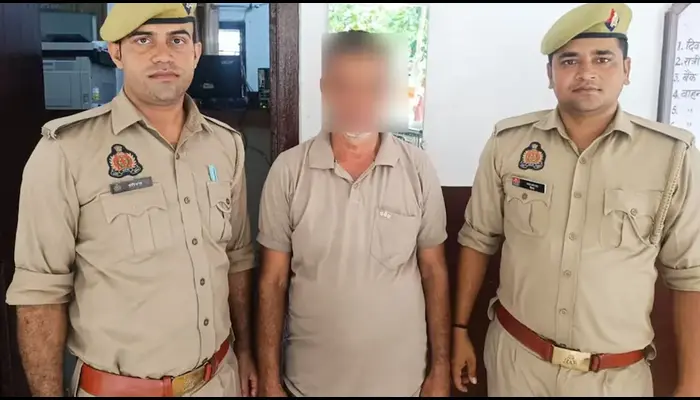
Case Summary
In Bijnor, Uttar Pradesh, a Hindu woman and her minor children were forced to convert to Islam. The accused posed as a Hindu to deceive the woman. According to the complaint, the woman's husband had died around nine years ago. Some time later, she met a man who introduced himself as “Ravi Jat.” Over time, he gained her trust, established a relationship, and eventually married her. The woman stated that the man, whose real name is Naseemuddin, a resident of Burhanuddinpur village in the Kotwali area, gradually began exploiting her emotionally, financially, and mentally. Under the pretext of constructing a house, he took around ₹8 lakh in cash and jewellery from her but never carried out any construction. Later, he confined the woman and her minor children in his home, forced them to convert to Islam, forced her to give thumb impressions on blank papers, changed their names, and obtained Aadhaar cards with Muslim names. He went on to arrange the marriage of her son within his own community and began planning similar marriages for her other children. When the woman objected and insisted on conducting the weddings according to Hindu customs, the accused threatened her and her children with dire consequences. On July 17, 2025, the accused left home to attend a wedding ceremony and forgot to lock the house. The woman seized the opportunity, escaped with her children, and reached the Kotwali police station, where she filed a complaint. Following her report, police registered FIR No. 635/25 under Sections 318(2), 127(2), and 351(2) of the BNS, along with Sections 3(1) and 5(1) of the Uttar Pradesh Prohibition of Unlawful Religious Conversion Act. Naseemuddin was arrested, and police officials confirmed that the investigation was being conducted on priority.
Why it is Hate Crime ?
This case has been added to the tracker under the primary category of: - Crimes against women in relationships and other sexual crimes. Within it, the sub-category selected is: - Man pretends to be Hindu, with the tertiary category being: - Name changed. When a non-Hindu man pretends to be a Hindu to deceive a Hindu woman into a relationship, the act is seen as triggered by malafide intentions. In some cases, the woman eventually accepts the man’s original religious identity and converts after the man’s identity is revealed. These cases could be argued as cases of religious brainwashing and a result of the pressure a woman feels after getting into a relationship with a man. The woman, it can be argued, also changed her religious identity because of the stigma she believes she might face if she chooses to walk out of a deceptive relationship. However, for the purpose of documenting hate crimes, the cases in this subcategory are limited to those where there is explicit violence aimed at religious conversion against the wishes of the victim (force-feeding beef, blackmailing with intimate videos, rape on refusal to convert, etc), or if the woman herself complains of the man’s religious deception. In such cases, it is established that the deception of the non-Hindu man had a specific aim of religious conversion or targeting of the victim due to her Hindu religious identity, therefore, making it a religiously motivated hate crime. The other sub-category selected is - Forced conversion after marriage. In such cases, a non-Hindu man marries a Hindu woman, and the force/pressure to convert to Islam begins after marriage. In such cases, typically, two patterns emerge. First, when the relationship is consensual, and the religious identity of the perpetrator is known to the Hindu woman in the relationship. The marriage could be under the Special Marriages Act, where neither parties are required to convert their religion for the marriage to be considered legitimate. While the victim in such cases enters matrimony assuming that religious identity is not a barrier, the non-Hindu man starts to pressure the woman to convert to Islam after marriage. The second is when the woman gets into a marriage with the man pretending to share her faith. Later, when the truth is revealed, the man starts pressuring the woman to convert her religion and give up her religious identity. In both situations, there is application of force by the perpetrator, including the denial of the woman’s religious rights. Some of the means by which the woman is forced/pressured to convert include force-feeding beef, being forced to read the Kalma, being forced to wear a hijab, forced to undergo Halala, etc. There are several instances where, after marriage, the woman voluntarily converts to Islam. Such cases are often argued to be a result of religious brainwashing, however, for the purpose of documenting religiously motivated hate crimes, in the absence of the victim complaining of forced conversion, such cases do not form a part of the database. The other sub-category selected is - Assault or threat upon refusal to convert. When Hindu women are in a relationship with non-Hindu men, there are cases where the woman faces threats or assault after she refuses to convert and change her religious identity owing to pressure/force by the non-Hindu man. Such relationships may be consensual with the religious identity of the non-Hindu man known to the victim. Somewhere along the relationship, the non-Hindu man starts pressurizing the Hindu woman to convert to Islam and upon her refusal, assaults or threatens the victim. Such cases are driven by specific religious motivations and against the religious identity of the victim and are therefore qualified as hate crimes. Cases where the Hindu woman converts to Islam and does not file a complaint about the force or threat, are not considered a part of the hate tracker, even though, it may be argued that the woman was brainwashed or threatened to convert to Islam. The other sub-category selected is - Blackmailed to convert. When Hindu women are in a relationship with non-Hindu men, there are cases where the woman is blackmailed to convert her religion, owing to her religious identity of being a Hindu. Such relationships may be consensual with the religious identity of the non-Hindu man known to the victim, however, there could be cases where the relationship is not consensual and the non-Hindu man starts blackmailing a Hindu woman to convert her religion. In these cases, it is often seen that the Hindu woman is blackmailed with intimate photos and/or videos, threats of harm to her or her family, threats of violence etc. Such cases are driven by specific religious motivations and against the religious identity of the victim and are therefore qualified as hate crimes. The other sub-category selected is - Brainwashed and/or Groomed, with the tertiary category being - Conversion of minor. In our database, we have not added incidents where women have converted to another religion of their free will and no allegations of forced/involuntary conversion have been made. However, there are certain cases of conversion where the consent itself is a result of the brainwashing or grooming of a minor by the non-Hindu perpetrator trying to victimise a woman for her Hindu religious identity. The phenomenon of grooming points to non-Hindu perpetrators identifying their Hindu victims’ vulnerabilities and exploiting them over months and sometimes years, to extract the supposed ‘consent’ in order to convert their religion. In most cases of grooming, the victims are minors or the grooming started when the victim was a minor. In other cases of grooming, the non-Hindu perpetrator brainwashes and grooms a minor victim to extract their trust and then proceeds to rape them repeatedly with the intent of converting them to their faith. It is pertinent to understand here that when the victim is a minor, the ‘consent’ to convert or enter into a romantic relationship with an adult itself is redundant – addressed by POCSO. While every case of conversion of a minor and incidents of establishing a physical relationship with a minor by an adult is a crime, for the purpose of this database, a case would be considered a hate crime only if there is a distinct religious angle to the grooming. For example, in the UK, if a Hindu minor is targeted by Pakistani grooming gangs, it would be considered a hate crime because the victims are specifically targeted owing to their non-Muslim religious identity with the perpetrators being Muslim. In other cases, if a Hindu minor is brainwashed into entering a physical relationship with the non-Hindu adult perpetrator and the family alleges grooming/brainwashing of the minor to convert her religion, it would form a part of this database. If the victim is a Hindu adult, the case would form a part of this database only if the victim herself says that she was brainwashed/groomed to convert her religion. However, if the victim is deceased (murdered or otherwise), the case would form a part of this database if her family/friends provided testimony that the victim was brainwashed/groomed to convert her religion. Since these crimes have a distinct religious angle where the victim is being targeted owing to her Hindu religious identity, these cases are considered a hate crime. This case has been added to the tracker because a Hindu woman was lured into a relationship by a Muslim man, who pretended to be Hindu. The perpetrator deliberately concealed his religious identity to initiate and sustain a relationship with a Hindu woman. This itself is a clear manifestation of bias and malicious intent towards the victim's religion. By concealing his true identity, he exploited her trust, targeting her under false pretences. This indicates a premeditated intent to manipulate her based on her religious background. In cases like these, the tactic of adopting a false Hindu identity to manipulate and "ensnare" a Hindu individual is not just an act of personal betrayal but can also be interpreted as an expression of disdain or disregard for Hinduism and its customs that reflects a deeper animosity towards Hindus and their beliefs. The woman entered into the marriage believing the accused was a Hindu. Post-marriage, the pressure to convert began, including confinement, coercion, intimidation, and name changes for both the woman and her minor children. She did not convert voluntarily, nor did she accept the accused’s religion after discovering the truth—instead, she resisted and eventually escaped. This shows a sustained intent to replace her religious identity with his own—not out of mutual choice, but through force, coercion, and control. The accused used power and control—physical confinement, social isolation, coercive documentation, and intimidation—to force religious change. This is not a case of individual domestic abuse that incidentally touched on religion. It was about exerting dominance over a person of another faith and making her submit to a new religious identity against her will. This dynamic is what makes it a hate crime, not just a domestic crime. The woman was coerced into signing blank documents and had her identity and her children’s identities changed without consent. The coercion was directly tied to her being Hindu, targeting her for the purpose of religious erasure. Hence, it qualifies as a hate crime. It is further important to note here that the two victims were minors, which means the element of consent and genuine change of conscience was missing ab initio. Minors, due to their young age and lack of maturity, are particularly vulnerable to manipulation and coercion. They may not have the ability to fully understand the implications of converting to another religion, and the Muslim perpetrator purposely targeted and exploited this vulnerability of the victim. Since this case exemplifies the use of coercion and manipulation to achieve religious conversion, it is a blatant act of religious hate, which is why it has been documented here in the hate tracker. Hence, this is a hate crime as the woman and her children were deliberately targeted for their Hindu identity, subjected to religious deception, coercion, and forced erasure of their faith, with the clear intent to convert them against their will. Disclaimer: It is important to clarify that the report does not specify the exact date when the woman's ordeal began, but it mentions that the victim escaped with her children on 17th July, 2025. Since this is the earliest date mentioned, we are considering this as when the victim's ordeal began and using this as the incident date. While media coverage of the incident emerged later, the Hinduphobia Tracker records the incident based on when the victim’s ordeal began, not when it was reported.
Victim Details
Total Victim
3
Deceased
0
Gender
- Male 1
- Female 1
- Third Gender 0
- Unknown 1
Caste
- SC/ST 0
- OBC 0
- General 0
- Unknown 3
Age Group
- Minor 2
- Adult 1
- Senior Citizen 0
- Unknown 0


Case Status
Arrested


Perpetrators Details
Perpetrators
Muslim Extremists
Perpetrators Range
One Person
Perpetrators Gender
male
 Sources




