Deliberate attack on Hindu religious beliefs: Hindu temple vandalised and defaced with hateful slurs in Australia
 Melbourne, Victoria, Australia
  20 July, 2025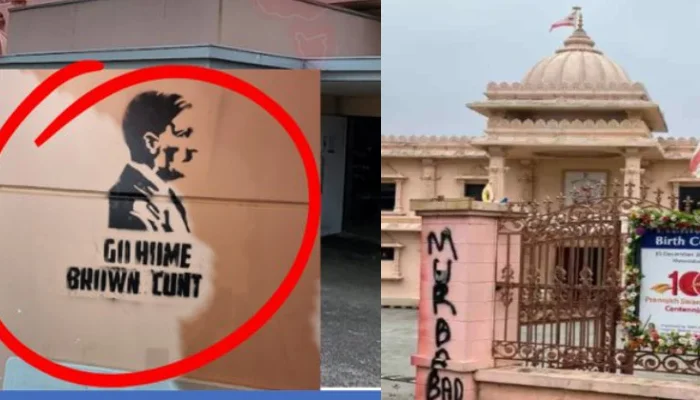
Case Summary
In Boronia, Australia, a Hindu temple named the Swaminarayan Temple was vandalised and defaced with slurs by unknown miscreants. The temple was targeted with hate graffiti in red paint, which read, "Go home brown c**t". It also included a crude portrait of Adolf Hitler, dictator of Nazi Germany. As per media reports, in the aftermath of the incident, Makrand Bhagwat, the head of the Hindu Council of Australia's Victoria chapter, condemned the attack. He stated, "Our temple was meant to be a sanctuary of peace, devotion and unity. Seeing it vandalised felt like an attack on our identity, our right to worship and freedom of religion.'' Makrand also said, “This was not just vandalism. This was terror by paint". He further stated, “This attack was not just on a building; it was on our identity, our right to exist, worship, and be safe in the country we have called home for decades.” The Swaminarayan temple functioned as more than a place of worship. It was a vital socio-cultural hub that hosted daily aartis, free community meals, youth programmes, and festivals that drew thousands from across the Greater Melbourne area. While the graffiti sparked outrage across the community, Victoria’s Premier, Jacinta Allan of the Victorian Labour Party, remained absent from the public discourse for days. There was no press conference, no social media statement, and no symbolic visit. She only sent a private letter to the temple authorities. It was later cited in The Australia Today, a media channel, which offered a sterile attempt at reassurance. The letter stated, “What happened this week was hateful, racist and deeply disturbing. It was not just vandalism, it was a deliberate act of hate, designed to intimidate, isolate, and spread fear.” Jacinta further stated, "You carry with you the full support of our government. We stand beside you, with respect and unwavering support.” Vikrant Thakur, a community organiser based in Dandenong, stated, “Why the silence? Why the delay? Why not stand with us in public?”. He further stated, “If this had been an attack on any other religious community, would the response have been as muted?” Subsequently, the Victoria police were informed about this incident, and they launched an investigation into this matter.
Why it is Hate Crime ?
This case has been added to the tracker under the primary category - Attack on Hindu religious representations. Within this, the first subcategory selected is- Desecration of Hindu religious symbol. Icons and symbols or a religious representation of a spiritual ideal are widely revered in Hinduism. Iconography is of vital significance in the Hindu milieu. It helps connect people’s spiritual beliefs with the real world. Iconography within the Hindu faith takes several shapes and forms. Murtis are of most significance to Hindus, to which daily rituals, prayers and offerings are done. Besides the murtis, there are several other symbols which have deep significance in the Hindu faith – the Om and Swastika for example. Since these Hindu religious symbols hold paramount importance in Hinduism, any desecration of symbols, icons, murtis, religious representations and manifestations, is driven by animosity towards the faith itself which manifests itself through these murtis, icons and symbols. Therefore, any desecration of these Hindu religious symbols and representations is considered religiously motivated hate crimes under this category. The other subcategory selected is- Attack on temples. In Hinduism, a temple is the abode of the Deity. The Deity in the Temple is consecrated, thereby, making it a real, breathing entity. Hindus believe that not just the Deity but the temple premises itself are sacred to Hindus since Hindus hold the faith that the entire Temple space is an amalgamation of the divine energy of the deity. Given the central significance of Temples in Hindu Dharma, any attack against a Hindu Temple or its peripheral premises is an attack on the faith itself and is born out of animosity towards the faith, of which, the Temple is a central tenet. Any manner of attack against a Temple and/or its premises would therefore be considered a religiously motivated hate crime. Another primary category relevant in this case is- Hate Speech against Hindus. Within this, the subcategory selected is- Anti-Hindu slurs, mocking faith. Anti-Hindu slurs and the deliberate mocking of the Hindu faith owing to religious animosity involve the usage of derogatory terms, stereotypes, or offensive references to religious practices, symbols, or figures. One of the common anti-Hindu slurs used against Hindus is “cow-worshipper” and “cow piss drinker”. The intention of using this term is to demean and mock Hindus as a group and their religious beliefs since Hindus consider the cow holy. Additionally, some symbols and the slurs attached to them have a historical context that exacerbates the insult, hate, stereotyping, dehumanisation and oppression against Hindus. Cow worship has been used for centuries to denigrate Hindus, insult their faith and oppress Hindus specifically as a religious group. There has been overwhelming documentation about how cow slaughter has been used to persecute Hindus with cow meat being thrown in temples and places of worship. There has also been overwhelming documentation where cow meat (beef) has been force-fed to Hindus to either forcefully convert them to Islam or denigrate their faith. Apart from cow worship, the Swastika – which holds deep religious significance for the Hindus – has also been misinterpreted and distorted to use as a slur against Hindus. Similarly, the worship of the Shivling has been used by supremacist ideologies and religions to denigrate Hindus owing to religious animosity. Such slurs and denigration stem out of inherent animosity and hate towards Hindus and their faith, therefore, it is categorised as hate speech targeted at Hindus specifically owing to their religious identity. In this case, vandalising and defacing a Hindu temple wall with hateful slurs clearly constituted a hate crime against Hindus. This act targeted a sacred space at the heart of the Hindu community’s religious and cultural life. The language and imagery used did not merely damage the physical structure; they sent a stark message of intolerance and hostility towards Hindu beliefs and those who practise them. Such acts are not just about property damage; they are meant to instil fear, undermine dignity, and marginalise an entire faith group, in this case, Hindus, making this a religiously motivated crime. In the Hindu worldview, a temple (mandir) is not merely a physical structure — it is a divine space, an embodiment of the spiritual universe. The temple is ritually consecrated and functions as a living space for the deity (murti) installed within. This sanctity extends to the entire structure, including the walls, entrances, courtyard, and surrounding premises. As such, any defilement of its surfaces, especially with hateful intent, is an act of desecration. The use of red paint to defile the walls of the temple, including slurs and Nazi imagery, constitutes symbolic violence. It reflects a deliberate intent to insult, degrade, and intimidate Hindus by desecrating a space that embodies their spiritual ideals. It is important to recognise that although the attack featured overtly racist language, the fact that it took place at a Hindu temple made it, above all, a communal and religiously motivated attack. The perpetrators could have scrawled hateful messages elsewhere, but by choosing a Hindu temple, they demonstrated a deliberate intent to insult and provoke Hindus specifically in their place of worship. Such actions are rooted in underlying religious hostility towards Hinduism and its followers. It must also be noted that, while the language used by the miscreants included racist elements, the context and location rendered the attack fundamentally anti-Hindu. Through the desecration of a sacred site, this act communicated a powerful message of hatred and exclusion, not simply on the grounds of ethnicity, but in an attempt to intimidate and marginalise Hindus specifically. It is also important to note that even though the perpetrators remain unidentified, the nature of this attack, the choice of the temple, the particular slurs, and the desecration of a religious site made it abundantly clear that it was anti-Hindu, designed to sow fear and division within the Hindu community. Given that this incident involved the vandalism of a Hindu temple and hate-filled language, it has been added to the hate crime database.


Case Status
Complaint filed


Perpetrators Details
Perpetrators
Unknown
Perpetrators Range
Unknown
Perpetrators Gender
unknown
 Sources




