Hindus brutally attacked and threatened with death by Muslim mob during religious event in Solapur, Maharashtra
 Solapur, Maharashtra, India
  18 July, 2025
Case Summary
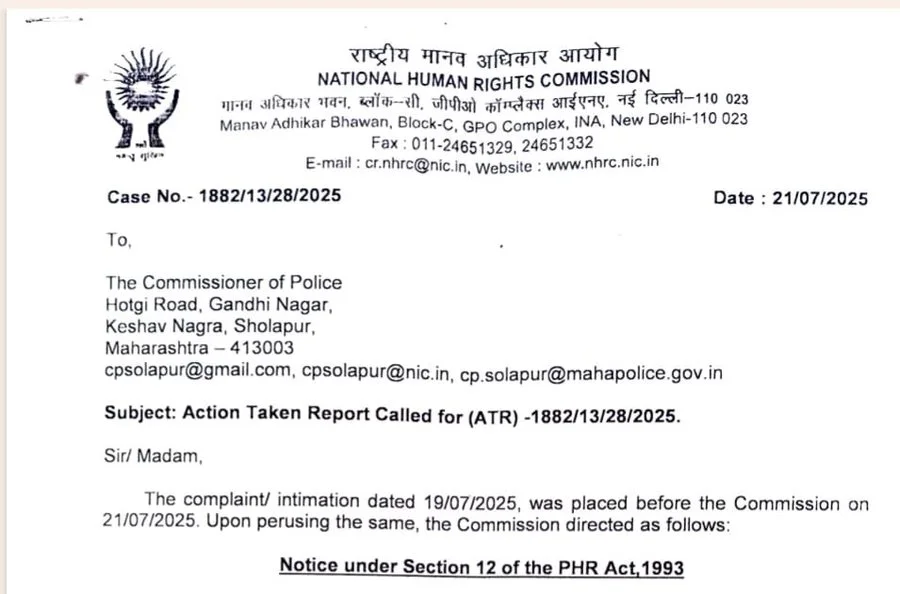
In Karmala, Solapur, Maharashtra, Hindus belonging to the Vadar community were brutally attacked by Muslims during a religious event. The Hindu participants were violently assaulted and threatened with death. They were also warned to leave Karmala or face dire consequences. The identified Hindu victims included Govind Vitkar, Laxman Chougule, Aniket Vitkar, Ganesh Gunjal, Sunanda Vitkar, Shobha Vitkar, and Ranjana Chougule. A video depicting the suffering of the Hindu victims circulated widely on social media, in which the victims narrated their ordeal. According to their account, they had organised a religious event at their village, which was attended by their family members and acquaintances. During the event, a group of Muslims arrived at the venue. One of the Muslim men initiated a confrontation and then physically attacked one of the Hindu members present at the event. Following this, near the dining area, the Muslim group assaulted the Hindu attendees and started pelting stones. Those who were seated for the meal were forced to flee inside the temple for safety. The Muslim attackers then targeted nearby Hindu homes with further stone-pelting. After the incident, the victims approached the local police station to file a complaint, but the authorities did not register the case. They later attempted to receive medical treatment at the government hospital but were denied admission. Consequently, they were forced to seek treatment at a private facility. This was not an isolated incident but a sustained pattern of harassment by the Muslim community against the Hindu families in the area. One of the female victims described how, while returning from the vegetable market, a Muslim man near the mosque threatened her by saying, "Pack up your belongings and leave this area. You all settled here during the lockdown and now behave as if you own the place. You must leave, or we will kill all of you." Another female victim described a separate incident during which, at night, while they were taking out their goats for grazing, two young Muslim men confronted her group and warned: "So far, we have only broken your arms and legs and smashed a few heads. Next time, we will not spare either the men or the women. We will destroy your families and leave none of you." Following these events, the National Human Rights Commission (NHRC) received complaints regarding this incident. They took swift action by demanding an Action Taken Report (ATR) from the police and urging authorities to ensure justice for the Hindu victims.
Case Images
Why it is Hate Crime ?
This case has been added to the tracker under the primary category- Attack not resulting in death. Within this, the first subcategory selected is- Communal Attack/Clash. Communal clash is a form of collective violence that involves clashes between groups belonging to different religious identities. For a communal clash between Hindus and non-Hindus to qualify as a religiously motivated hate crime, the trigger of the violence itself would have to be anti-Hindu in essence. For example, if there is a Hindu religious procession that comes under attack from a non-Hindu mob and after the initial attack, Hindus retaliate in self-defence, leading to a communal clash between the two religious communities. While at a later stage, both communities are involved in the clash/violence, the initial trigger of the violence was by the non-Hindu mob against the Hindus and therefore, it could safely be termed as an anti-Hindu violence. Further, the trigger would also have to be religiously motivated. In the cited example, the attack by the non-Hindu mob was against religious processions and therefore, can be concluded to be religiously motivated. In some cases, the trigger may be non-religious, however, it develops into religious violence against Hindus at a later stage. In such cases too, the foundational animosity towards Hindus becomes the motivating factor of the crime and therefore, it would be classified as a religiously motivated hate crime against Hindus under this category. The other subcategory selected is- Attack against Hindu devotees. Hindu devotees are a few of the easiest targets of religiously motivated hate crimes because during the festival/procession/puja etc, for non-Hindus it is easy to profile their victims on the basis of religion. Hindu devotees come under attack on several occasions by individual non-Hindus or mobs of non-Hindus owing to their animosity against Hinduism, its symbols and tradition/practices. There are several instances of Hindu devotees being attacked while they worship in temples or temporary religious structures, during religious processions, doing bhajan/kirtan/puja in their own homes, in the residential society etc. These attacks are perpetrated by non-Hindus primarily because of their animosity towards Hindus and their faith. In some cases, the trigger for the violence may be non-religious, however, there are two elements that make these hate crimes. First, the Hindus who come under attack are attacked violently while indulging in religious activity. Whether they are in a place of worship or not is immaterial to the crime. When individuals are attacked while indulging in religious practices, the attack in itself is a hindrance to their freedom to practice religion and therefore constitutes a hate crime. Secondly, religious supremacist doctrines and ideologies deem religious practices of Hindus to be offensive ab initio since they are considered “sinful” by these ideologies, worthy to be annihilated by force or coercion. Driven by these religious supremacist ideologies and doctrines, the attacks against Hindu devotees stem from intrinsic animosity towards Hinduism. In some cases, the trigger for the violence may be non-religious, however, it develops into a religiously motivated crime during the course of the violence. Since these attacks stem from animosity towards Hindus and Hinduism, they are considered religiously motivated hate crimes under this category. The other sub-category selected here is: - Attacked for Hindu identity. In several cases, Hindus are attacked merely for their Hindu identity without any perceived provocation. A classic example of this category of religiously motivated hate crime is a murder in 2016. 7 ISIS terrorists were convicted for shooting a school principal in Kanpur because they got ‘triggered’ seeing the Kalava on his wrist and tilak that he had put. In this, the Hindu victim had offered no provocation except for his Hindu religious identity. The motivation for the murder was purely religious, driven by religious supremacy. Such cases where Hindus are targeted merely for their religious identity would be documented as a hate crime under this category. Another primary category selected is- Attack on Hindu religious representations. Within this, the subcategory selected is- Defiling religious customs. Sanatan Dharma is not a religion of one book, which is to say that while it has religious scriptures that form the central tenets of the faith, there are several traditions followed through thousands of years, mostly passed from generation to generation orally. There are several such customs and traditions that are followed by various Hindus and Hindu sects. Defiling of these traditions and customs is a breach of an individual or group’s religious practices. Such practices can range from dietary restrictions like not eating non-vegetarian food for a certain period of the year, not eating non-vegetarian food at all, not eating beef since the cow is considered holy in Hinduism, the sanctity of religious customs followed in the house (like many ISCKON devotees), etc. Any malicious action leading to the breach of such traditions or defilement of these traditions owing to animosity towards the faith or for the sake of activism stems not only from the lack of faith in the religion itself but also from disregard for the faith of the devotees who follow the customs/traditions and implicit bias against the faith, the tradition itself. Since these specific traditions are central to the faith of the devotees of that specific sect of Hindus, any non-compliance with these traditional rules would be considered a religiously motivated hate crime. Another primary category selected is- Hate Speech against Hindus. Within this, the subcategory selected is- Violent threats. Violent threats, explicit, implicit or implied, is the most dangerous form of hate speech since it goes beyond discriminatory and prejudicial language to express the intent of causing harm to an individual or a group of people based on their religious identity and faith. There could be several different kinds of threats that are issued to Hindus based on religious animosity. An explicit threat would mean the direct threat of violence towards an individual Hindu, a group of Hindus or Hindus at large. Physical violence, death threats, threats of destruction of property belonging to Hindus and threats of genocide would mean explicit threats against Hindus for their religious identity. Implicit threats may not be a direct threat but implied through the use of symbols of actions – for example – in the Nupur Sharma case, other than explicit threats, there were also implicit threats when Islamists took to the streets to burn and beat her effigies. It implies that they want to do the same to Nupur Sharma – thereby is considered an implicit threat. Violent threats can be delivered in person, through letters, phone calls, graffiti, or increasingly through social media and other online platforms. It would be important to understand that a threat – explicit or implicit, online or offline – to an individual who happens to be a Hindu does not qualify as a religiously motivated threat. Such a threat, while vile and dangerous, could be owing to non-religious reasons and/or personal animosity. To qualify as a religiously motivated threat, it would need to exhibit an indication that the individual is being targeted for religious reasons and/or owing to his/her religious identity as a Hindu. This case from Karmala, Solapur district, Maharashtra, meets several parameters to be classified as a religiously motivated hate crime against Hindus. Firstly, the attacks were carried out by a Muslim mob during a Hindu religious event organised by members of the Hindu community. This was not merely an incident of interpersonal violence; rather, it was a calculated and deliberate attempt to disrupt a sacred Hindu event, desecrate a religious function, and instil fear among Hindus in the locality. The violence began when a group of Muslims stormed the event and provoked an argument that quickly escalated into physical aggression. Hindu devotees were attacked, and the religious environment was defiled through stone-pelting and violent interruption. This incident must be recognised not as a routine altercation but as a deliberate assault on religious freedom and the right of Hindus to worship. The intent was transparent: to desecrate a sacred Hindu function and frighten the Hindu devotees through targeted and organised mob violence. This stands as a clear example of a hate crime driven by religious animosity. Another significant detail is the targeting of Hindu homes, which were selectively attacked and pelted with stones by Muslims. This further reveals that the violence was not spontaneous or directionless—it was a premeditated and targeted attack against Hindus. Such targeted aggression, on the basis of religious identity, underscores that the motivation behind the violence was not personal enmity but a broader hostility towards the Hindu community. What makes this even more grave was the targeting of Hindu women through direct threats. One woman, while returning from the vegetable market, was threatened by a Muslim man who told her, “Pack up your belongings and leave the area or we will kill all of you.” This was not an isolated remark. It was part of an ongoing pattern of religious intimidation, intended to force Hindus out of the area, which can only be described as religiously motivated displacement. The Muslim man wasn’t expressing personal grievance; he invoked a sense of communal entitlement and resentment, accusing Hindus of “settling during the lockdown” and demanding they vacate under threat of death. These actions reflect a conscious attempt to change the demographic character of the area and are rooted in an ideology of Islamic supremacy, aiming to assert Muslim dominance over a locality through fear. This behaviour reflects the deeply disturbing consequence of Islamic radicalisation, which seeks to marginalise the Hindu community. Another chilling account was revealed by a female of how further threats of large-scale violence were issued. The Muslim perpetrators stated, “So far, we have only broken your arms and legs. Next time, we will not spare either men or women.” This language was deployed with clear intent to terrorise the entire Hindu community. The Muslims aimed to assert religious superiority and dominance through threats of violence. The public and provocative nature of these threats shows that this was not just an eruption of anger—it was a doctrinally motivated campaign of hate, where Hindu women were especially targeted, dehumanised and made vulnerable because of their faith. The overall pattern of this incident—the attack on a religious gathering, physical assaults on Hindu devotees, the stoning of homes, the desecration of a sacred function, threats directed at Hindu women, threats to kill and displace the Hindu community makes it unequivocally clear that this was a religiously motivated hate crime against Hindus. The objective of the Muslim perpetrators extended beyond immediate acts of violence. Their aim was to instil religious fear, assert communal dominance, and expel a peaceful Hindu community from their homes. These actions are not isolated; they stem from a deep-rooted hostility towards Hinduism and its followers. The acts of the Muslim perpetrators were due to indoctrination by the Islamic theology that promotes the subjugation, persecution, and dehumanisation of non-Muslims, in this case, the Hindus. Given that this incident meets multiple parameters of a religiously motivated hate crime, it is being recorded and added to the hate crime database in the Hinduphobia Tracker. Disclaimer: It is important to clarify that the exact date when the incident happened is unknown, but it mentions that, as per the National Human Rights Commission (NHRC), the complaint was received on 19th July 2025. Since this is the earliest date mentioned, we are considering this as when the victim's ordeal began and using this as the incident date. The Hinduphobia Tracker records the incident based on when the victim’s ordeal began, not when it was reported.
Victim Details
Total Victim
7
Deceased
0
Gender
- Male 4
- Female 3
- Third Gender 0
- Unknown 0
Caste
- SC/ST 0
- OBC 7
- General 0
- Unknown 0
Age Group
- Minor 0
- Adult 7
- Senior Citizen 0
- Unknown 0


Case Status
Complaint filed


Perpetrators Details
Perpetrators
Muslim Extremists
Perpetrators Range
Unknown
Perpetrators Gender
male
 Sources




