Hindu temple desecrated with meat ahead of festival in Uttar Pradesh; sacred customs violated in deliberate attack on faith
 Shamli, Uttar Pradesh, India
  31 August, 2022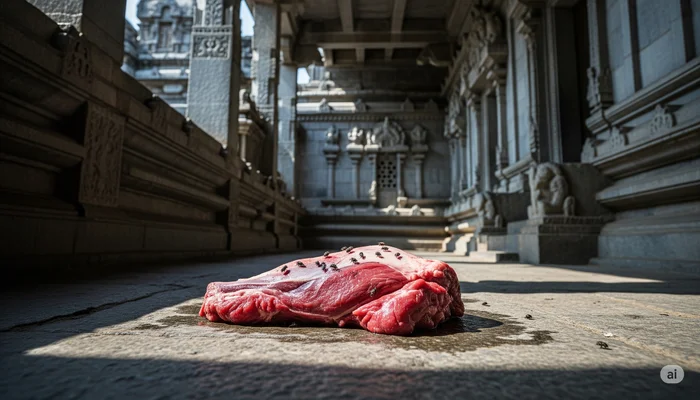
Case Summary
In Sikka village of Shamli district, Uttar Pradesh, pieces of meat were deliberately thrown inside and around the compound of a Hindu temple by unidentified miscreants. The incident occurred just ahead of an annual Hindu festival that includes havan, yagya, and other religious rituals performed at the Bhumiya Kheda temple. Every year, the villagers celebrate the festival with great devotion and enthusiasm. This year too, elaborate preparations had been made to mark the occasion. At around 5 a.m., a woman visiting the temple to offer prayers discovered pieces of meat scattered across the temple premises. She immediately alerted the temple authorities, who then contacted the police. Upon reaching the site, the police removed the meat and collected forensic samples for investigation. It was found that meat had been scattered at 11 different spots, including the temple courtyard and the main road leading to the shrine. The timing and manner of the act clearly indicate it was a deliberate attempt to desecrate the temple and incite tension. The incident sparked outrage among local residents, who took to the streets demanding immediate arrests and strict punishment for those behind the desecration. Police launched an investigation and assured the public that those responsible would face stern action.
Why it is Hate Crime ?
This case has been added to the tracker under the primary category- Attack on Hindu Religious Representations. The subcategory selected is- Defiling Religious Customs. Sanatan Dharma is not a religion of one book, which is to say that while it has religious scriptures that form the central tenets of the faith, there are several traditions followed through thousands of years, mostly passed from generation to generation orally. There are several such customs and traditions that are followed by various Hindus and Hindu sects. Defiling of these traditions and customs is a breach of an individual or group’s religious practices. Such practices can range from dietary restrictions like not eating non-vegetarian food for a certain period of the year, not eating non-vegetarian food at all, not eating beef since the cow is considered holy in Hinduism, the sanctity of religious customs followed in the house (like many ISCKON devotees), etc. Any malicious action leading to the breach of such traditions or defilement of these traditions owing to animosity towards the faith or for the sake of activism stems not only from the lack of faith in the religion itself but also from disregard for the faith of the devotees who follow the customs/traditions and implicit bias against the faith, the tradition itself. Since these specific traditions are central to the faith of the devotees of that specific sect of Hindus, any non-compliance with these traditional rules would be considered a religiously motivated hate crime. The other subcategory selected is- Breaking rules of place of worship. Sanatan Dharma is not a religion of one book, which is to say that while it has religious scriptures that form the central tenets of the faith, there are several traditions followed through thousands of years, mostly passed from generation to generation orally. One of these oral traditions or written traditions is the rules of specific temples. Certain temples have rules which are traditional rules, dependent on the worship of the presiding deities. These rules and traditions have been followed for thousands of years whether they find scriptural mention or not. Such traditions are based on the nature and rules of worship of the presiding deity of that temple. Any non-compliance of these traditions owing to animosity towards the faith or for the sake of activism stems not only from the lack of faith in the presiding deity but also disregard for the faith of the devotees of that deity/temple and implicit bias against the faith, the tradition and the deity itself. Since these specific traditions are central to the faith of the devotees of that specific temple and presiding deity, any non-compliance with these traditional rules would be considered a religiously motivated hate crime. The other subcategory selected is- Attack on Temples. In Hinduism, a temple is the abode of the Deity. The Deity in the Temple is consecrated, thereby, making it a real, breathing entity. Hindus believe that not just the Deity but the temple premises itself are sacred to Hindus since Hindus hold the faith that the entire Temple space is an amalgamation of the divine energy of the deity. Given the central significance of Temples in Hindu Dharma, any attack against a Hindu Temple or its peripheral premises is an attack on the faith itself and is born out of animosity towards the faith, of which, the Temple is a central tenet. Any manner of attack against a Temple and/or its premises would therefore be considered a religiously motivated hate crime. This case has been added to the tracker because pieces of meat were deliberately thrown inside a Hindu temple by some unknown miscreants. This is a deliberate violation of the sanctity of Hindu temples, which are revered as sacred spaces of worship. Introducing meat into such premises is a blatant desecration aimed at provoking Hindus and mocking their deeply held beliefs. Such an act reflects a profound disregard for the faith and its practices, stemming from underlying animosity toward Hinduism. This incident exemplifies an intentional effort to insult religious sentiments, warranting its inclusion as a serious offence motivated by hatred. This act cannot be viewed merely as a breach of law and order but as a calculated attempt to dishonour Hindu religious customs, particularly those linked to temple purity and ritual observance. Also, the desecration took place just before an important Hindu festival marked by rituals like havan and yagya, which are performed with a high degree of ritual purity and sanctity. Many devotees observe strict dietary and environmental purity in preparation for and during religious observances—especially refraining from consuming or even coming into contact with meat. The act of deliberately scattering meat in and around the temple not only violates these customs but seeks to forcibly disrupt a sacred Hindu tradition observed by the villagers for generations. This constitutes an intentional breach of core religious customs and reflects religious animosity. Such desecration is not an accidental act; it is aimed at mocking and violating the deeply held faith of the devotees. Secondly, throwing meat inside a Hindu temple, where the presence of meat is often strictly forbidden, violates the temple’s rules and defiles its premises. This clearly demonstrates a profound disregard for Hindu religious sites and their established customs. The act is indicative of deep-seated animosity towards Hinduism and its sacred shrines, which are held in the highest regard by Hindus. Such incidents reflect a persistent hostility towards both the Hindu community and their religious shrines. In Hindu belief, a temple is not just a place of congregation but the living abode of the deity, who is considered a real presence after consecration. By throwing meat into and around the temple compound, the perpetrators launched a direct assault on the sanctity of the deity’s abode. The temple premises, which are considered spiritually charged and holy, were intentionally desecrated. Such an act represents a symbolic and spiritual attack on Hindu faith itself. It was designed to insult, desecrate, and provoke the Hindu community. This is not merely an act of mischief—it is an attack rooted in religious hatred. It is also important to mention here that, though the last update was that the miscreants were unknown, regardless, the action stemmed from hatred against Hinduism and resulted in the defilement and desecration of the sacred idols in the Hindu temple and would therefore be considered a religiously motivated hate crime.


Case Status
Complaint filed


Perpetrators Details
Perpetrators
Unknown
Perpetrators Range
Unknown
Perpetrators Gender
unknown
 Sources




