Tilak-wearing Hindu employee at Aligarh Muslim University harassed by Muslim officer; denied promotion and salary appraisal due to religious intolerance
 Aligarh, Uttar Pradesh, India
  18 July, 2025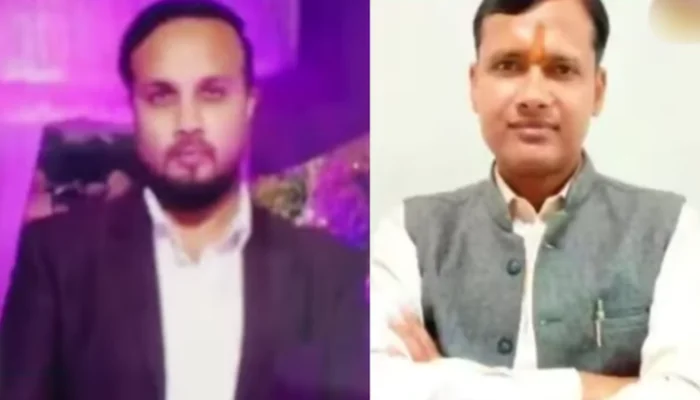
Case Summary
In the Jawaharlal Nehru Medical College at Aligarh Muslim University (AMU), a Hindu employee named Ashish Sharma was discriminated against and subjected to harassment by a Muslim man named Sameer Mursil Khan, Assistant Finance Officer at AMU. According to the victim, he had been working at AMU for seven years and was facing religious discrimination for over a year at the hands of a Muslim man. He reported that Sameer Khan frequently mocks him for wearing a Tilak, a Hindu religious symbol, and makes derogatory comments such as “Go back” and “Who is this Tilak-wearing person?". Khan also mocked him by saying that his tilak is growing larger day by day. Sharma further reported that he was routinely prevented from entering Khan’s office when delivering mail and subjected to threatening language. Khan also warned him by saying, “You don’t know my background. Don’t take me lightly. My father has been president here.” Sharma stated that he wasn't given a promotion or salary appraisal because of his religious identity. He said that whenever he goes to Khan’s office to hand over a parcel, he is not allowed to enter. Khan has also interfered in Sharma’s professional duties, overriding Sharma’s responsibilities and directing suppliers, even in areas where he has no authority. The victim has filed an internal complaint at the AMU and stated that he has full faith in the university administration and expects an impartial investigation into the matter. He also said that his life was in danger and that he could be attacked at any time. Even the victim's family members are scared because of threats, and have asked him to resign. Sharma also indicated that if justice is not delivered, he will escalate the issue by approaching the police and local elected officials.
Why it is Hate Crime ?
This case has been added to the tracker under the primary category of: - Restriction/ban on Hindu religious practice. Within this, the subcategory selected is- Restriction on expression of Hindu identity. An example of the state-affected prejudicial and targeted orders against the Hindu community would be a government denying the right of a Hindu or a group of Hindus to hold a religious procession owing to the animosity of non-Hindu groups. Denial of the religious right of the Hindus to assuage the non-Hindu group which harbours animosity to a point where it could lead to violence against Hindus is not only a failure of law and order but is a prejudicial order against Hindus, denying them their fundamental rights to express their religious identity. An example of a hate crime against Hindus by a non-Hindu would be a non-Hindu institution forcing its Hindu employees to abandon religious symbols that a Hindu would wear as an expression of faith owing to inherent prejudice against the faith professed by the victim or a non-Hindu group of people restricting a Hindu group from constructing a place of worship simply because the demography of the area in which the temple is being built is dominated by non-Hindus. Such actions are driven by religious animosity and/or prejudice against Hindus and their faith and would therefore be categorized as a hate crime. The second primary category selected here is: - Hate speech against Hindus. Within it, the sub-category selected is: - Anti-Hindu slurs, mocking faith. Anti-Hindu slurs and the deliberate mocking of the Hindu faith owing to religious animosity involve the usage of derogatory terms, stereotypes, or offensive references to religious practices, symbols, or figures. One of the common anti-Hindu slurs used against Hindus is “cow-worshipper” and “cow piss drinker”. The intention of using this term is to demean and mock Hindus as a group and their religious beliefs since Hindus consider the cow holy. Additionally, some symbols and the slurs attached to them have a historical context that exacerbates the insult, hate, stereotyping, dehumanisation and oppression against Hindus. Cow worship has been used for centuries to denigrate Hindus, insult their faith and oppress Hindus specifically as a religious group. There has been overwhelming documentation about how cow slaughter has been used to persecute Hindus with cow meat being thrown in temples and places of worship. There has also been overwhelming documentation where cow meat (beef) has been force-fed to Hindus to either forcefully convert them to Islam or denigrate their faith. Apart from cow worship, the Swastika – which holds deep religious significance for the Hindus – has also been misinterpreted and distorted to use as a slur against Hindus. Similarly, the worship of the Shivling has been used by supremacist ideologies and religions to denigrate Hindus owing to religious animosity. Such slurs and denigration stem out of inherent animosity and hate towards Hindus and their faith, therefore, it is categorised as hate speech targeted at Hindus specifically owing to their religious identity. The third primary category selected here is: - Attack not resulting in death. Within it, the sub-category selected is: - Attacked for Hindu identity. In several cases, Hindus are attacked merely for their Hindu identity without any perceived provocation. A classic example of this category of religiously motivated hate crime is a murder in 2016. 7 ISIS terrorists were convicted for shooting a school principal in Kanpur because they got ‘triggered’ seeing the Kalava on his wrist and tilak that he had put. In this, the Hindu victim had offered no provocation except for his Hindu religious identity. The motivation for the murder was purely religious, driven by religious supremacy. Such cases where Hindus are targeted merely for their religious identity would be documented as a hate crime under this category. This case has been added to the tracker due to it being a clear instance of a religiously motivated hate crime. A Hindu man was discriminated against, threatened, and ridiculed for his religious identity by a Muslim officer. He was constantly mocked for donning a Tilak and subjected to derogatory remarks like “Go back” and “Who is this Tilak-wearing person?” These were not isolated taunts but deliberate attempts to shame and pressure the Hindu man into removing his Tilak. It was a calculated attempt by Khan to suppress the Hindu identity of an employee under his authority. Khan didn’t directly order the victim to remove the Tilak; instead, he created such a hostile and intimidating environment, effectively pressuring the employee to abandon the visible expression of his faith. When these tactics failed, the harassment escalated into punitive measures, including withholding salary appraisals and promotions, a shift from psychological coercion to outright professional punishment intended to enforce conformity and suppress Hindu identity within the workplace. The Tilak is a sacred religious symbol and an expression of the Hindu faith. It is not merely decorative but holds deep spiritual and cultural meaning for practising Hindus. Forcing an employee to abandon such religious expressions is a violation of basic religious freedom and an act of prejudice. It amounts to targeted suppression and a form of religious persecution. The Muslim man abused his superior authority over the Hindu man to suppress and restrict an outward display of Hinduism. His actions portrayed a mindset of religious supremacy. In this case, the aim is to shame, suppress, and gradually erase Hindu identity from visible life. This subtle coercion is a form of cultural erasure, where Hindus are slowly pushed to either privatise or abandon their religious identity in public spaces. This case is on the lines of a larger pattern where Hindus are attacked, shamed, or silenced for any outward displays of Hinduism, such as a tilak, having a shikha or wearing a kalawa. This portrays the religious animosity that Abrahamic faiths (Christianity and Islam) have towards polytheists, such as Hindus, where any outward or harmless display of their faith is met with resistance. Such acts are not isolated but part of an ongoing effort to normalise Hindu exclusion and gradually delegitimise Hindu presence in public spaces. Therefore, this case has been added to the tracker. Disclaimer: It is important to clarify that the report does not specify the exact date when the discrimination started. Therefore, for documentation purposes, we have recorded the date based on when the incident was reported in the media.
Victim Details
Total Victim
1
Deceased
0
Gender
- Male 1
- Female 0
- Third Gender 0
- Unknown 0
Caste
- SC/ST 0
- OBC 0
- General 1
- Unknown 0
Age Group
- Minor 0
- Adult 1
- Senior Citizen 0
- Unknown 0


Case Status
Complaint filed


Perpetrators Details
Perpetrators
Muslim Extremists
Perpetrators Range
One Person
Perpetrators Gender
male
 Sources




