Murti of Lord Kartikeya desecrated; Shiva temple targeted in Sawan, hurting Hindu sentiments in Bareilly
 Bareilly, Uttar Pradesh, India
  14 July, 2025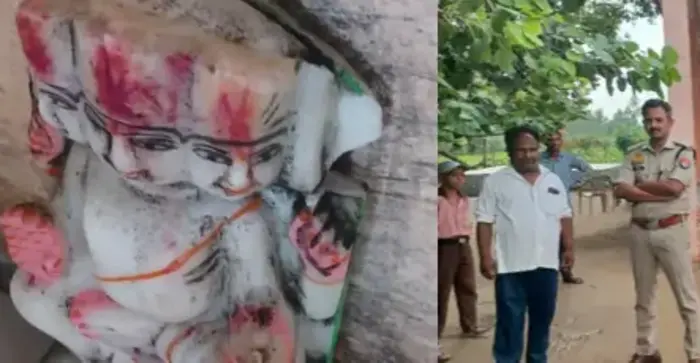
Case Summary
In the Hafizganj area of Bareilly, Uttar Pradesh, in the holy month of Sawan, the unknown miscreants targeted the Shiva temple located in Kashipur village and desecrated the idol of Lord Kartikeya. When a devotee arrived for her daily worship, she discovered the desecrated idol. Word spread rapidly across the village, triggering widespread anger and grief among the Hindu community. The temple, which houses the complete Shiv Parivar, including Lord Shiva, Goddess Parvati, Lord Ganesha, and Lord Kartikeya, is a central place of worship for the villagers. Word spread rapidly across the village, triggering widespread anger and grief among the Hindu community. The temple, which houses the complete Shiv Parivar, including Lord Shiva, Goddess Parvati, Lord Ganesha, and Lord Kartikeya, is a central place of worship for the villagers. Upon receiving the information, SDM, CO, and a police team reached the spot and began immediate restoration. The broken idol of Lord Kartikeya was reinstalled under official supervision, and a case was registered against unknown persons. Police teams began an investigation, and village resident Vinod Singh filed the formal complaint. Inspector-in-charge Pawan Kumar stated that the accused will be arrested and sent to jail soon. As a precautionary measure, additional police forces have been deployed in the village to prevent any further tension. The incident is being seen in connection with another recent act of desecration in the region. Just days earlier, a statue of Dr B.R. Ambedkar was vandalised in Gangapur, a locality under the Nawabganj police station. That case led to FIRs against 19 people, including a teacher. Villagers believe that anger arising from the Ambedkar statue case may have led to this retaliatory attack on the Hindu temple. CO Nawabganj, Gaurav Singh, confirmed the desecration of Lord Kartikeya’s idol and stated that the police are actively working to identify and arrest the culprits. He added that the situation in the village is currently under control and peaceful.
Why it is Hate Crime ?
This case has been added to the tracker under the primary category of: - Attack on Hindu religious representations. Within it, the sub-category selected is: - Desecration of Hindu religious symbol. Icons and symbols or a religious representation of a spiritual ideal are widely revered in Hinduism. Iconography is of vital significance in the Hindu milieu. It helps connect people’s spiritual beliefs with the real world. Iconography within the Hindu faith takes several shapes and forms. Murtis are of most significance to Hindus, to which daily rituals, prayers and offerings are done. Besides the murtis, there are several other symbols which have deep significance in the Hindu faith – the Om and Swastika for example. Since these Hindu religious symbols hold paramount importance in Hinduism, any desecration of symbols, icons, murtis, religious representations and manifestations, is driven by animosity towards the faith itself which manifests itself through these murtis, icons and symbols. Therefore, any desecration of these Hindu religious symbols and representations is considered religiously motivated hate crimes under this category. The other sub-category selected is - Attack on temples. In Hinduism, a temple is the abode of the Deity. The Deity in the Temple is consecrated, thereby, making it a real, breathing entity. Hindus believe that not just the Deity but the temple premises itself are sacred to Hindus since Hindus hold the faith that the entire Temple space is an amalgamation of the divine energy of the deity. Given the central significance of Temples in Hindu Dharma, any attack against a Hindu Temple or its peripheral premises is an attack on the faith itself and is born out of animosity towards the faith, of which, the Temple is a central tenet. Any manner of attack against a Temple and/or its premises would therefore be considered a religiously motivated hate crime. In this case, the murti of Lord Kartikeya in the Shiva temple at Kashipur village was desecrated by unknown miscreants. It is a clear instance of a religiously motivated hate crime rooted in animosity toward the Hindu faith and its sacred representations. This attack did not occur in isolation or randomly; it took place during Sawan, a month of deep religious significance in the Hindu tradition, especially dedicated to Lord Shiva and his divine family. By targeting a consecrated temple during this sacred period, the miscreants aimed not only to physically damage a religious site but also to emotionally and spiritually wound the sentiments of the Hindu community. In Hinduism, murtis (idols) are not mere statues but living manifestations of the divine, worshipped daily with rituals, prayers, and offerings. The idol of Lord Kartikeya, being part of the Shiv Parivar, holds immense devotional value. Its desecration is not merely an act of vandalism—it is an assault on the very core of Hindu worship and belief. Such acts directly attack the sanctity of the faith and are intended to provoke fear, grief, and anger among devotees, which is a defining feature of hate crimes. Furthermore, the temple itself, as per Hindu belief, is not just a place of congregation but the abode of the deity, where divine energy is believed to reside. It is an institution that holds immense spiritual importance in the Hindu faith. For Hindus, temples are not mere physical structures; they are sanctified spaces that embody the divine presence of Hindu deities. Acts of violence against such spaces are not isolated incidents of destruction but reflect underlying hostility towards Hindu beliefs and identity. Damaging the murti points to premeditated intent to violate the sanctity of the space and disrupt the spiritual life of the Hindu community. This constitutes a direct attack on a Hindu religious institution. The deliberate targeting of Hindu icons and sacred spaces, coupled with the timing and manner of the desecration, affirms that the motivation stems from hostility toward Hinduism. Hence, this case is categorised as a hate crime.


Case Status
Complaint filed


Perpetrators Details
Perpetrators
Unknown
Perpetrators Range
Unknown
Perpetrators Gender
unknown
 Sources




