Hindu temple land encroached to build mosque and madrasa in Jabalpur, MP
 Jabalpur, Madhya Pradesh, India
  11 July, 2025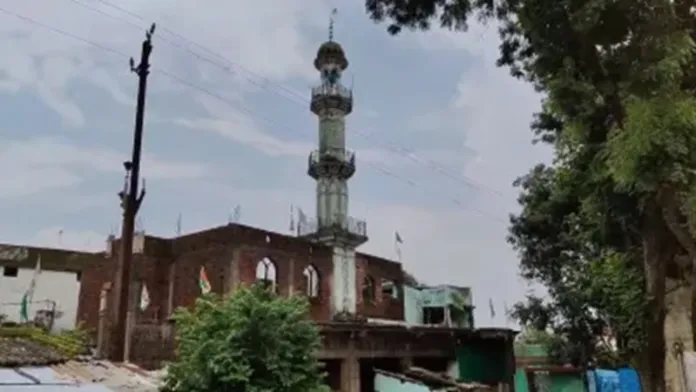
Case Summary
Temple land in Jabalpur, Madhya Pradesh, was encroached upon, leading to the construction of a mosque and significant unrest in Ranjhi, Jabalpur, Madhya Pradesh. The situation escalated following a social media post from the Jabalpur Collector. The controversy arose over the mosque's construction on land designated for the Gayatri temple in Madhai, Ranjhi. This issue gained prominence after Raghuvir Singh Marawi of Jabalpur shared details about the mosque's construction on 12th July, prompting Hindu groups to demand intervention. Subsequently, a post from the official account of the Jabalpur Collector asserted that no evidence had ever been found on the site indicating a prior temple or that the mosque was built on temple land. The Collector's post maintained that the mosque was constructed on land that had been in the mosque committee's possession and ownership before settlement. This post was removed within hours, but not before it was observed by Hindu organisation activists. Hindu organisations presented evidence refuting the Collector's assertions, affirming that the mosque was indeed built at the temple's site, which fuelled further protests. The Collector's post intensified public outrage, leading to Hindu groups conducting an "Arthi" procession for SDM Raghuveer Singh. The matter was brought to the attention of Madhya Pradesh Chief Minister Mohan Yadav, who committed to forming an inquiry committee. The SDM was subsequently relieved of his duties. While Hindu organisations initially planned additional protests for 15th July, they postponed their demonstrations after the Chief Minister ordered an inquiry. The new SDM, Rishabh Jain, stated that the contentious post was shared without the SDM's knowledge. Hindu organisations asserted that the mosque was built on Khasra No. 169, stating that the Waqf Board was allotted only 1,000 square feet, whereas the mosque occupied approximately 3,000 square feet. Furthermore, Hindu organisations stated that madrasas were operating unlawfully under the guise of the mosque. The mosque committee had previously pursued this case in the High Court but withdrew it due to a lack of documentary evidence.
Why it is Hate Crime ?
The primary category in this case is: Attack on Hindu religious representations. The secondary category in this case is: Encroachment or illicit takeover of temple land/land near temple. In Hinduism, a temple is the abode of the Deity. The Deity in the Temple is consecrated, thereby, making it a real, breathing entity. Hindus believe that not just the Deity but the temple premises itself are sacred to Hindus since Hindus hold the faith that the entire Temple space is an amalgamation of the divine energy of the deity. Not only the Temple but the Temple premises in its entirety are considered sacred by Hindus. In several cases, the premises of the Temple and/or religious centre are illicitly taken over by institutions belonging to other faiths – like the Waqf board or the Church. Other times, the temple property, land or the property of religious centres are illicitly encroached by non-Hindu groups. Any illicit take over or encroachment is a crime an initio, however, when non-Hindu groups illicitly take over or encroach the sacred land of Hindus, it is an affront to the Hindu community and is therefore classified as a religiously motivated hate crime under this category. In this instance, the illicit takeover of land long recognised as sacred by the Hindu community, where the temple premises are venerated as the spatial embodiment of the deity, into a site for another religion’s institution deliberately disregards the sanctity ascribed to that ground. Such an act, whether through overt means or administrative circumvention, is not only an encroachment in legal terms but a direct affront to the religious beliefs and collective identity of Hindus. The mosque in question, reportedly exceeding by a wide margin the area formally allotted to the Waqf Board, was erected despite the absence of any authoritative legal documentation confirming rightful possession. The fact that the mosque committee previously initiated but soon withdrew legal proceedings from the High Court due to a lack of documentary evidence strengthens the conclusion that this construction was undertaken knowingly and with the intent to encroach on Hindu religious property. This case represents not an isolated instance but a long-standing pattern of targeted encroachment on Hindu temple lands, which historically dates back to the Islamic invasions of India. Throughout medieval history, temples were systematically desecrated, destroyed, or taken over by Islamic tyrants, and in many cases, mosques were erected in their place. From Somnath in Gujarat, which was plundered multiple times beginning with Mahmud of Ghazni, to the Kashi Vishwanath temple in Varanasi, and Ayodhya’s Ram Janmabhoomi, numerous instances show how sacred Hindu sites were intentionally desecrated and replaced with Islamic structures. These were not acts of war but deliberate efforts to assert religious dominance and humiliate the Hindus and their faith. This was not coincidental: these attacks on temples were ideologically motivated, meant to destroy the physical symbols of Hindu dharma and erase indigenous religious identity. In this light, contemporary instances of illegal occupation of temple land, especially by groups or individuals belonging to the Abrahamic faith, are not isolated encroachments; instead, they are a continuation of historical persecution, made worse by the failure of modern administrative and legal mechanisms to protect Hindu religious institutions. In some, such illicit takeovers of sites sacred to Hindus are seen as an affront to the Hindu community, warranting inclusion in the Hinduphobia Tracker as a religiously motivated hate crime. Disclaimer: It is important to clarify that none of the media sources covering this case have specified the exact date on which the encroachment started. It is, however, mentioned that the matter gained prominence after Raghuvir Singh Marawi of Jabalpur shared details about the mosque's construction on 12th July 2025, prompting Hindu groups to demand intervention. Therefore, for documentation purposes, we have recorded July 12 as the incident date, in line with Hinduphobia Tracker’s practice of recording the earliest verifiable date associated with the incident, rather than the date when the media reported.


Case Status
Unknown


Perpetrators Details
Perpetrators
Muslim Extremists
Perpetrators Range
Unknown
Perpetrators Gender
unknown
 Sources




