Kerala government targets Hindu ritual in schools, labels traditional Guru Pooja as regressive and initiates investigation
 Kerala, India
  9 July, 2025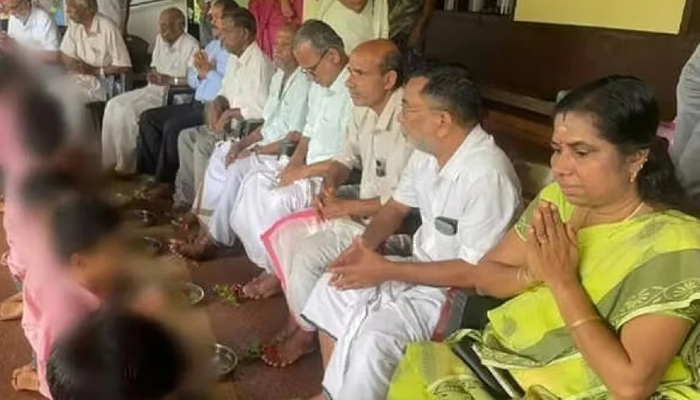
Case Summary
Hindu students across several private schools in Kasaragod district, Kerala, participated in the traditional ritual of Guru Pada Pooja on 9 July 2025, as part of Guru Purnima celebrations. The event was organised in institutions affiliated with Bharatheeya Vidya Niketan (BVN), including Saraswathy Vidyalaya in Bandadka, Vivekananda Vidya Peedom in Mavelikkara, and other BVN schools in Trikaripur, Kundamkuzhy, and Cheemeni. Students were seen offering floral tributes at the feet of retired teachers and receiving blessings, a practice long observed in several parts of India during Vyasa Jayanthi. The Hindu traditional ritual was sharply criticised by the Kerala government and Left-affiliated organisations. The Democratic Youth Federation of India (DYFI) and the Students’ Federation of India (SFI), the student wings of CPI(M), condemned the practice as casteist and regressive. SFI claimed political motivations behind the events, claiming the rituals were intended to normalise what they described as “Brahmanical hierarchy” in schools. Kerala's General Education Minister V Sivankutty promptly ordered an investigation, and the Kerala State Commission for Protection of Child Rights (KSCPCR) registered a suo motu case, calling for police reports and institutional responses. School officials defended the practice as a longstanding Hindu tradition, not coercive in nature, and said it was conducted respectfully and voluntarily. Saraswathy Vidyalaya’s headmistress, P.T. Uma, clarified that teachers, not students, performed the symbolic washing, while students only offered flowers. She added that promoting such gestures encourages children to uphold respect for elders and instils moral discipline. Several Hindu organisations and community members condemned the Kerala government’s reaction, calling it a targeted attempt to vilify Hindu practices and interfere in traditional rituals under the pretext of child rights and secularism. They argued that similar religious expressions of other communities were not subjected to the same scrutiny, and that the backlash against Guru Pada Pooja reflected a selective and anti-Hindu bias in the administration’s approach to cultural observances.
Why it is Hate Crime ?
The primary category in this case is: Restriction/Ban on Hindu practices. The secondary category under this is: Administration restricting religious practice. In several cases, it is seen that the administration/state disallows a religious practice owing to prejudicial orders and concerns, targeted specifically against the Hindu community. Such restriction/prohibition would be considered documented as a hate crime because the orders are often a result of pressure by groups that harbour animosity towards Hinduism and Hindus. Often, the restriction by the authorities is driven by bias, hostility, or prejudice against the specific community being stopped from holding a religious practice, by pressure groups that harbour animosity towards Hindus, intrinsic to their faith. Since practices are intrinsic to the faith of the Hindus, such prejudicial restriction is considered a curtailing of the fundamental rights of the Hindu community. In several cases, for example, the authorities ban a Hindu religious practice due to pressure from groups opposed to the religion. In other instances the prohibition is selectively enforced against one religious group (Hindus) while others are allowed to proceed. There are still other cases where the authorities preemptively restrict a religious practice by Hindus because those who hold animosity towards Hindus may get “provoked” leading to them being violent, thereby assuaging the sentiments of those who hold animosity towards Hindus by curtailing the religious rights of Hindus. Such acts and orders are prejudiced, indicating discriminatory motives owing to the capitulation to groups that harbour animosity towards Hindus and therefore, would be categorised as a religiously motivated hate crime since the original pressure leading to the order itself is a result of hatred/bias/prejudice/religious hate against Hindus. The decision to subject Guru Pada Pooja, an age‑old element of Hindu pedagogy, to official investigation illustrates a selective and prejudicial approach by the Kerala State authorities toward Hindu customs. The ritual was neither coercive nor clandestine; it is an established part of Vyāsa Jayanthi and Guru Pūrṇimā observances in numerous Hindu institutions. Yet, the General Education Department ordered an inquiry within hours of the video’s circulation, and the State Commission for Protection of Child Rights (KSCPCR) lodged a suo motu case, framing the ceremony as inherently oppressive and “casteist.” No equivalent scrutiny is imposed on comparable devotional practices of other faith‑based schools. Such asymmetry of enforcement demonstrates institutional bias rather than a neutral commitment to child welfare. This pattern of administrative obstruction against Hindu practices in Kerala is not new. The same Left-led Kerala government under Chief Minister Pinarayi Vijayan has repeatedly positioned itself antagonistically toward Hindu religious sentiments. One of the most glaring examples of this occurred in 2018, following the Supreme Court’s ruling allowing women of reproductive age to enter the Sabarimala temple, against the temple’s longstanding Hindu tradition, which views Lord Ayyappa as a Naishtika Brahmachari (eternal celibate). While lakhs of ordinary devotees, especially women, protested and called for a review, the Kerala government refused to file a review petition and instead facilitated the forced entry of activists into the shrine under heavy police protection. This act was widely perceived by the Hindu community as an aggressive violation of religious autonomy, driven more by ideological zeal than constitutional obligation. In other cases too, such as attempts to reform rituals at the Guruvayur temple or interfere in the management practices of Sivagiri Math, the same pattern is evident: the government identifies Hindu customs as “backward,” applies secular or social reformist arguments selectively to Hindu institutions, and resists the natural evolution of tradition within the community itself. These actions are not neutral expressions of governance but targeted encroachments designed to delegitimise and marginalise Hindu practices in the public sphere. Such prejudicial treatment reflects not a concern for children’s rights or social harmony, but a broader ideological campaign that views Hinduism through a lens of suspicion and contempt. The refusal to protect Hindu customs and the eagerness to curtail them, especially when pressured by ideologically driven organisations such as SFI or DYFI, reveals deep-seated institutional Hinduphobia. This bias, when encoded into administrative action, becomes a form of systemic discrimination. Hence, this case rightfully qualifies as a religiously motivated hate crime, and must be recorded as such in any serious account of targeted anti-Hindu hostility. The prohibition on celebrating a Hindu event while potentially allowing similar events for other communities can create a perception of bias. This action may lead to feelings of marginalisation among Hindu communities, who may view it as an unfair targeting of their cultural practices. Further, every individual has the right to practice their religious faith and restricting someone from doing that can also be considered a prejudicial order denying the Hindu community its fundamental rights. Such arbitrary actions taken against Hindus are prejudicial to the rights of Hindus and stem from animosity and prejudice against Hindu beliefs, which is why this case is being categorised as a religiously motivated hate crime.


Case Status
Unknown


Perpetrators Details
Perpetrators
State and Establishment
Perpetrators Range
Unknown
Perpetrators Gender
unknown
 Sources




