Hindu youth crushed to death by Muslims in Damoh for opposing meat sale near Shiva temple
 Damoh, Madhya Pradesh, India
  10 July, 2025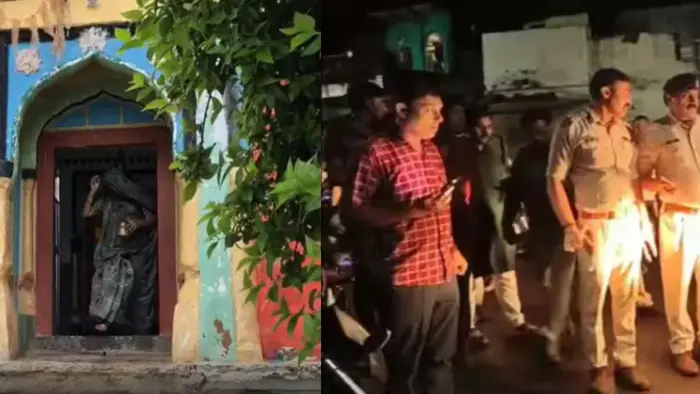
Case Summary
In Damoh, Madhya Pradesh, a Hindu youth was killed by Muslim men after protesting against the sale of meat in front of a historic Shiva temple. According to Nanni Bai, the mother of the deceased, her son Rakesh Raikwar was taking her to the doctor when a speeding car ran him over near Ajmeri Garden. She narrowly escaped, but Rakesh died on the spot. The car fled the scene after crushing him. It was later identified that the driver was Aqil Khan, a resident of the same locality. Nanni Bai further reported that Aqil's father, Nasir Khan, was present near the site and pointed out Rakesh to Aqil, signalling him to target the youth. Aqil then drove the car over Rakesh with deadly intent. Rakesh’s brother, Bablu, explained the background of the incident. Near Ajmeri Garden lies Hazaari ki Talaiya, adjacent to which stands a centuries-old Shiva temple of historical and religious significance. Devotees regularly visit the temple with reverence. Aqil and his father Nasir had, a few years ago, encroached upon the area near the temple and constructed a house. For the past three years, they had also been running a meat shop directly in front of the temple, selling non-vegetarian food at the temple entrance. The local Hindu community had objected to the meat sale near the temple, and Rakesh had been leading this protest. On the day of the incident, a heated argument broke out between Rakesh and Nasir regarding this issue. Later that evening, Aqil and Nasir together executed the attack, running Rakesh over with a car in a premeditated act. Following the murder, tensions rose in the locality. The police acted promptly, and Additional SP Sujeet Bhadauria confirmed that after reviewing CCTV footage, it was established that the incident was not an accident but a deliberate act of murder. Based on the complaint filed by Rakesh’s mother, an FIR was registered against both Aqil Khan and Nasir Khan under charges of murder. Subsequently, the accused were arrested. ASP Bhadauria stated that opposition to the sale of meat near the Shiva temple is also emerging as a key motive behind the murder. Authorities have also initiated proceedings to remove the illegal construction and the shop near the temple premises.
Why it is Hate Crime ?
This case has been added to the tracker under the prime category of- Attack resulting in death and under this, the sub-category selected is- Attacked for opposing radicals or trying to save victim. In several cases, Hindus are attacked for opposing religiously motivated crimes being committed against a fellow Hindu or simply for voicing an opinion opposing radical elements, who either have in the past or continue to persecute Hindus. In such cases, the initial attack against the victim, against which the Hindu was trying to defend the victim, would also need to be classified as a religiously motivated hate crime. Since the initial crime itself was religiously motivated and the subsequent crime of attempting to save the victim or speaking against the radical elements ends up inviting a violent attack, it would also be classified as a religiously motivated hate crime. Under this category, cases where the attack led to the death of the Hindu victim/s would be documented. The second category selected here is- Attack on Hindu religious representation, and within this, the sub-category selected is- Encroachment or illicit takeover of temple land/land near temple. In Hinduism, a temple is the abode of the Deity. The Deity in the Temple is consecrated, thereby, making it a real, breathing entity. Hindus believe that not just the Deity but the temple premises itself are sacred to Hindus since Hindus hold the faith that the entire Temple space is an amalgamation of the divine energy of the deity. Not only the Temple but the Temple premises in its entirety are considered sacred by Hindus. In several cases, the premises of the Temple and/or religious centre are illicitly taken over by institutions belonging to other faiths – like the Waqf board or the Church. Other times, the temple property, land or the property of religious centres are illicitly encroached by non-Hindu groups. Any illicit take over or encroachment is a crime an initio, however, when non-Hindu groups illicitly take over or encroach the sacred land of Hindus, it is an affront to the Hindu community and is therefore classified as a religiously motivated hate crime under this category. In this case, Rakesh Raikwar, a Hindu youth, was targeted and killed after he took a stand against a deeply offensive and provocative act: the operation of a meat shop directly in front of a historic Shiva temple. The shop was run by Aqil Khan and Nasir Khan, both of whom had also encroached upon temple-adjacent land. The illicit takeover of the land near a temple and the sale of non-vegetarian food at a sacred Hindu site was not only a violation of religious sensibilities but also a deliberate affront to the local Hindu community’s beliefs. The temple land or areas around the sacred space are not simply a piece of property; they hold profound religious significance for the Hindu community. For Hindus, both the temple and its land are regarded as the abode of the deity. Any form of encroachment or seizure of temple land is an attack on the religious rights and sentiments of Hindus, disrupting their ability to worship and to maintain their sacred spaces. Any unauthorised occupation of this space, especially one that halts worship and religious observance, is a violation of that sanctity. Such an act, regardless of the identity of the offenders, qualifies as a hate crime due to its religious impact and the targeting of a sacred Hindu site. Further, the case highlights the deliberate violation of the sanctity of Hindu temples, which are revered as sacred spaces of worship. Introducing meat into such premises is a blatant desecration aimed at provoking Hindus and mocking their deeply held beliefs. Such an act reflects a profound disregard for the faith and its practices, stemming from underlying animosity toward Hinduism. Here, the Muslim accused, despite knowing this fact, was deliberately running a meat shop directly in front of the temple. This was clearly done with the intent to mock the Hindu faith, underscoring the deep-rooted hatred towards Hinduism in the mind of the perpetrators. Rakesh was attacked and killed for opposing this radical behaviour. His actions, opposing the sale of meat near the temple and defending the religious sanctity of a Hindu site, constituted a direct challenge to the Muslim accused targeting Hindu religious identity. Therefore, this murder is a hate crime, as it was a violent retaliation against a Hindu youth who was resisting religiously motivated provocation. Rakesh Raikwar was not only protesting as an individual but was widely recognised within the community as someone actively working to defend Hindu religious interests. He led the opposition against the meat shop in front of the temple for an extended period and was seen by the community as a protector of Hindu religious space and traditions. In this context, even though he may not have held a formal post in any organisation, his leadership in a Hindu cause—protecting a temple from encroachment and religious insult—cast him as a perceived representative of the Hindu community. His public stance and persistent activism made him a target for those who wished to suppress Hindu resistance. Rakesh was targeted and eliminated to silence a voice that was protecting Hindu dignity and asserting religious rights. Hence, this is a hate crime as a Hindu youth was deliberately killed for opposing religious provocation and defending the sanctity of a Hindu temple, and it has therefore been included in the hate crime database.
Victim Details
Total Victim
1
Deceased
1
Gender
- Male 1
- Female 0
- Third Gender 0
- Unknown 0
Caste
- SC/ST 0
- OBC 0
- General 1
- Unknown 0
Age Group
- Minor 0
- Adult 0
- Senior Citizen 0
- Unknown 1


Case Status
Arrested


Perpetrators Details
Perpetrators
Muslim Extremists
Perpetrators Range
From 2 To 5
Perpetrators Gender
male
 Sources




