Hindu shopkeeper brutally assaulted by Muslim mob during Muharram procession in Sitapur
 Sitapur, Uttar Pradesh, India
  5 July, 2025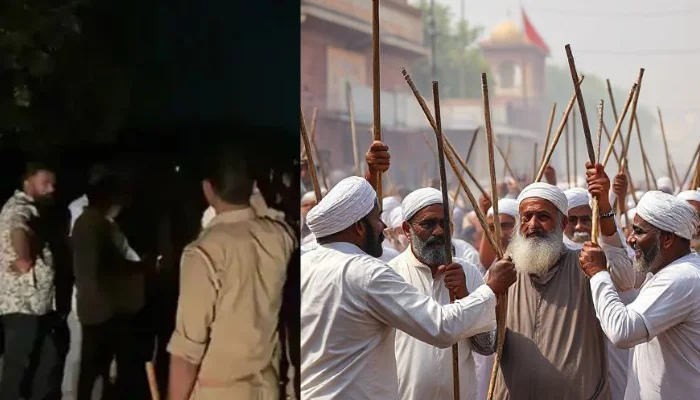
Case Summary
In Sahadat Nagar village, Sitapur, Uttar Pradesh, a Hindu man named Beche Lal was brutally assaulted by Muslims during a Muharram procession. The incident led to a communal clash between Hindus and Muslims. According to news reports, the Muslims were taking out a Muharram procession through the area where Beche Lal’s shop is located. They began removing bricks that had been kept outside his shop to clear the path. When Lal asked them not to do so, a verbal altercation ensued, which quickly escalated into violence. The Muslim group attacked Lal with sticks, leaving him severely injured. The assault sparked outrage in the area, prompting local Hindus to gather at the scene. This led to a communal clash between the two communities. As a result, four people from both the Hindu and Muslim sides were injured. The police were informed, and Circle Officer (CO) Maholi Deepak Singh, along with SHO of Imalia Sultanpur, Shyamu Kanaujia, arrived at the scene with a police team. The injured were taken to the hospital, and the police appealed to both sides to remain calm. An investigation was initiated, and additional police forces were deployed in the area to maintain law and order. Authorities urged the public to maintain peace and avoid any provocative actions.
Why it is Hate Crime ?
This case has been added to the tracker under the primary category- Attack not resulting in death. Within this, the subcategory selected is- Communal Clash/Attack. Communal clash is a form of collective violence that involves clashes between groups belonging to different religious identities. For a communal clash between Hindus and non-Hindus to qualify as a religiously motivated hate crime, the trigger of the violence itself would have to be anti-Hindu in essence. For example, if there is a Hindu religious procession that comes under attack from a non-Hindu mob and after the initial attack, Hindus retaliate in self-defence, leading to a communal clash between the two religious communities. While at a later stage, both communities are involved in the clash/violence, the initial trigger of the violence was by the non-Hindu mob against the Hindus and therefore, it could safely be termed as an anti-Hindu violence. Further, the trigger would also have to be religiously motivated. In the cited example, the attack by the non-Hindu mob was against religious processions and therefore, can be concluded to be religiously motivated. In some cases, the trigger may be non-religious, however, it develops into religious violence against Hindus at a later stage. In such cases too, the foundational animosity towards Hindus becomes the motivating factor of the crime and therefore, it would be classified as a religiously motivated hate crime against Hindus under this category. In this case, the initial trigger for the violence was a group of Muslims participating in a Muharram procession forcibly removing bricks that had been kept outside the shop of Beche Lal, a Hindu man. When Beche Lal protested and asked them not to disturb the structure near his property, a verbal altercation ensued, which quickly escalated into a physical assault on him by the Muslim group. Beche Lal was brutally beaten with sticks and left severely injured. This attack did not stem from a personal enmity or a neutral civic issue, but occurred in the context of a religious procession wherein a Hindu man was targeted after resisting actions taken by members of another religious group. His objection to the removal of his property became the pretext for a violent outburst from members of the procession. Given that the procession was a religious one and the violence was directed at a Hindu individual who was not interfering with their religious practice but merely protecting his property, the nature of the response—mob assault—reveals the underlying communal hostility. The subsequent gathering of Hindus and the outbreak of a broader communal clash further reinforces the fact that this was not a personal dispute but a religiously charged conflict. Although both sides were eventually involved in the clash, the violence was initiated by the Muslim group, turning it into a communal incident rooted in anti-Hindu aggression. Therefore, the foundational animosity towards a Hindu individual during a non-Hindu religious event and the escalation of violence from there make this incident a clear case of a religiously motivated hate crime against Hindus under the communal clash category.
Victim Details
Total Victim
4
Deceased
0
Gender
- Male 4
- Female 0
- Third Gender 0
- Unknown 0
Caste
- SC/ST 0
- OBC 0
- General 0
- Unknown 4
Age Group
- Minor 0
- Adult 4
- Senior Citizen 0
- Unknown 0


Case Status
Complaint filed


Perpetrators Details
Perpetrators
Muslim Extremists
Perpetrators Range
Unknown
Perpetrators Gender
male
 Sources




