T-shirts with Palestine flag worn by Muslim youths during Muharram procession in Uttar Pradesh
 Deoria, Uttar Pradesh, India
  5 July, 2025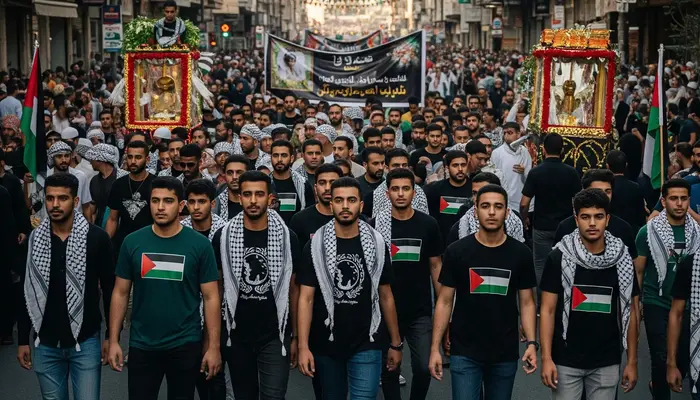
Case Summary
In Baghauchghat, Uttar Pradesh, during a Muharram taziya procession, several Muslim youths were seen wearing t-shirts bearing the image of the Palestinian flag. Upon receiving this information, Station House Officer (SHO) Pradeep Asthana promptly arrived at the scene with a police team to assess the situation. To maintain law and order, the police detained a few of the youths for questioning. Additional police forces were deployed as a precautionary measure to ensure peace and prevent any untoward incidents. As of the time of this report, the investigation is ongoing. Authorities have urged the public to avoid spreading rumours or misinformation during the course of the inquiry.
Why it is Hate Crime ?
This case has been added to the tracker under the primary category of - Hate speech against Hindus. The sub-category selected here is - Anti-Hindu slurs, mocking faith. Anti-Hindu slurs and the deliberate mocking of the Hindu faith owing to religious animosity involve the usage of derogatory terms, stereotypes, or offensive references to religious practices, symbols, or figures. One of the common anti-Hindu slurs used against Hindus is “cow-worshipper” and “cow piss drinker”. The intention of using this term is to demean and mock Hindus as a group and their religious beliefs since Hindus consider the cow holy. Additionally, some symbols and the slurs attached to them have a historical context that exacerbates the insult, hate, stereotyping, dehumanisation and oppression against Hindus. Cow worship has been used for centuries to denigrate Hindus, insult their faith and oppress Hindus specifically as a religious group. There has been overwhelming documentation about how cow slaughter has been used to persecute Hindus with cow meat being thrown in temples and places of worship. There has also been overwhelming documentation where cow meat (beef) has been force-fed to Hindus to either forcefully convert them to Islam or denigrate their faith. Apart from cow worship, the Swastika – which holds deep religious significance for the Hindus – has also been misinterpreted and distorted to use as a slur against Hindus. Similarly, the worship of the Shivling has been used by supremacist ideologies and religions to denigrate Hindus owing to religious animosity. Such slurs and denigration stem out of inherent animosity and hate towards Hindus and their faith, therefore, it is categorised as hate speech targeted at Hindus specifically owing to their religious identity. In this case, Muslim youths were seen publicly displaying symbols of Palestine during a Muharram procession. The youths wore t-shirts printed with the Palestinian flag—an act that, on the surface, may be interpreted as expressing solidarity with Palestinians. One could argue that wearing or displaying Palestinian symbols is political or humanitarian, and not directly anti-Hindu. However, in the communal context of Bharat, public expressions of Palestinian nationalism often go beyond political solidarity and serve as coded expressions of Islamic transnationalism and opposition to Bharat, which is perceived as a Hindu-majority nation-state. It is important to understand that Palestinian symbols and rhetoric are increasingly being used by Muslim groups across the world to signal unity with the global Ummah—the notion that Muslims worldwide constitute a single political and religious community. This transnational Muslim identity often supersedes allegiance to the nation-state, particularly when the state is viewed as non-Islamic or “kafir.” In Bharat, the Hindu identity of the nation is central to how many Muslim ideologues view India, making any transnational Islamic loyalty an implicit rejection of the Hindu cultural order. Further, such public displays of Palestinian symbols during Muslim religious processions are not ideologically neutral. They often function as provocative assertions of global Islamic resistance against what is perceived as global and local oppression of Muslims. In many parts of Bharat, including in recent protests and communal gatherings, the Palestinian flag has been displayed alongside slogans denouncing Hindus, India, or other non-Muslim forces. In this context, the act of displaying Palestinian symbols is not just an expression of political sentiment—it is a symbolic alignment with the idea of a global Islamic struggle, in which Hindus are often constructed as the ideological ‘other.’ Thus, the act is driven by an underlying animosity towards Bharat’s Hindu majority identity and functions as an expression of transnational loyalty to the Ummah over allegiance to the nation-state. Any such expression—especially in communal or religious contexts—undermines national harmony, fosters communal division, and is a rejection of Hindu cultural existence in Bharat. For this reason, the incident is recorded as a religiously motivated hate crime in the Hinduphobia Tracker.


Case Status
Complaint filed


Perpetrators Details
Perpetrators
Muslim Extremists
Perpetrators Range
Unknown
Perpetrators Gender
male
 Sources




