Hindu youth beaten by Muslim group for not funding Muharram programme
 Birbhum district, West Bengal, India
  4 July, 2025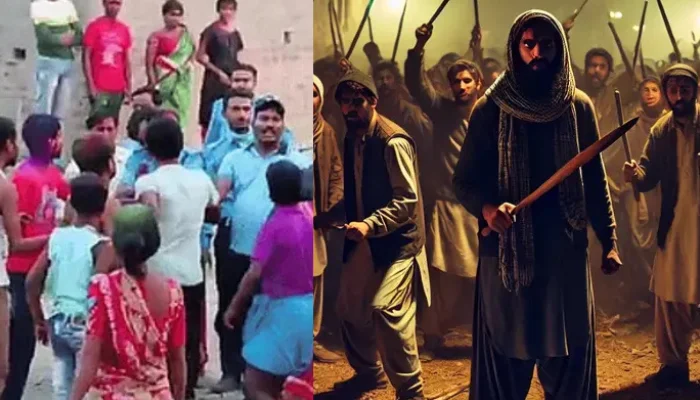
Case Summary
In the Sainthia area of the Birbhum district in West Bengal, a Hindu youth was attacked and brutally beaten by a Muslim group for refusing to contribute funds to the Muharram festival. According to media reports, the incident unfolded when a local Muslim group armed with weapons demanded money from Hindus in the area for a Muharram programme. Amidst these demands, a Hindu e-rickshaw driver refused to pay the chanda (donation). The victim had made a donation of ₹50 once on Thursday (3rd July) and refused to pay twice. Subsequently, he was severely attacked and beaten by the Muslim group, leaving him in a critical condition and requiring hospitalisation. The victim’s father, Tamal Ghosh, stated, “My son had gone there to drop off passengers. He had paid chanda the previous day. Once he reached there today, they demanded chanda from him again. He tried to tell them that his business for the day had just started, but they did not listen. I can’t explain how brutally they thrashed my son. He was rescued by some locals.” “What is the administration doing? They (Muslims) are committing atrocities against us repeatedly,” he said. This incident quickly triggered outrage among the local Hindu community. In response, they organised road blockades, demanding justice and police action against the Muslim perpetrators. After receiving the news of the incident, the police reached the spot and tried to bring the situation under control. A police source stated that an investigation had begun to apprehend the accused, and additional police forces were deployed in the area to maintain a law and order situation. Birbhum district police superintendent said, “We are investigating the incident. No one will be spared. Appealing to the people to maintain peace.” The Hindu locals stated that similar patterns of intimidation and forced fund collection had been taking place in several parts of West Bengal, where Muslim groups armed with sticks and sharp weapons were extorting money in the name of religious processions. Bedan Ghosh narrated how Muslim youths in Sainthia had been harassing Hindus for Muharram donations. “A group of 8-10 youths caught hold of me on Thursday (3rd July) when I went to drop my son at the school. They demanded chanda from them. They insisted that I pay the money to them then and there.” Ghosh was threatened with physical harm. He assured them that he would return to pay chanda after dropping his son off at school. He later chose a different route to his home to avoid confrontation with the Muslim youths.
Why it is Hate Crime ?
This case has been added to the tracker under the primary category- Attack not resulting in death. Within this, the subcategory selected is- Communal Clash/Attack. Communal clash is a form of collective violence that involves clashes between groups belonging to different religious identities. For a communal clash between Hindus and non-Hindus to qualify as a religiously motivated hate crime, the trigger of the violence itself would have to be anti-Hindu in essence. For example, if there is a Hindu religious procession that comes under attack from a non-Hindu mob and after the initial attack, Hindus retaliate in self-defence, leading to a communal clash between the two religious communities. While at a later stage, both communities are involved in the clash/violence, the initial trigger of the violence was by the non-Hindu mob against the Hindus and therefore, it could safely be termed as an anti-Hindu violence. Further, the trigger would also have to be religiously motivated. In the cited example, the attack by the non-Hindu mob was against religious processions and therefore, can be concluded to be religiously motivated. In some cases, the trigger may be non-religious, however, it develops into religious violence against Hindus at a later stage. In such cases too, the foundational animosity towards Hindus becomes the motivating factor of the crime and therefore, it would be classified as a religiously motivated hate crime against Hindus under this category. This case is a clear demonstration of a religiously motivated crime against Hindus. Here, the Hindu individual was targeted for refusing to comply with coercive demands made during a Muslim religious event. The Hindu youth in question was not merely assaulted over a financial disagreement; he was brutally attacked because of his refusal to participate in a religious event that was not his own, and because he belonged to a religious minority in that locality. The use of physical violence by a Muslim group to force contributions for Muharram celebrations demonstrates how religious festivals are, at times, weaponised to assert communal dominance. The attack was not incidental but deliberate—it was triggered specifically by the Hindu youth’s refusal to donate, which was interpreted as defiance. His assault thus becomes an expression of animosity towards the Hindu identity and belief system, particularly in a context where coercion is used to extract conformity. Within the framework of Islamic supremacist attitudes, such defiance by a non-Muslim is perceived not merely as a rejection but as a personal and religious affront that must be punished. The refusal of a Hindu to submit to demands made during an Islamic event is seen as an act of insubordination that challenges the perceived religious hierarchy. Therefore, violence becomes a punitive tool to enforce subjugation and to send a message to others in the minority community: non-compliance will not be tolerated. The forced collection of funds, the use of weapons to intimidate the community, and the violent assault that followed represent a calculated attempt to enforce communal submission. The demand for money is not merely economic but symbolic—a demand that Hindus validate and support the Islamic religious order in that locality, or suffer the consequences. Another point to highlight is that the local Hindu residents stated that this was not an isolated case. They stated that similar patterns of intimidation and forced fund collection have occurred in several parts of West Bengal. In these cases, Muslim groups, often armed with sticks and sharp weapons, have extorted money from Hindus under the guise of religious processions. Such repeated instances are clear demonstrations that such cases are not random incidents but are premeditated attacks on the Hindu community, rooted in bias and hatred for their religious identity. Therefore, this case is being added to the hate crime database. Such acts reflect a deeper religious hostility toward the Hindu community and are emblematic of hate crimes. The Hindu youth was assaulted not for personal reasons, but for upholding his autonomy as a Hindu and refusing to yield to religious coercion. That is why this case has been documented as a communal hate crime in the tracker.
Victim Details
Total Victim
1
Deceased
0
Gender
- Male 1
- Female 0
- Third Gender 0
- Unknown 0
Caste
- SC/ST 0
- OBC 0
- General 0
- Unknown 1
Age Group
- Minor 0
- Adult 0
- Senior Citizen 0
- Unknown 1


Case Status
Complaint filed


Perpetrators Details
Perpetrators
Muslim Extremists
Perpetrators Range
Unknown
Perpetrators Gender
unknown
 Sources




